
Can you see Zhangjiajie National Forest Park in one day, or do you need longer? I did it in one day, and the honest answer is that a day is enough if you go in with a good plan.
Most people won’t have seen rock formations like these before, and they really are impressive. The map makes it look complicated, but by the end of reading this you’ll be able to choose your gate, pick your areas and buy the right ticket to make the most of your time there, whether it’s one day or more.
More of my China guides to help plan your trip
- Tianmen Mountain: How to plan your visit now the big cableway’s closed.
- Things to do in Chengdu: The pandas, the best hotpot and a 24 hour spa.
- Chengdu Panda Base: How to see the pandas at their liveliest and skip the queue.
- Wangxian Valley: Is it worth it, and when to see the lights.
- Shanghai to Wangxian Valley: The easiest route there, and the last train back.
- Wangxian Valley hotels: Which hotel to book inside the valley, and cheaper options outside.
What is Zhangjiajie National Forest Park?
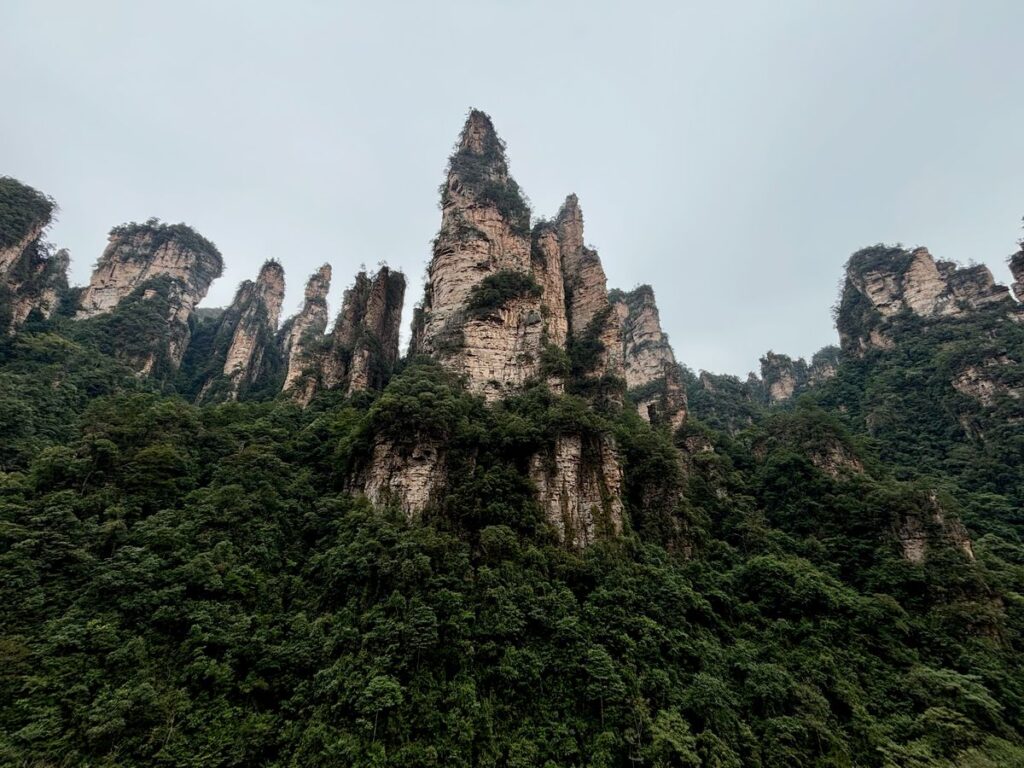
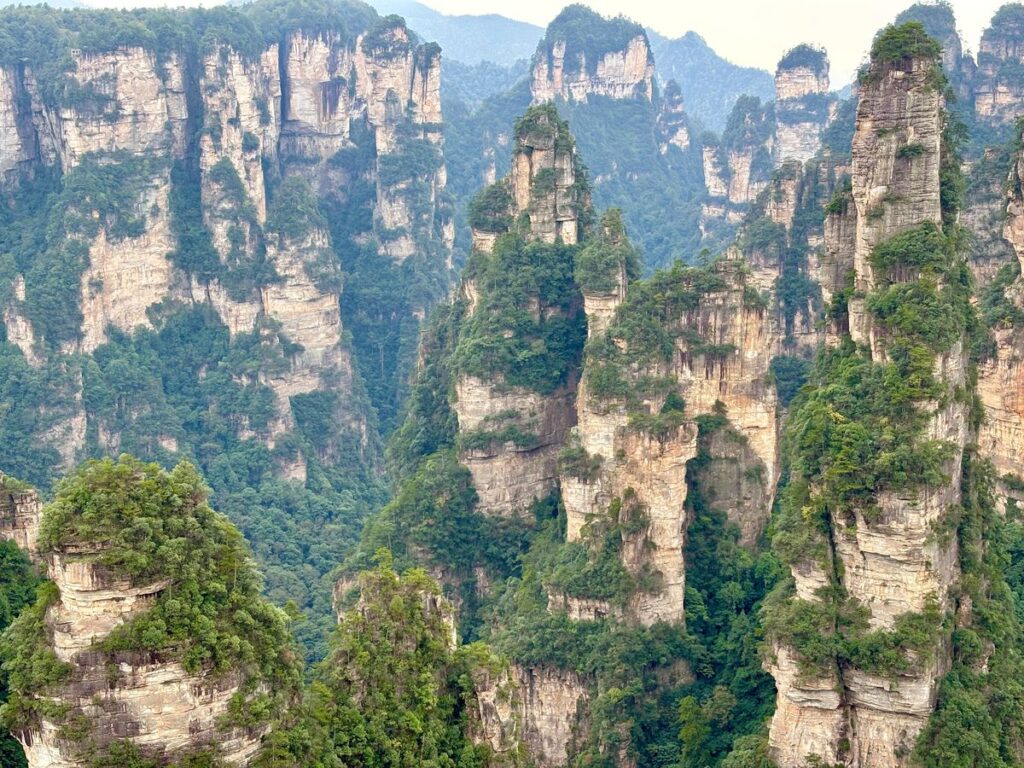
It’s a huge area of forest in Hunan province with more than 3,000 sandstone pillars standing up out of it, many of them over 200 metres tall. It opened in 1982 as China’s first national forest park, and the wider area has been on the UNESCO World Heritage list since 1992.
You ride up to a plateau and walk along the cliff edges, with the pillars in front of you and below. It’s an impressive sight and makes for some excellent photos.

Disclaimer: This article may feature affiliate links. If you click these links, and choose to book with that hotel or company, I will earn a small commission at no extra cost to you. I appreciate the support that allows me to continue providing this information.
Zhangjiajie, Wulingyuan and the park: which is which
You’ll see three names and they get mixed up constantly.
- Zhangjiajie is the city. It has the airport and the railway stations.
- Wulingyuan is the district the park sits in. The name is used for the whole scenic area and for the small town beside the park’s East Gate.
- Zhangjiajie National Forest Park is the ticketed park itself.
The park’s own signs call it ‘Wulingyuan Scenic Area (Zhangjiajie National Forest Park)’, so if a booking page says Wulingyuan, it’s the same place.
Tianmen Mountain and the glass bridge are not part of it. They’re separate sights with separate tickets.
Where are the Zhangjiajie Avatar mountains?
They’re in Yuanjiajie, one of the areas on top of the plateau. They got the nickname because they look like the floating mountains in the Avatar films, and one pillar has been renamed Avatar Hallelujah Mountain. Nothing was filmed here, I can definitely see the comparison though.
How to get to Zhangjiajie National Forest Park
The park is about 40 minutes by road from Zhangjiajie city, and there are three ways to cover it.
- By bus. Buses leave from the bus station beside Zhangjiajie railway station about every 15 minutes and go to both the East Gate and the South Gate. The fare is ¥13 (£1.50) and the ride takes 40 to 50 minutes. For the East Gate, you want a bus to Wulingyuan (武陵源).
- By taxi or DiDi. DiDi is the ride-hailing app that does Uber’s job in China. Expect to pay about ¥80 (£9) from the city centre to Wulingyuan.
- With a driver. This is what we did. A driver came with our guide, so we didn’t have to think about buses at all.
Make sure you check which gate a bus is going to before you get on.

How the park is laid out
Three areas sit on top of a plateau and are joined by road, and the rest is down on the valley floor. Once you know that, the map is much easier to read.
The top and the valley floor
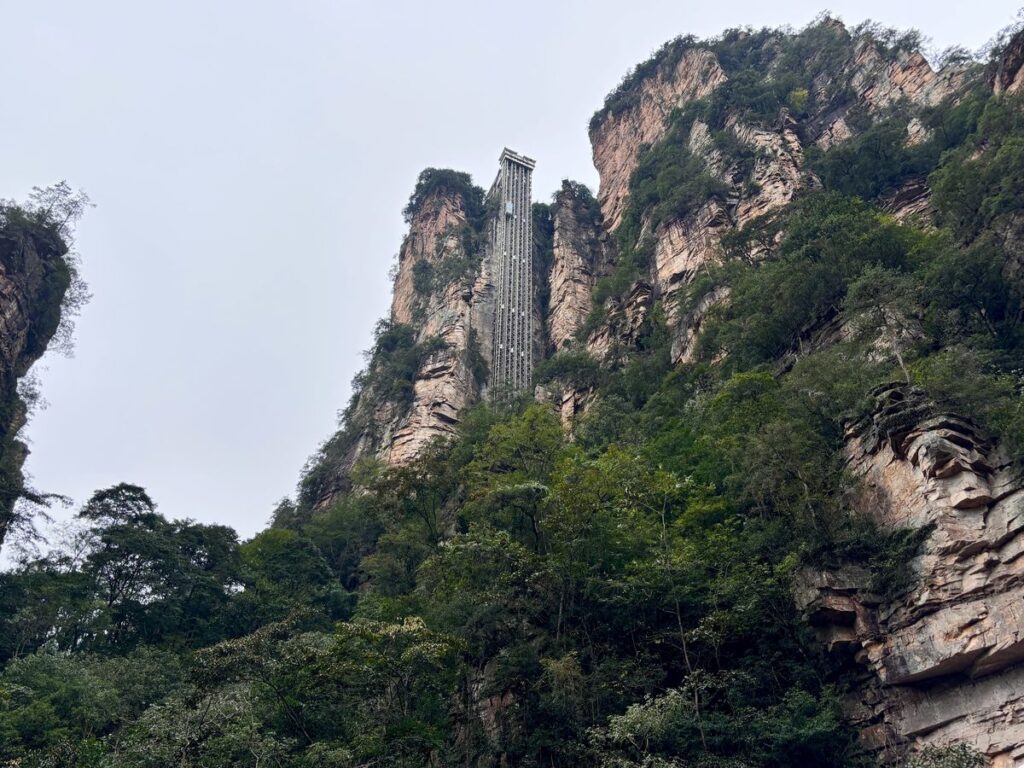
Yuanjiajie, Tianzi Mountain and Yangjiajie are the three areas on top. Each has its own way up: the Bailong Elevator (a lift built onto a cliff face that climbs 326 metres in under two minutes) for Yuanjiajie, and a cableway each for Tianzi Mountain and Yangjiajie. Once you’re up, park buses take you between all three, so you only need to ride up once and down once.
Golden Whip Stream and Ten Mile Gallery are on the valley floor. Huangshi Village is a separate plateau on the south side with its own cableway.
We went up on the Tianzi Mountain cableway and came down in the Bailong Elevator, and it worked well. My advice is to pick a direction, have a plan and stick to it.

East Gate or South Gate?
The park has five gates, but you only need to think about two.
The East Gate is the main one. It’s beside Wulingyuan town, the ticket station there is called Wujiayu, and it’s where the buses for Tianzi Mountain and the Bailong Elevator start. The South Gate is the one for Huangshi Village and Golden Whip Stream. The two are 30 to 40 minutes apart by road.
Use the East Gate for your first day, or your only day. Use the South Gate if you have a second.
How the park buses work
The buses inside the park are included in your entrance ticket and you can use them as often as you like. Two lines leave the East Gate. Line A goes to the bottom of the Tianzi Mountain cableway, and Line B goes to the foot of the Bailong Elevator, which is the longer ride at 25 to 30 minutes.
Our first bus from the gate was a comfortable coach and took about 10 minutes, on a winding road that’s worth knowing about if you get travel sick. After that we never waited more than 15 minutes for a bus all day. Allow 25 to 40 minutes for the one across the top between Tianzi Mountain and Yuanjiajie.
The areas of the park and which to prioritise
There are six areas worth knowing about. The Chinese names are in the table because they’re what you’ll see on bus signs, so are useful to check against or show someone for help.
| Area | What you see | How you get there | Time to allow | Nearest gate |
|---|---|---|---|---|
| Yuanjiajie (袁家界) | The Avatar pillar and a natural rock bridge | Bailong Elevator, or bus across the top | 1 to 2 hours | East |
| Tianzi Mountain (天子山) | Wide views over the pillars | Tianzi Mountain cableway | 1 to 3 hours | East |
| Yangjiajie (杨家界) | A quieter area with a ladder climb | Yangjiajie cableway, or bus across the top | Up to 3 hours | West |
| Huangshi Village (黄石寨) | A loop of lookouts on its own plateau | Huangshi Village cableway | About 2 hours | South |
| Golden Whip Stream (金鞭溪) | A flat walk along the valley floor | On foot | About 2 hours | South |
| Ten Mile Gallery (十里画廊) | A short valley walk past clusters of pillars | On foot or small train | About 1 hour | East |
Yuanjiajie (袁家界)
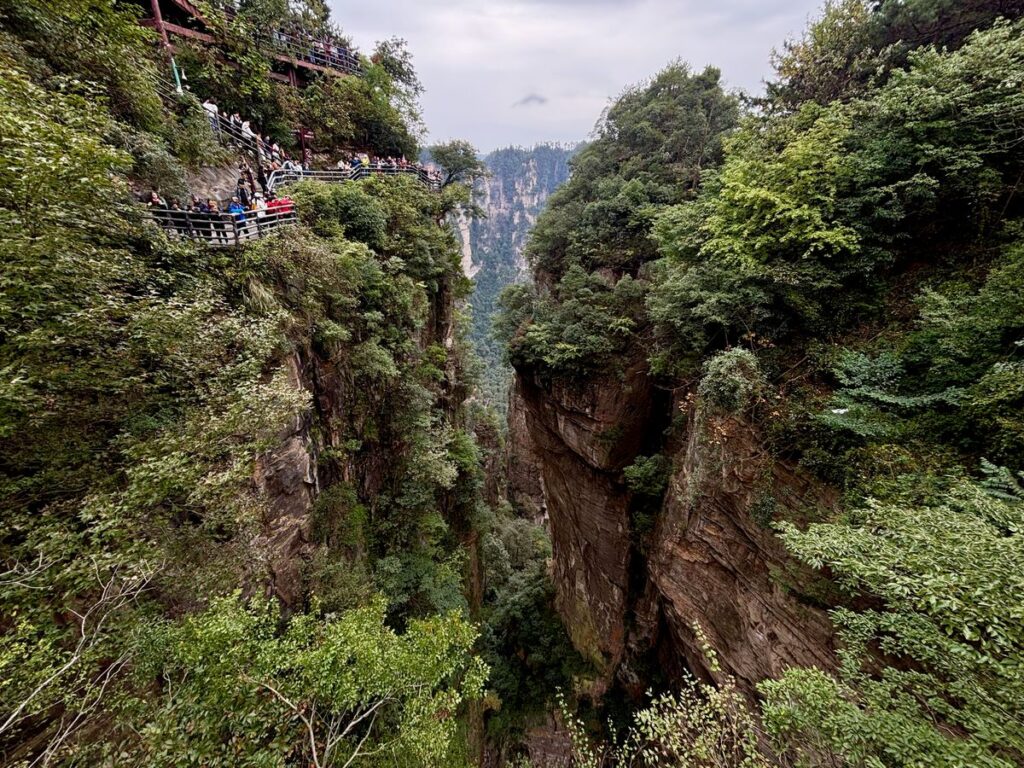
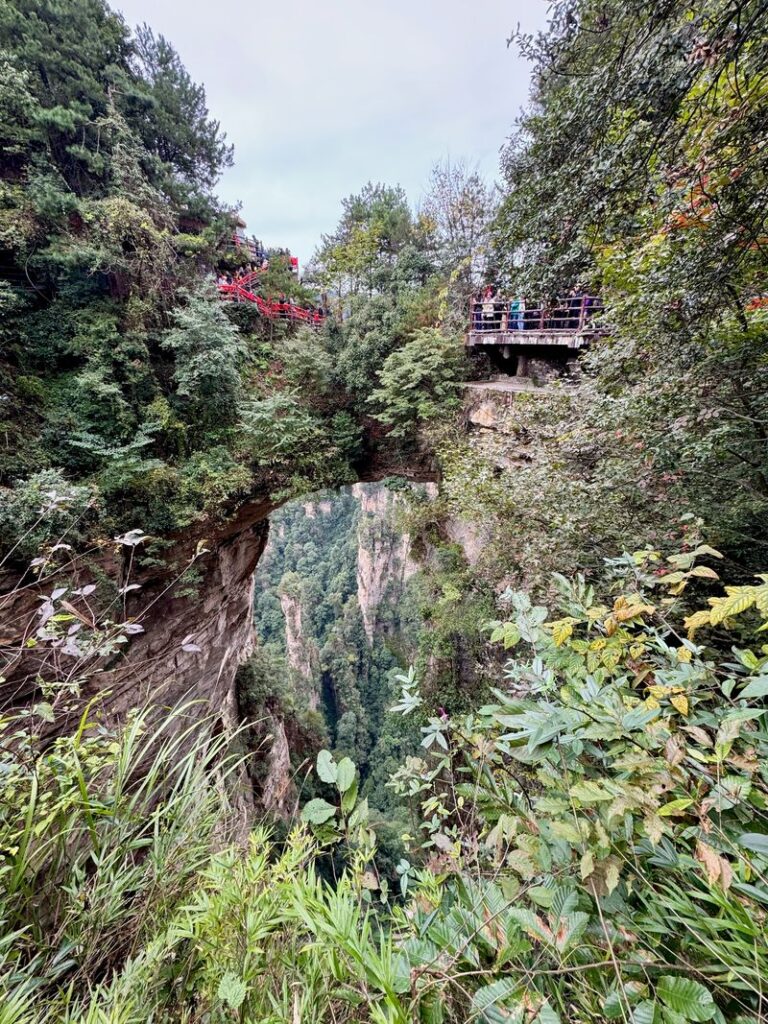
This is the area most people come for. A paved path follows the cliff edge past the Avatar pillar and on to the First Bridge Under Heaven, a natural rock arch that joins two pillars high above the valley.
We saw both and both were impressive. It was quite busy, busier than Tianmen Mountain had been the day before, but never busy enough to make it less enjoyable.
My Top Tip! Yuanjiajie is the busiest part of the park, and it’s the one thing I’d change with hindsight. I’d see it earlier in the day, so go here first if your plan allows.
Tianzi Mountain (天子山)
Tianzi Mountain was our first stop of the day, and I thought it was stunning. You look out over the pillars from above, and the main viewpoints, including Imperial Brush Peak, are grouped around Helong Park.
The cable car up was beautiful too. You rise between the pillars on the way, which was exciting and made for some good photos.
Yangjiajie (杨家界)
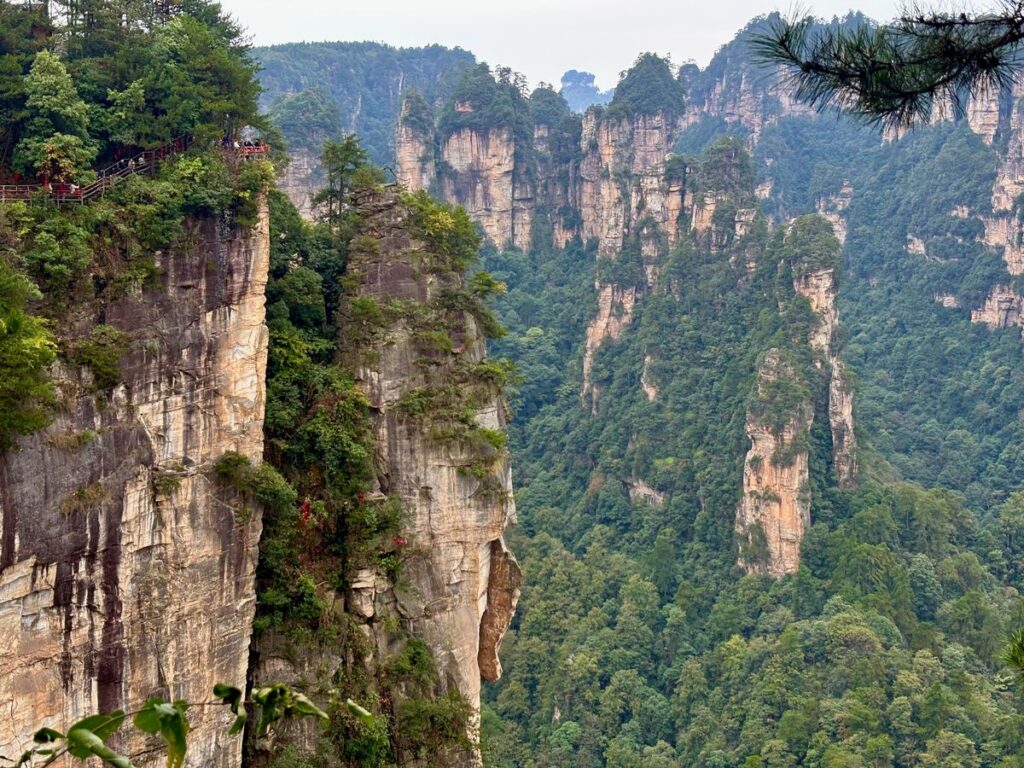
Yangjiajie is quieter than the other two areas on top. The best-known viewpoint is the Natural Great Wall, about 10 minutes’ walk from the cableway station. There’s also a route called One Step to Heaven, a 20 to 30 minute walk that ends in a near-vertical iron ladder of about 30 steps. The ladder is optional, so anyone uneasy with heights can turn back before it.
Huangshi Village (黄石寨)
You’ll also see this written as Huangshizhai. It’s the same place. It’s a plateau on the south side of the park with a loop path between lookouts. A cableway takes you up from near the South Gate. You can walk up, but it’s about an hour of steps.
Golden Whip Stream (金鞭溪)
Golden Whip Stream is a flat 7.5 km path along the valley floor, with the pillars above you. It starts near the South Gate and ends at a bus stop called Water Winding Four Gates (水绕四门). You don’t have to do all of it. Walking the first stretch from the South Gate and turning back gives you the feel of it in about an hour. Carry water and a snack, because there’s very little for sale along the middle of the path.
Ten Mile Gallery (十里画廊)
Ten Mile Gallery is a short valley walkway past clusters of pillars. You can walk it in 20 to 30 minutes each way or take a small sightseeing train. If you’re short of time, this is the easiest area to leave out.
If you only have one day
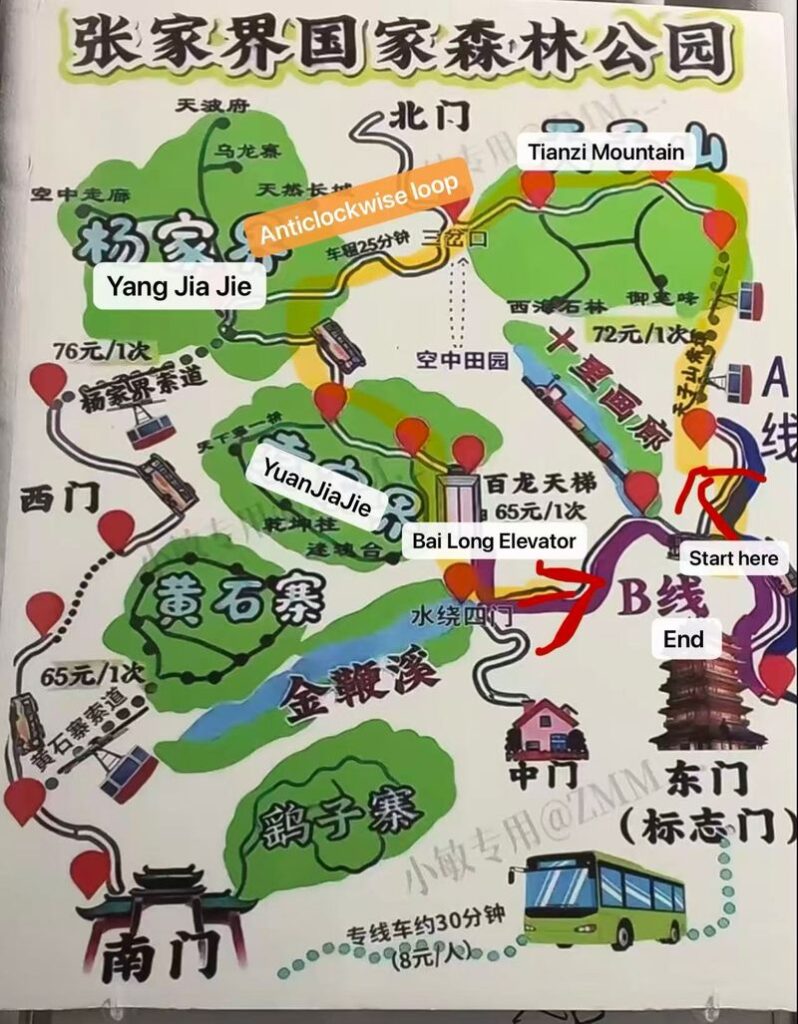
This is the route we did in one day:
- Enter at the East Gate and take bus Line A to the Tianzi Mountain cableway.
- Ride the cable car up and see Tianzi Mountain.
- Take the park bus across the top to Yuanjiajie.
- Walk the cliff path to the Avatar pillar and the natural bridge.
- Ride the Bailong Elevator down.
- Take bus Line B back to the East Gate.
It worked well for us. Our whole China trip was tight for time, so we wanted the park and the glass bridge at Zhangjiajie Grand Canyon in the same day. We did the park first and the bridge in the afternoon, and I’m glad we squeezed it all in.
Zhangjiajie National Forest Park tickets: what to buy and how to book
There’s one entrance ticket, and then a choice about how you pay for the lift and cable cars.
Which ticket should you buy?
The entrance ticket costs ¥236 (£27). It’s valid for four days in a row and covers the park buses, but not the lift or the cableways. Those are paid per ride, one way:
- Bailong Elevator: ¥65 (£7)
- Tianzi Mountain cableway: ¥72 (£8)
- Yangjiajie cableway: ¥76 (£9)
- Huangshi Village cableway: ¥65 (£7)
The easiest way to choose your ticket is to count your rides. For the top of the park you need a minimum of two, one up and one down, because the buses link everything once you’re up there. Trip sell bundles that cover all options, sometimes with special discounted rates too.
| Rides you’ll take | Best ticket | Total cost |
|---|---|---|
| Two or three | Entrance ticket, then pay per ride | ¥373 (£42) for my two |
| One on each of the four | Entrance plus one ride on each | About ¥480 (£54) |
| Five or more | Entrance plus unlimited rides | About ¥530 (£60) |
Our guide had bought tickets with the rides included, so we walked straight past the cable car ticket booth. The small train at Ten Mile Gallery isn’t covered by any ticket, so you pay for that on the day.
How to book
Book ahead. Tickets are in your own name for a set date, gate and entry slot.
- Choose where to book. The official channel is a WeChat mini program called Zhangjiajie Yijiyou (张家界一机游), which is in Chinese and takes WeChat Pay. Trip.com sells the same tickets in English.
- Pick your date, your gate and your entry slot.
- Enter each person’s name exactly as it appears on their passport.
- Book a week or two ahead for a morning slot. On Trip.com, dates go on sale about a month in advance.
Make sure you bring the passport you booked with for each person.
If you’re going back in on a later day, you need to book an entry slot for that day as well. It’s free, and you do it in a second WeChat mini program, Zhangjiajie Tourism Assistant (张家界旅游小助手), under ‘book re-entry’ (再次入园预约). You can book it as soon as you’ve bought your ticket. If you don’t use WeChat, staff at the gate ticket windows can book it for you.
Guide or do it yourself?
We had a guide and a driver for the day. We booked them because we had a lot to fit into one day. He helped us with every change of bus and cable car, talked us through bits of the history we wouldn’t have known, and knew the best spots to go to in the best order. Making the logistics easier was the best part of it for me.
You can 100% do the park yourself, especially if you have a bit more time. A guide takes the admin away: the tickets, the transport and the route. You can easily find an English speaker under VIP tours, and guided day tours of the park were £53 to £63 a person depending on dates.
My advice is to pick a guide if you have one day and want to fit a lot in. Do it yourself if you have two days and don’t mind working out the buses as you go.
Arriving at the East Gate: what happens
This is how the first half hour went for us.
- The ticket windows are on the left as you approach. If you’ve booked online or have a guide, you can skip them.
- You go in during your booked slot, which was one hour long for us.
- Your passport is scanned at the first gate.
- After that, face recognition gets you through most of the later checkpoints. If it doesn’t recognise you, staff can let you through with your passport.
- A park bus takes you on from there.
Arrive inside your slot. The park expects you at the gate and time you booked, and being late can mean waiting for a later one or missing out entirely.
How many days you need and when to go
Is one day enough?
One full day covers the top of the park, and it’s what we did. It was busy, but we’re happy to cram a lot in. If you have more time, two days would be ideal and a more relaxed pace, and it lets you see the south side as well. The ticket lasts four days so that you can come back, not because you need all four.

Best time to visit
April, May, September and October are the months to aim for. Avoid China’s main holiday weeks if you can, because that’s when the park is at its busiest. They’re the May Day holiday (1 to 5 May), National Day week (1 to 7 October) and the school summer holidays from mid-July to late August. Queues for the lift and cable cars can be over three hours then.
What if it’s misty or raining?
Cloud isn’t a reason to cancel. Our day in the park was cloudy and we could still see plenty, though bright blue skies would have made it even better. Our day at Tianmen Mountain was thick fog, and even there the mist made for good photos.
Unfortunately we fixed our trip length, so we had no spare days to wait for better weather, and I wish we had. If you can leave a day spare in Zhangjiajie, do, and give the clearest one to Tianmen Mountain.
What a day in the park is like
Queues and crowds
The queues moved quickly on our day. We waited about 10 minutes for the Tianzi Mountain cable car and about 15 minutes for the Bailong Elevator.
My Top Tip! At the Bailong Elevator, don’t rush into the first lift that arrives. Let people go ahead so you’re at the front of the queue for the next one. You get right up to the glass with no one in front of you, which means a better view and better photos.
How much walking is there?
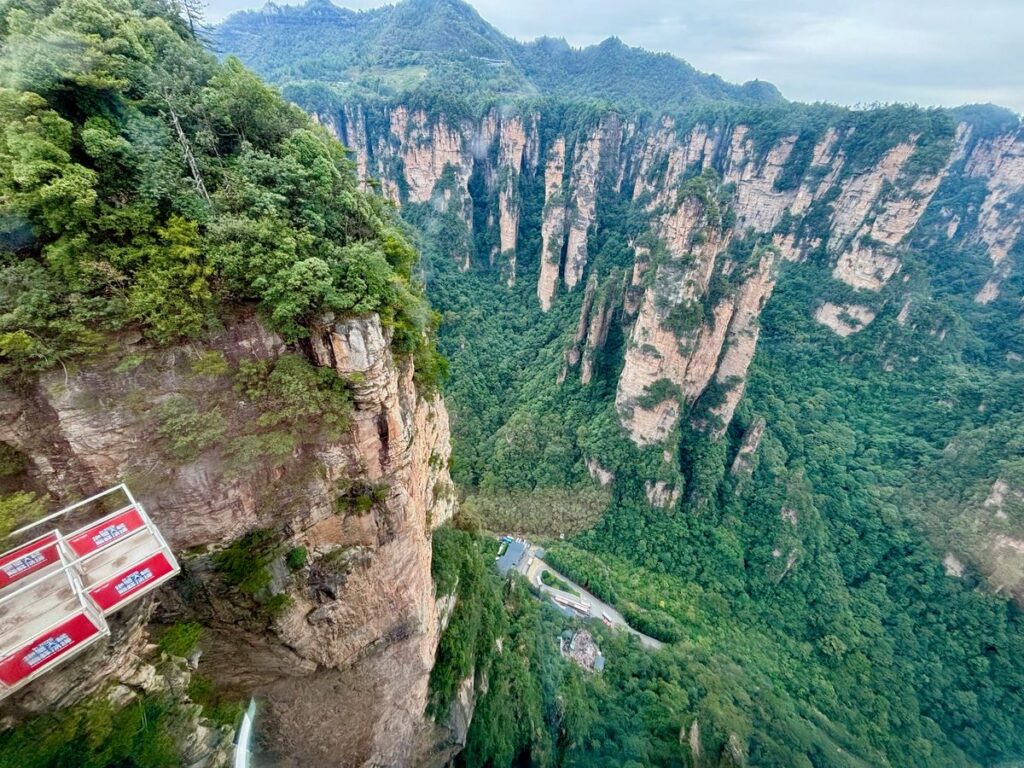
Less than you’d think. I found it easy. There’s a little up and down, but nothing hard, and most areas are very well paved. The lift and cable cars do the climbing for you.
It’s logistically very well organised, almost to the point that it doesn’t feel like exploring. It’s still really interesting to see and do.
I wore comfortable shoes and took a light waterproof jacket just in case, and that worked well. I’d checked the forecast beforehand and planned around it.
Monkeys, food and toilets
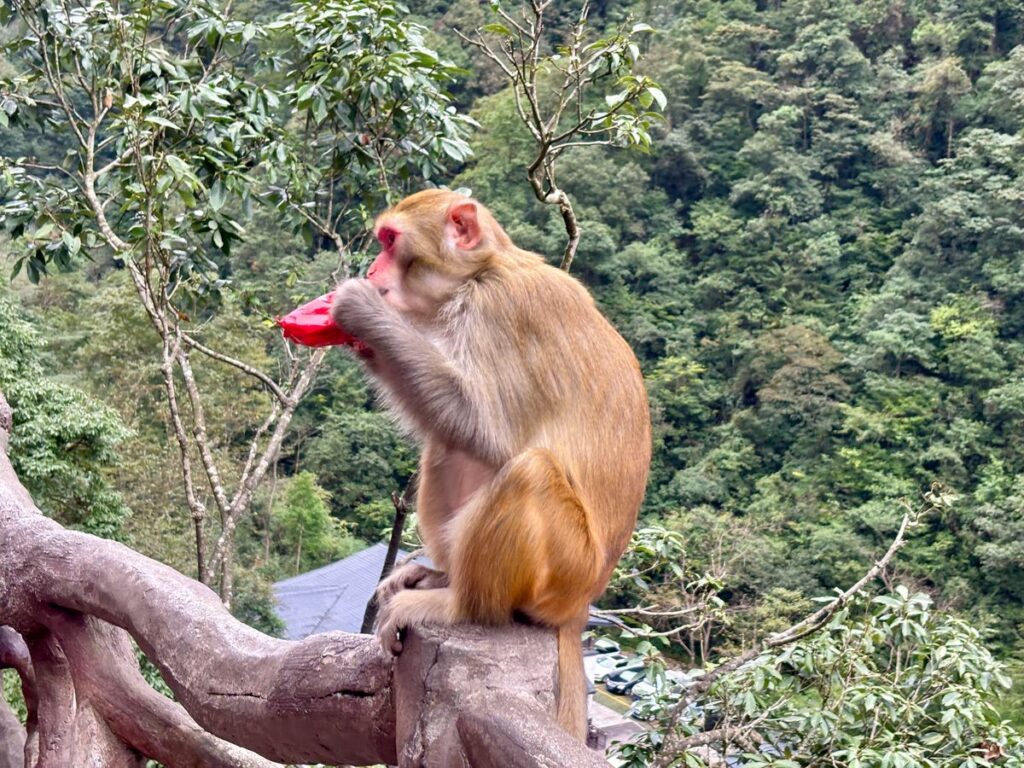
There were lots of monkeys near the Bailong Elevator, and they’re common at Huangshi Village too. They go for food, so keep snacks out of sight in your bag.
The toilets were fine and the food was OK. There were even western options, including a McDonald’s. We only had snacks while we were up there and then a big meal once we’d finished. It’s worth carrying a pack of tissues, as there isn’t always toilet paper.
Finding your way
Announcements on the park buses are in Chinese, so have the name of your next stop saved in Chinese characters to show a driver or attendant. Amap, a Chinese maps app, worked much better for me than Google Maps in China. Stalls inside the park take WeChat Pay or Alipay, so set one of them up before you go.
Where to stay and what else is nearby
Wulingyuan or Zhangjiajie city?
I’d stay in the city, near Tianmen Mountain. It means you don’t need to move hotels, and we found there was more hotel choice.
Pick the city if you’re doing Tianmen Mountain as well and have one day for the park. Pick Wulingyuan town, beside the East Gate, if you’re spending two or more days in the park and you’re getting around on your own.
Tianmen Mountain
Tianmen Mountain is a separate mountain on the edge of Zhangjiajie city, known for a huge natural arch in the rock and glass walkways along its cliffs. It has its own ticket, and we spent most of a day there.
The glass bridge at Zhangjiajie Grand Canyon
The glass bridge is at Zhangjiajie Grand Canyon, a separate attraction about 40 minutes from the East Gate. We arrived 10 minutes before last entry at 16:00, and there was no queue at all. Our guide said most people go in the morning, and he was right. Allow about two hours.
Going on to Chengdu
Zhangjiajie West has direct high-speed trains to Chengdu East, and ours took just under 5 hours. That’s how we got to Chengdu for the pandas, and my guide to things to do in Chengdu covers what we did there.
Zhangjiajie National Forest Park FAQs
What time does Zhangjiajie National Forest Park open and close?
The park is open from 7:00 to 17:00, and the lift and cableways also stop at 17:00, so aim to be on top by early afternoon. The park buses keep going after closing. The last one leaves 1.5 hours later from April to November and 1 hour later from December to March.
Is Zhangjiajie National Forest Park worth visiting in winter?
Yes, if you don’t mind the cold. December to February is the quietest time of year, and the pillars sometimes get snow. The ticket has cost the same all year since January 2025, so there’s no winter discount. Winter is also when the cableways are serviced, so check the one you need is running.
What happens if it rains on the day you’ve booked?
Rain alone doesn’t close the park. It shuts only for severe weather, as it did for three days after heavy rainfall in June 2025. If the forecast looks bad, you can move your booking to another date in the Zhangjiajie Tourism Assistant mini program, or ring the gate you booked for help.
Do children and older visitors need a ticket?
Yes, everyone needs a booking, but not everyone pays. Children under 14 get in free, park buses included, with a free ticket booked in their name. Visitors over 65 don’t pay to get in but pay a small bus fee, £4.38 on Trip.com. Ages 14 to 17 and 60 to 64 get a discount with ID.
Can you walk up instead of paying for the cable cars?
Yes. Stone-step trails lead up to Yuanjiajie from Golden Whip Stream and up to Huangshi Village from near the South Gate, so you can reach the top on the entrance ticket alone. It saves money but costs you time and energy, and you’d still need the park buses to get between the areas on top.
Can you stay overnight inside the park?
Not really. From 2018, almost everyone living on the Tianzi Mountain and Yuanjiajie plateau was moved out to protect the World Heritage site, and the family inns went with them. A few small guesthouses remain, but for most visitors the closest base is Wulingyuan town, beside the East Gate.
Is there anywhere to leave luggage?
Yes. If you’re visiting between train journeys, Wulingyuan bus station has paid luggage storage at about ¥10 (£1) a day for a suitcase, and it’s about 10 minutes by taxi from the East Gate. If you’re staying nearby, most hotels will hold your bags after check-out.


6 Comments
Comments are closed.