
Is Wangxian Valley worth the detour, or does it only look good in photos? I stayed a night inside the valley, and the honest answer is yes, it’s well worth the trip. It’s like nowhere else I’ve been, a cliffside town you can stroll around.
I’ve written my guide to help you pick your arrival time, sort your ticket and decide whether to stay the night.
More of my China guides to help plan your trip
- Tianmen Mountain: How to plan your visit now the big cableway’s closed.
- Zhangjiajie National Forest Park: Our one-day route to the Avatar mountains.
- Things to do in Chengdu: The pandas, the best hotpot and a 24 hour spa.
- Chengdu Panda Base: How to see the pandas at their liveliest and skip the queue.
- Shanghai to Wangxian Valley: The easiest route there, and the last train back.
- Wangxian Valley hotels: Which hotel to book inside the valley, and cheaper options outside.
Is Wangxian Valley worth visiting?
For me, yes, it’s very photogenic. Every so often you have a moment of realising it was all built recently, which has a light Disney style feel to it, but it didn’t bother me or my friends. If that would spoil it for you, it’s better to know before you book the train.
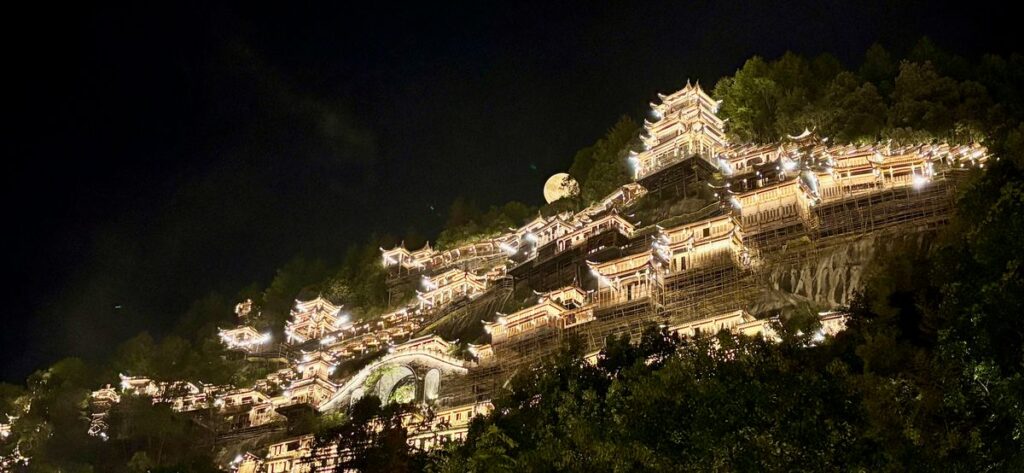
Is Wangxian Valley real or fake?
It’s a real place you can walk around, but it isn’t an ancient village. Wangxian Valley is a scenic area, which in China means a ticketed tourist site, and it opened on 21 October 2020. You’ll see it branded Vagoo on the signs.
The valley used to be a granite quarrying area. The local government shut the stone industry down in 2007, and the company behind it says restoration work began in 2012. The buildings are in the traditional style of this part of Jiangxi.
Who it suits
Go to Wangxian Valley if you want somewhere that looks different from everything else on your trip and you’re happy just wandering with a camera. Skip it if you’re after history or everyday authentic village life.
Disclaimer: This article may feature affiliate links. If you click these links, and choose to book with that hotel or company, I will earn a small commission at no extra cost to you. I appreciate the support that allows me to continue providing this information.
Where is Wangxian Valley in Jiangxi?

Wangxian Valley is in Wangxian Township, in the Guangxin District of Shangrao, a city in Jiangxi province in south-east China. Shangrao is the place to aim for because it has the nearest high-speed rail station, just under 3 hours from Shanghai by train. This is exactly what I did, and my Shanghai to Wangxian Valley guide covers the train, the bus and the driver step by step.
There’s no station at the valley, so the last stretch is by road. A pre-booked driver from Shangrao station takes about 45 minutes, and the scenic area has its own bus to and from the station. Have the name in Chinese (望仙谷) ready on your phone to show a driver.
Wangxian Valley tickets: price, where to buy and what’s included
An adult ticket is ¥140 (about £15.50). Ages 6 to 18 and full-time students pay ¥70 (about £7.75) with ID, and visitors aged 65 to 69 pay ¥110 (about £12.20). Children under 6 or under 1.2 m tall go free, and so does anyone aged 70 or over.
You can buy at the ticket window, which sells from 09:30 to 20:30, or book ahead on Trip.com, the booking app I used for almost everything in China. Trip.com also sells bundles that include transport from Shangrao or Shanghai, or activities inside the valley. In my opinion it’s the easiest way to do it.
I didn’t buy tickets myself, because we decided to stay in the scenic area overnight and they came with our room. We stayed at Xiansu, one of three hotels inside the scenic area. Given the journey, staying one night is my top recommendation if you have the time.
Do you need your passport?
Yes, make sure you take it. Ours were checked at hotel check-in, and after that we were free to roam with nothing checked again. You need your passport for train tickets in China and it works as your ticket at most attractions.
Can you leave and come back in?
Each day ticket lets you in once, unless you’re staying at a hotel inside, where you can come and go as you like. If you want to see the valley in daylight and with the lights on, you walk in once and stay, so don’t plan on popping out for dinner and coming back. There are plenty of places to eat on site, so it’s well set up for you to spend a good chunk of time there.
What’s included and what costs extra
There’s no separate night ticket. One ticket covers you from opening to closing. Craft workshops such as lantern making and tie-dye cost extra, as do Hanfu (traditional costume and makeup) experiences and rafting through the canyon, which is summer only.
Opening hours and the best time to arrive

Wangxian Valley is open all year, from 09:30 to 23:00, and last entry is at 21:00. Hours can change on the day, so check the official site before you travel.
Everything was open during the day and we sat down for lunch, but there weren’t many people around. That wasn’t a bad thing, it was nice to stroll around without the crowds. It got far busier after sunset, because most day trippers come for the lights.
My Top Tip! If you’re not staying over, walk in around 14:00 to 15:00. You get a few quiet hours in daylight, then you’re there for dusk and the lights. Dusk is earlier in winter and later in summer, so shift your arrival to suit.
Wangxian Valley at night

What time do the lights come on?
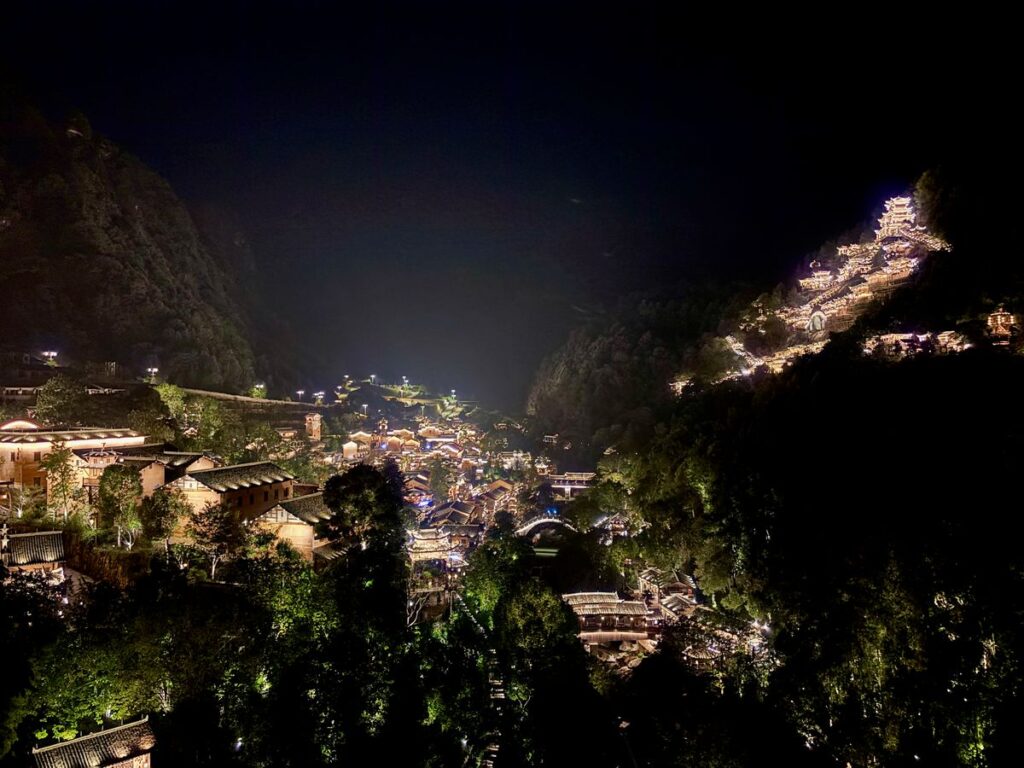
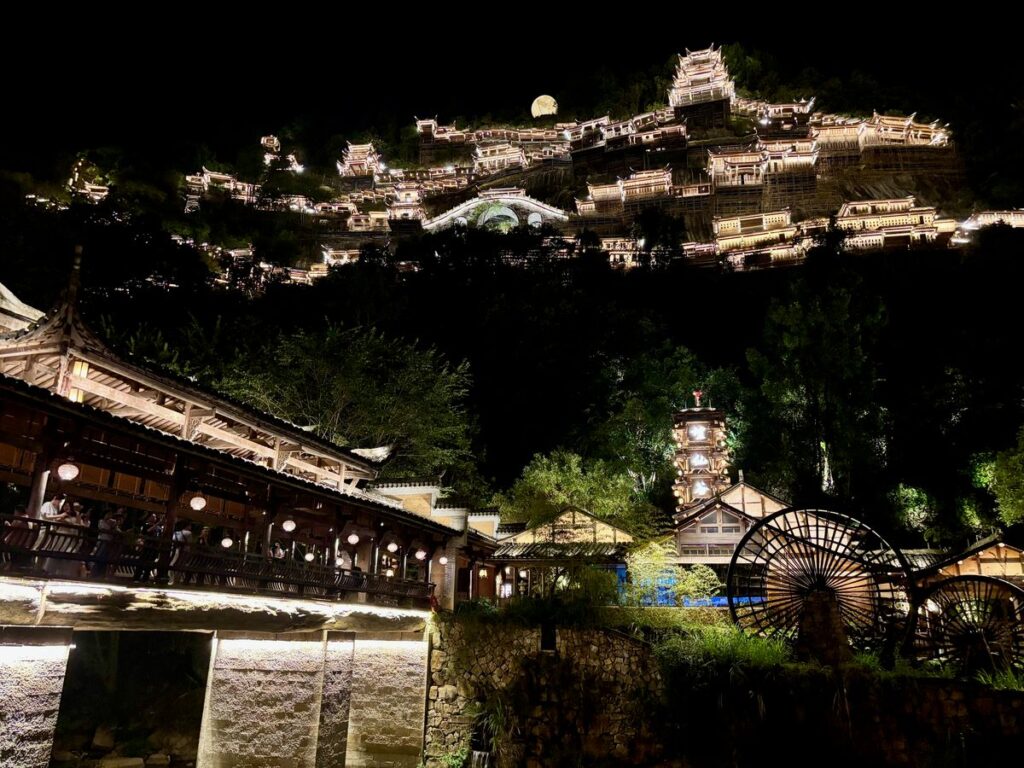
The lamps in the streets you walk around came on as it got dark. The big moment is the cliffside town across the valley, which lit up just after 6pm on my October visit.
It’s done as a ceremony. We were in the square with the stage (Yangfu Plaza on the site map), watching a show with dancing. Then, with what felt like a dramatic flick of a switch, the whole hillside opposite lit up.
My Top Tip! Get to the stage square before it gets dark, so you’re already in place for the switch-on.
The evening shows
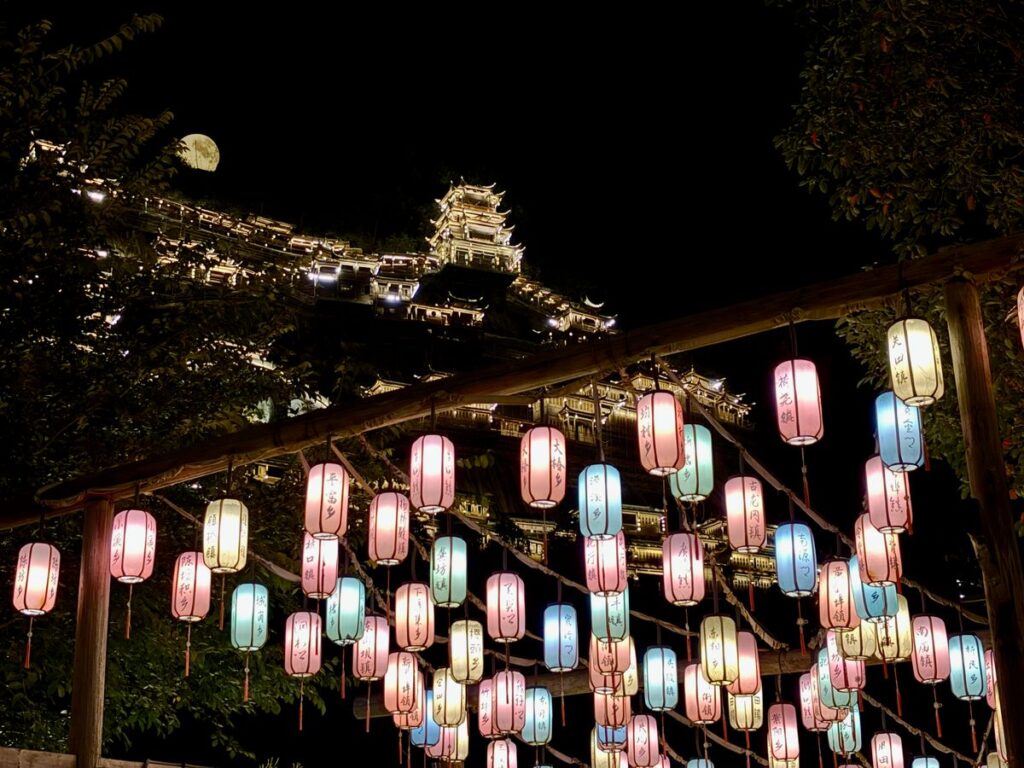
There are a lot of them and they go on for a while. Traditional dance, some martial arts displays and some singing as well. We dipped in and out, grabbing snacks and walking around the other parts between acts, and that was nice. Lots of people stayed watching the whole thing, but dipping in was enough for me.
Show times change from day to day. The maps around the valley have a QR code for that day’s programme, so scan one when you arrive.
How to check how busy it is
The official site has a live visitor count. It shows how many people are in the valley against its capacity of 25,074, with a one-word rating. The page is in Chinese, so use your browser’s translate option. At 18:00 on a Wednesday in November it showed 9,909 visitors, so the valley was about 40% full and rated 舒适 (comfortable). The same page also shows how many parking spaces are free.
Check it on the day, before you set off.
Getting back to Shangrao after dark
The scenic area runs its own bus between the valley and Shangrao high-speed rail station, and it’s the cheapest way back at about ¥30 (£3.30) per person. You book it in DiDi, China’s ride-hailing app. Go to the Station Bus section (站点巴士) and pick Wangxian Valley Visitor Centre and Shangrao High-Speed Rail Station as your stops. Return buses leave from the Visitor Service Centre, and the last one is at 21:00. Around Chinese public holidays the timetable can change, so book a day ahead.
The trade-off is time. The bus takes 1 to 1.5 hours, against about 45 minutes for the driver we pre-booked on Trip.com. If you’ve got a train to catch, or you want to stay past 21:00, book a return trip with a driver.
What to see in Wangxian Valley
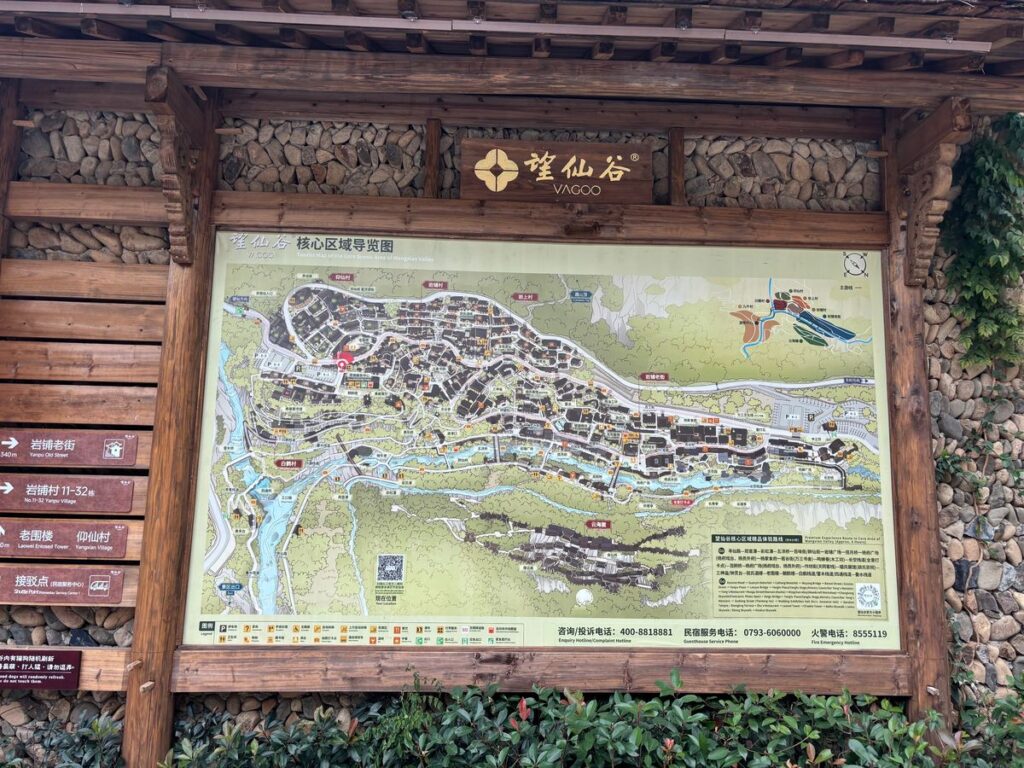
I walked all of it, both sides of the river and right to the far end of the map, without having a specific plan. The names I’m sharing are the ones on the site map, so you can match them up when you’re there.
The area’s suggested route starts along the river, past Guanyin Waterfall and Caihong (Rainbow) Waterfall, before it reaches the main street. The falls were pretty, I actually preferred them in the daylight though.
The main street and stage square (Yanpu Old Street)
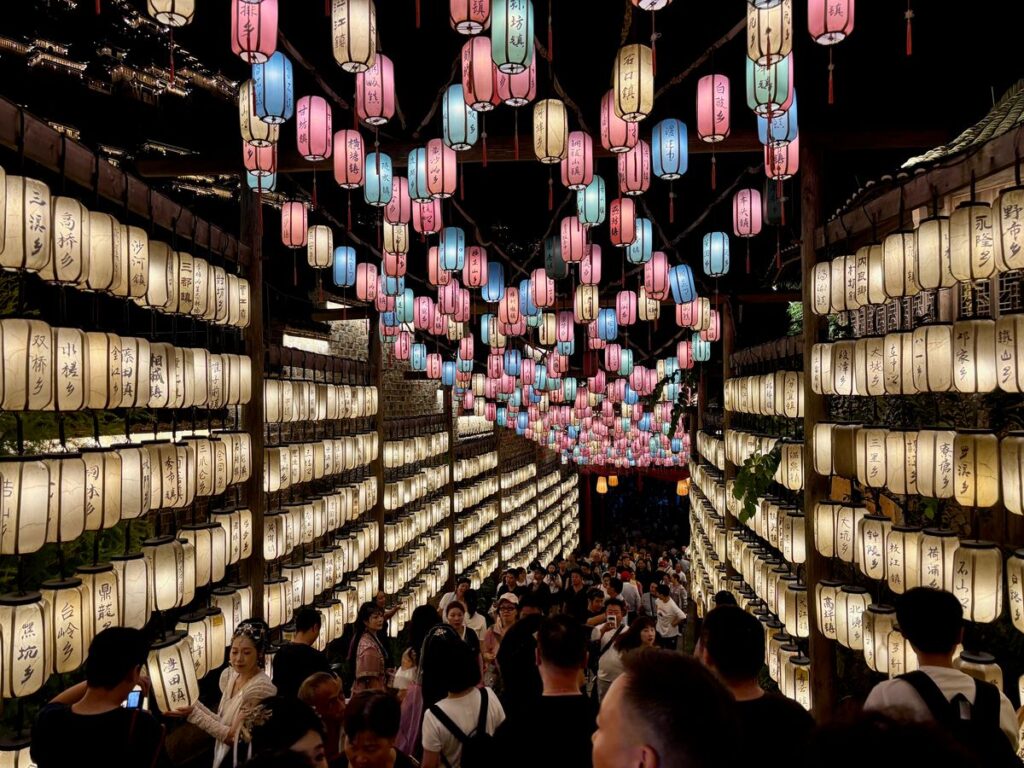
Yanpu Old Street is the long street of shops and stalls, and Baiwei Street is the snack street. We got snacks, browsed the shops and went into lots of the buildings. The whole point of being here is to stroll around, explore, take photos and enjoy the scenery and how lively it all is.
The stage square is Yangfu Plaza, where the stage and Yang’s Mansion are. Just off it is the Lantern Corridor, a covered walkway hung with hundreds of paper lanterns, and it’s busy after dark. The wedding hall is close by, inside the Hu family’s ancestral hall. It was the first thing we saw lit up in the village, and a traditional Han wedding is one of the shows put on here.

Zuofang Street is the craft workshop street, and the woodcraft workshop is in Mingchan Alley. We went into several of the workshops as we passed. You’ll also find a bookhouse on Ruogu Street and a temple, Sanshen Temple, in this part.
At the far end of the street the Changkong Skywalk is a good spot for a photo of the whole valley.
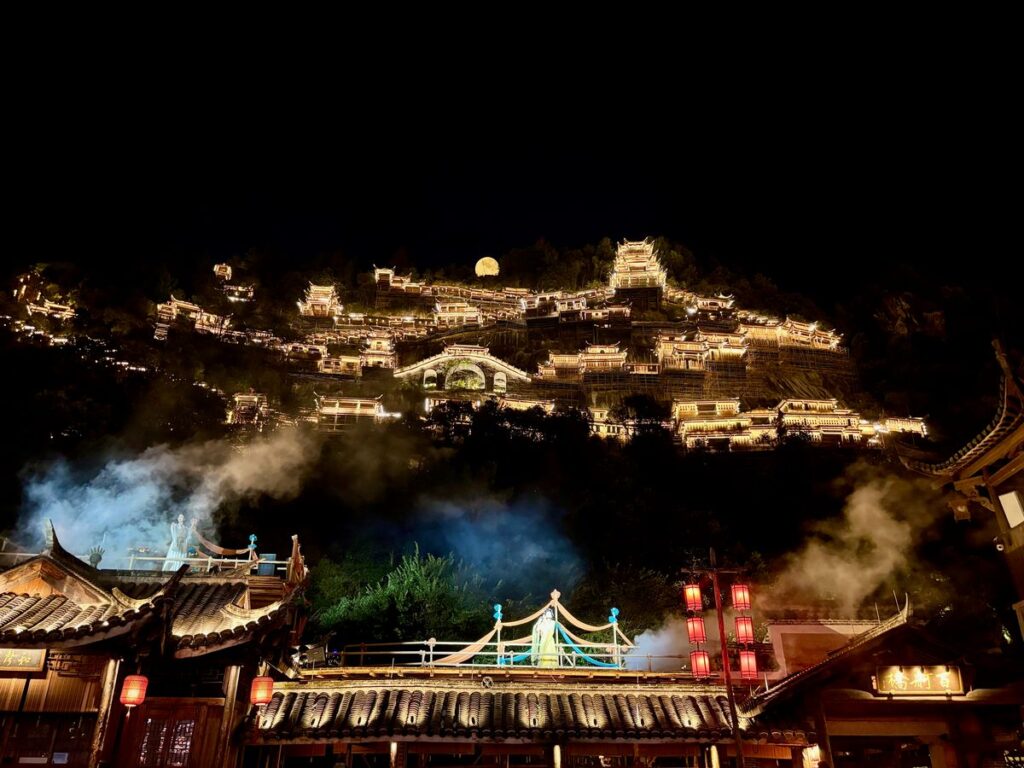
Across the river: Lanyue Bridge and bar street
Lanyue Bridge is the arched bridge over the river. It was lit up when we crossed and we walked it both ways. It’s very steep for a bridge and was clearly a very popular spot for photos as some people had some elaborate tripods they were setting up!
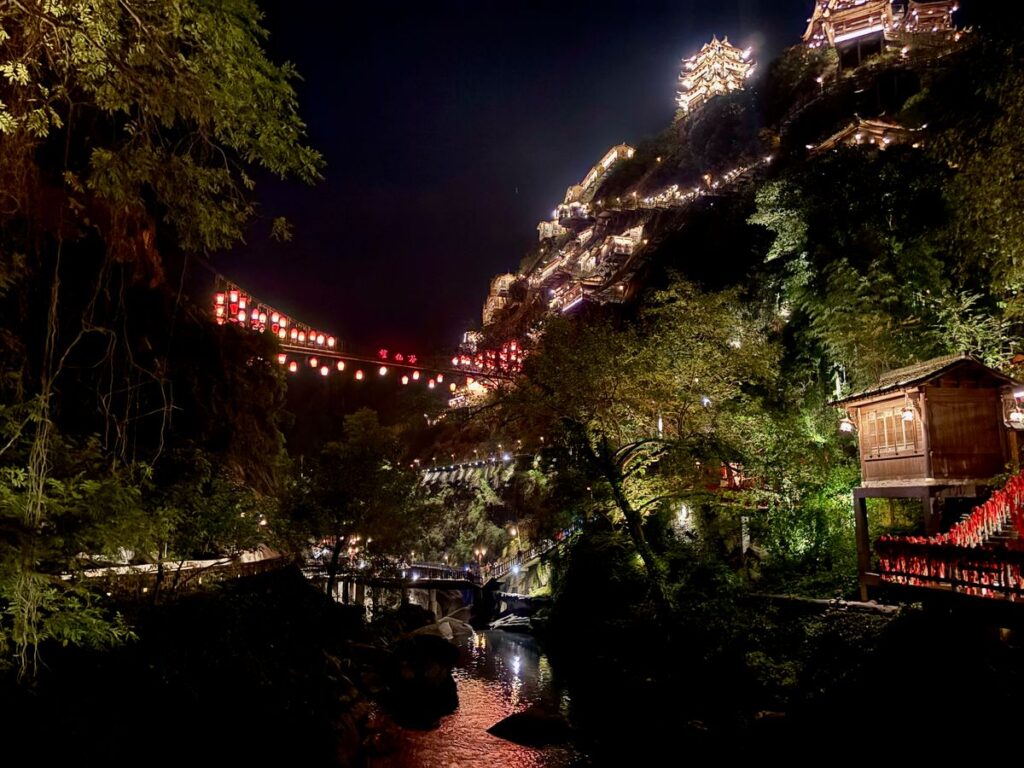
Do cross over. We walked along the river on the other side, and it was well worth it to see the side we’d just walked, and the lights, from a different angle. We didn’t go up to the cliff buildings above (Yunhai Cliff on the map) as they weren’t open to the public.
Bar street (Zuixian Street) is down by the river as well. We had some drinks and even did karaoke for a while, on a big screen in a bar, which was free as long as you were drinking. It was only us and three Chinese guys in there which was very funny.
The cliff top: skywalks, viewing tower and cliff restaurant (Baihe Village)

This is the high part, up on the cliff, and there are four skywalks here: Baihe, Leimu, Sitong and Dieshui. We did the skywalks and the viewing tower, and our hotel breakfast was in the cliff restaurant, which we really enjoyed.
The hotel area and the round houses (Yangxian Village)
This is the guest house area at the top of the valley, with a coffee house and the homestay service centre. It’s built around large round buildings, in the style of traditional Hakka round houses, and the map labels the old one Laowei Tower. Go inside. We did and got photos, and it’s a food stop as well, with vendors all around the edge.

How long do you need?
The suggested route on the site map takes about 4 hours, so a mid-afternoon arrival gives you time for all of it before you leave. We walked around the best part of a day, with food and drink stops and some downtime planned in too. A day and a night are the most you would need in my opinion.
Food and paying inside the valley
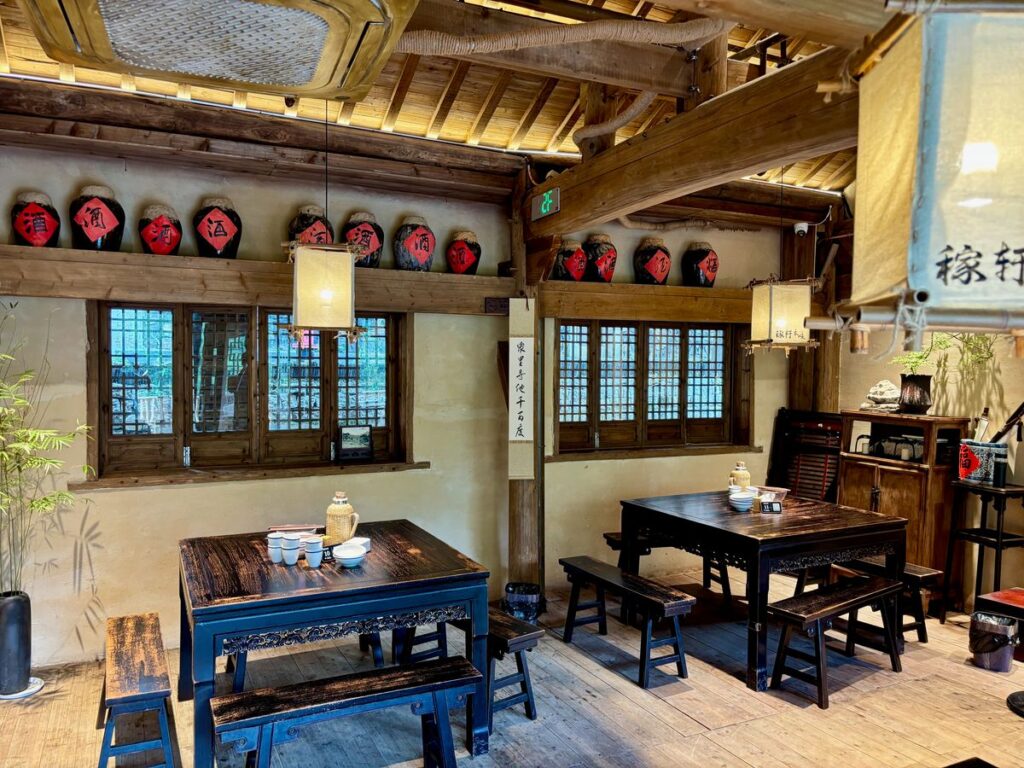
You don’t need to bring food. We ate from the stalls through the evening: a Chinese burger (meat in a flatbread), ribs, corn on the cob and a baked sweet potato. Six ribs were about ¥50 (£5.65) and the sweet potato about ¥15 (£1.69). Most snacks are about ¥5 to ¥20 (55p to £2.20) each with more substantial dishes available if you don’t like to graze.
Payment is by phone. I set up WeChat Pay and Alipay, the two Chinese payment apps, with my UK card before flying, and they worked everywhere. Do it at home, before you fly.
What to know before you go
Best time of year to visit Wangxian Valley
September and October are the best months to go. They’re the driest of the year, with rain on 8 or 9 days a month. September is still hot, with average highs of 31°C, and October cools to 26°C, which is easier for a day of walking and stairs. We went in October and had low 20s and sunshine the whole time, comfortable in shorts and a T-shirt day and night.
| When | Average high | Rain | What to expect |
|---|---|---|---|
| March to May | 18°C rising to 28°C | Rain on 16 to 18 days a month | Warm but wet, so pack a waterproof |
| June | 31°C | The wettest month, with 377 mm | The heaviest rain of the year |
| July and August | 35°C | Rain on about 11 days a month | Hot and the sunniest months, and rafting is on |
| September and October | 31°C falling to 26°C | The driest stretch, with rain on 8 or 9 days a month | Warm days and the best odds of a dry evening |
| November | 19°C | Rain on about 11 days | Cooler, so bring a layer for the evening |
| December to February | 11°C to 14°C, with nights at 4°C to 6°C | Rain on 11 to 15 days a month, and a day or two of snow in January and February | Cold after dark |
These are long-term averages for Guangxin District, where the valley is.
Whatever the month, avoid China’s public holidays if you can: Spring Festival in late January or February, the Labour Day break at the start of May and National Day week from 1 October. The official site advises booking early and visiting at off-peak times around them.
How much walking is there?
There are a lot of steps, but at a relaxed pace it’s easy going. The paths are all properly paved, and we mixed the walking with snacks, drinks and the shows, so it never felt like a day of stairs.
The steepest part is the cliff top in Baihe Village, which sits on a 110 m cliff, and the hillside hotels are reached by steps too. That makes it harder going for older visitors and anyone with mobility problems. Wear shoes with some grip, because the stone gets slippery in the rain. If you’re bringing a pushchair, be ready to carry it, as there are steps throughout.
Do you need to speak Chinese?
No. The site maps and direction signs are in English as well as Chinese, and translation apps covered everything else. WeChat’s translate worked well and so did Google Translate. We had two Chinese friends with us, but we split up a few times and I got by fine on my own.
Do you need to stay overnight?
You don’t need to, but I’d recommend it. You get longer in the valley and you have it after the crowds leave. My guide to Wangxian Valley hotels covers the three hotels inside the gates and the cheaper ones outside the scenic area.
If you do stay, ask your hotel to arrange for your car to drive up to reception. Our taxi dropped us right at the door because we’d asked. Otherwise you’re dropped at the gate and shuttled up.
Wangxian Valley FAQs
Can you visit Wangxian Valley as a day trip from Shanghai?
Yes, but you’ll spend about 8 hours travelling. The high-speed train from Shanghai to Shangrao takes about 3 hours, then it’s 45 minutes to 1.5 hours by road to the valley, each way. If you do it in a day, check the last train from Shangrao before you book. Staying a night is far more relaxed. If you’re set on a day trip it’s worth considering an organised one so you’re as efficient as possible.
What does Wangxian mean?
Wangxian means ‘gazing at immortals’. The name comes from a legend about Hu Zhao, a scholar from the Eastern Han dynasty (25 to 220 AD) who retreated to the mountains here to live as a hermit. His son built a platform in the valley so he could gaze up towards him.
Can you fly a drone at Wangxian Valley?
Only with permission. Drone flights have to be registered in advance, and the area around the Baihe Village cliff is a no-fly zone.
What can you combine with Wangxian Valley?
Wuyuan, Jingdezhen and Sanqingshan are the easiest to add. Scenic-area buses run from the valley to Huangling, a village in Wuyuan, and to Jingdezhen, China’s porcelain city. Sanqingshan, a mountain scenic area, is about 1.5 hours away by road. If you’re heading further west like we did, the fastest train from Shangrao reaches Changsha in about 2 hours, where you change for Zhangjiajie, home of Zhangjiajie National Forest Park and Tianmen Mountain.


3 Comments
Comments are closed.