
Yes, you can watch real sumo training in Tokyo, and you don’t need to time your trip around a tournament to do it.
A handful of working stables in Ryogoku, Tokyo’s sumo district just east of the city centre, let visitors sit in on morning practice.
This guide covers everything you need to know as a first-timer: when training happens (and when it doesn’t), the three main ways you can watch it, what to expect inside the stable, and the etiquette rules. It also includes my full review of the experience I did, the Wabunka private tour at Nakamura Stable.
Quick verdict on the Wabunka sumo experience
If you want to actually understand sumo, not just tick it off, this is the way. You’re feet from the wrestlers, close enough to hear every impact, with a private guide next to you explaining what’s happening and why. It’s not cheap at ¥40,000 (£188) per person, but for anyone with a genuine interest in sumo, it’s the option I’d book. A real experience, not a packaged one.
Best for: First-time visitors to Tokyo, or anyone who wants a well-organised morning with real context on the sport rather than a tourist photo-op.
FREE GUIDE
Planning your trip to Japan?
I made a free 13-page guide that strips Japan planning down to the few decisions that matter.
No ads, instant download.
More of my Japan guides to plan around your Tokyo trip
- Kamakura day trip from Tokyo – One of the most rewarding trips from Tokyo
- Best restaurants in Tokyo – Cheap eats, special occasions and something for all
- Kyoto in 2 Days – A guide to everything you will want to do in Kyoto
- Tokyo 3 day itinerary – A guide to the best sights and hidden gems
- Perfect Hakone Loop – What to do and how to get around when you are in Hakone
- Japan Two-Week Itinerary – All my tips to make the most of two weeks in Japan
A bit about the guide
This has been written by Sarah Quero in partnership with me. Sarah is a good friend of mine, who I enjoy travelling with. As well as being an avid explorer, she lives in Tokyo and is something of a Japan expert.
Disclosure: I was hosted by Wabunka on this experience, meaning the trip was complimentary. I was under no obligation to write about it, and all opinions, observations, and recommendations in this article are my own, based on what I actually experienced on the day. As always, I will only recommend things I genuinely think are worth it.
When can you watch sumo training in Tokyo?
This catches a lot of people out, so worth getting clear on before you book anything.
Sumo wrestlers train year-round, but they don’t train every day, and they don’t train at all during tournament periods. The sumo calendar runs in six “basho” (grand tournaments) per year, and stables effectively shut their training to the public during and just after each one.
The six tournament periods to plan around:
- January, Tokyo (Ryogoku Kokugikan)
- March, Osaka
- May, Tokyo (Ryogoku Kokugikan)
- July, Nagoya
- September, Tokyo (Ryogoku Kokugikan)
- November, Fukuoka
Each tournament runs for 15 days, and stables are usually closed to visitors for the tournament itself plus around a week afterwards while wrestlers recover. During the non-Tokyo tournaments (March, July, November), most Tokyo stables also pause public viewing because the wrestlers have travelled.
Most stables also don’t train on Sundays, and some take Saturdays off too.
My Top Tip! If your trip falls inside or just after a tournament window, Nakamura Stable is the exception. It’s one of the few stables that deliberately keeps its training open to the public during Tokyo tournament periods.
Best months to plan around if watching training is a priority: February, April, June, August, October and December.
Disclaimer: This article may feature affiliate links. If you click these links, and choose to book with that hotel or company, I will earn a small commission at no extra cost to you. I appreciate the support that allows me to continue providing this information
How to watch sumo training in Tokyo: your three options
There’s no single “official” way to watch sumo training. You’ve got three realistic options, and they sit at very different price points. The right one depends on how much context you want, your budget, and how confident you are turning up at a stable on your own.
| Option | Cost | Group size | Guide | Best for |
|---|---|---|---|---|
| Wabunka private tour (Nakamura Stable) | from ¥40,000 (£188) per person | 1 to 10, fully private | Private English-speaking guide | First-timers who want full context and a personal experience |
| Large Group tour (GetYourGuide, Viator, Klook) | ¥9,000 to ¥18,000 | Larger shared group | Shared guide, English | Those comfortable with less explanation and more people |
| Arashio-beya window (free) | Free | Stand outside, so depends how many are there | None | Curious, on a tight budget, happy with a glance at sumo |
My Top Tip! Whichever option you pick, book at least a few weeks ahead if you can. Stable viewing slots are limited and the better-rated tours sell out, especially in cherry blossom season and autumn.
Get prepared for your Japan trip with my first-timer starter kit
- Break down the language barrier: key phrases and tech for an easy first trip
- How to stay connected: the cheapest data and easiest setup
- Avoid currency fees: the best cards for spending and cash
- 25 apps that make your trip easier: the best free downloads
- Save 30 to 90 minutes at the airport: the free Visit Japan Web QR code
- Etiquette do’s and don’ts: what to know on your first visit
My experience: the Wabunka private tour at Nakamura Stable
Everything below is from the morning I spent on the Wabunka Ryogoku Sumo Training experience. If you’ve decided this is the option for you, here’s exactly what you get.
What’s Included
- A private guided walk through the Ryogoku neighbourhood
- A visit to the Ryogoku Kokugikan stadium area and sumo museum (when open)
- Access to Nakamura Stable to watch a real morning training session
- A dedicated private guide who interprets, explains, and answers questions throughout
- A photo with the wrestlers at the end
- A special sumo-themed souvenir to take home
Note: the stable viewing is shared with other visitors, but the group stays small, and your guide is entirely private throughout.
The Ryogoku Neighbourhood Walk
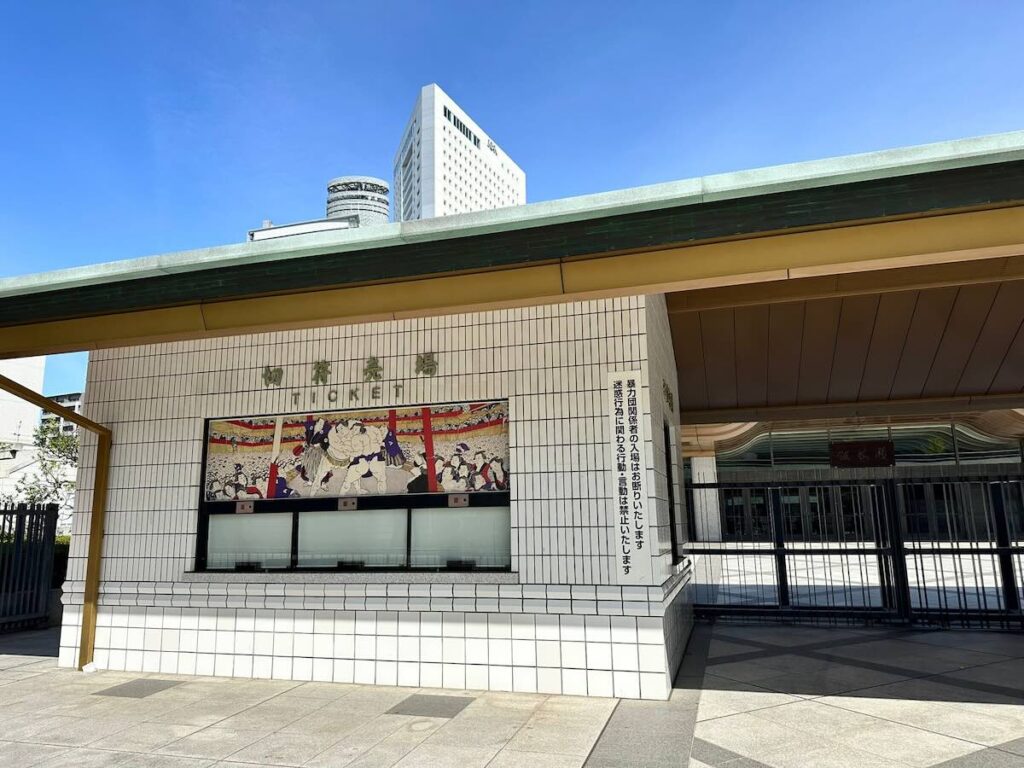
Before the stable, your guide takes you through the Ryogoku area.
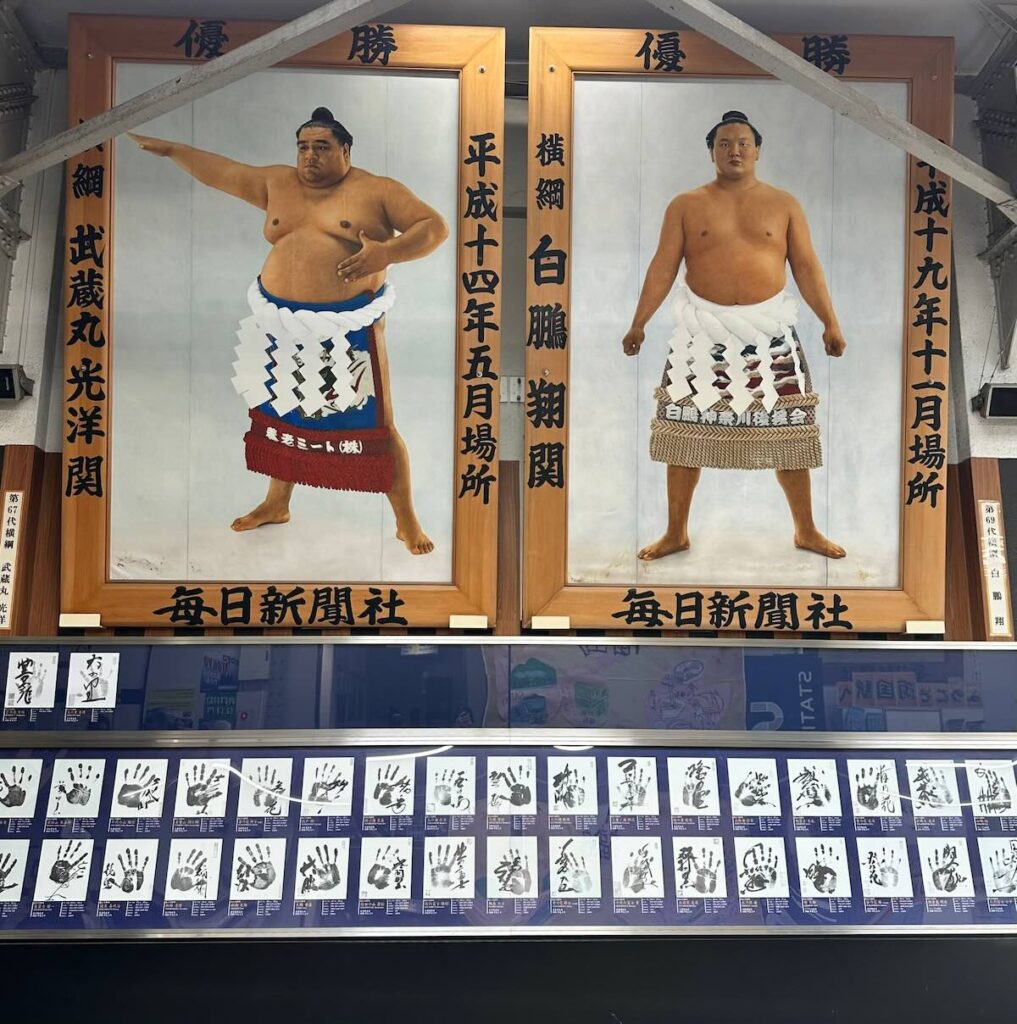
Ryogoku is where sumo has been rooted for centuries. At the station exit, images of the neighbourhood’s past sit alongside photos of the greatest sumo champions, the yokozuna, the highest rank in the sport, and it sets the tone before you even step outside.
The guide explains the history of how sumo became rooted in this area, and it makes the stable visit easier to appreciate. Without it, you would just be watching people push each other around in a room.
The Nakamura Stable
Nakamura Stable opened in June 2024. It was founded by Masatsugu Nakamura, a former sekiwake-ranked wrestler (third rank in professional sumo, behind only yokozuna and ozeki) who competed under the name Yoshikaze. He is known in sumo circles for an explosive, head-on style and for a clear philosophy that the sport should evolve without being strangled by rigid tradition.
The stable has nine wrestlers and trains from early morning. What makes it unusual is that Nakamura’s approach deliberately breaks with convention. In most stables, lower-ranked wrestlers train first while the higher-ranked wrestlers join later. At Nakamura’s, everyone trains together from the start – because, in his words, “standing at the top should be a position of respect.”
Getting into the stable is smooth and well-organised. Shoes off at the entrance, a clear briefing from the guide, and then the training begins.
Rules Inside the Stable
These are worth knowing before you arrive:
- No talking during training
- Phones on silent – switch to live mode if your camera makes a shutter sound automatically
- No flash photography
- No sunglasses or hats
- Do not lean against the walls
- Do not step into the wrestlers’ space under any circumstances.
- If you leave the room, you cannot re-enter – use the bathroom before you go in.
- If you leave before the end, you forfeit the photo with the wrestlers
Watching the Training
This is what you come for.
The atmosphere is solemn. This is a real working session, not a performance, and that becomes obvious the moment it begins.
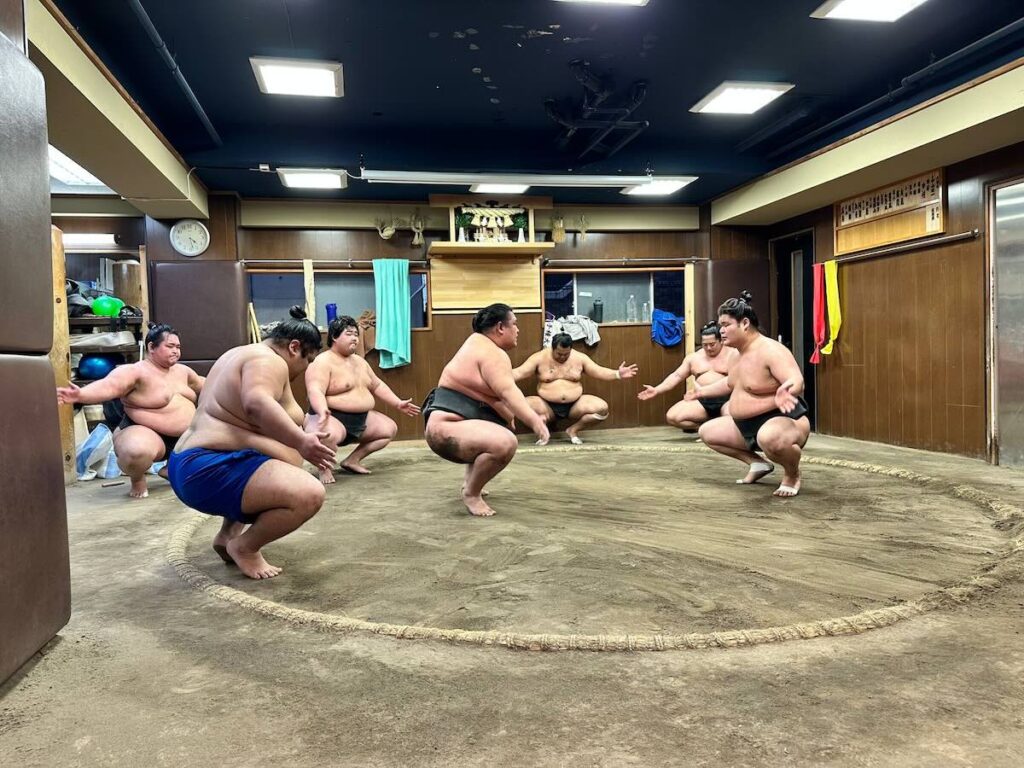
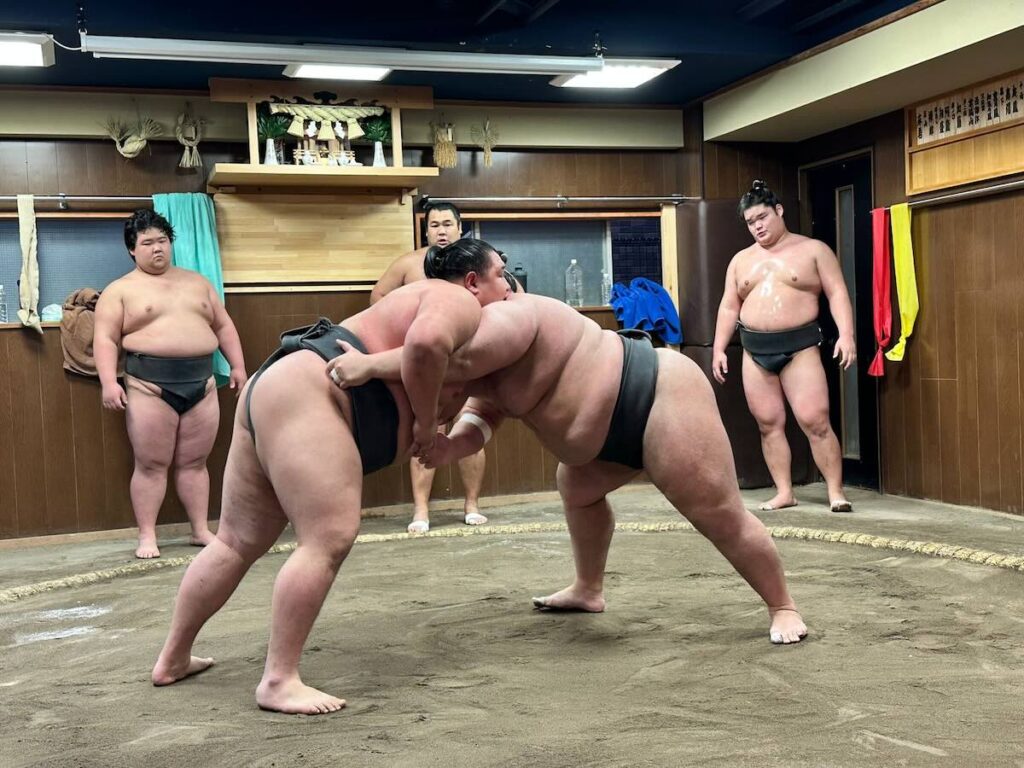
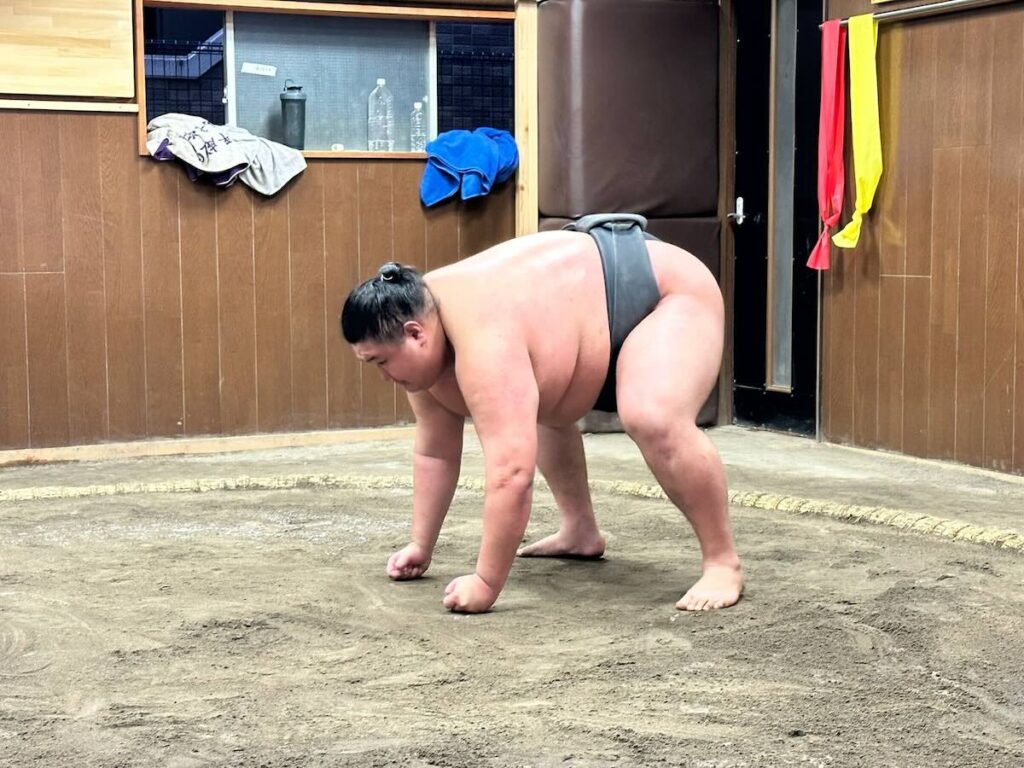
The session starts with a brief Shinto ritual, a prayer at the small shrine mounted on the wall, which the guide explains is present in every sumo stable in Japan. Then the wrestlers step into the dohyo, the clay ring at the heart of every sumo stable, and the shiko begins: each leg raised slowly to the side, then brought down hard into the ground.
It looks ceremonial because it partly is. Historically, it was performed to drive evil spirits from the earth. It is also one of the most fundamental lower-body strength exercises in the sport.
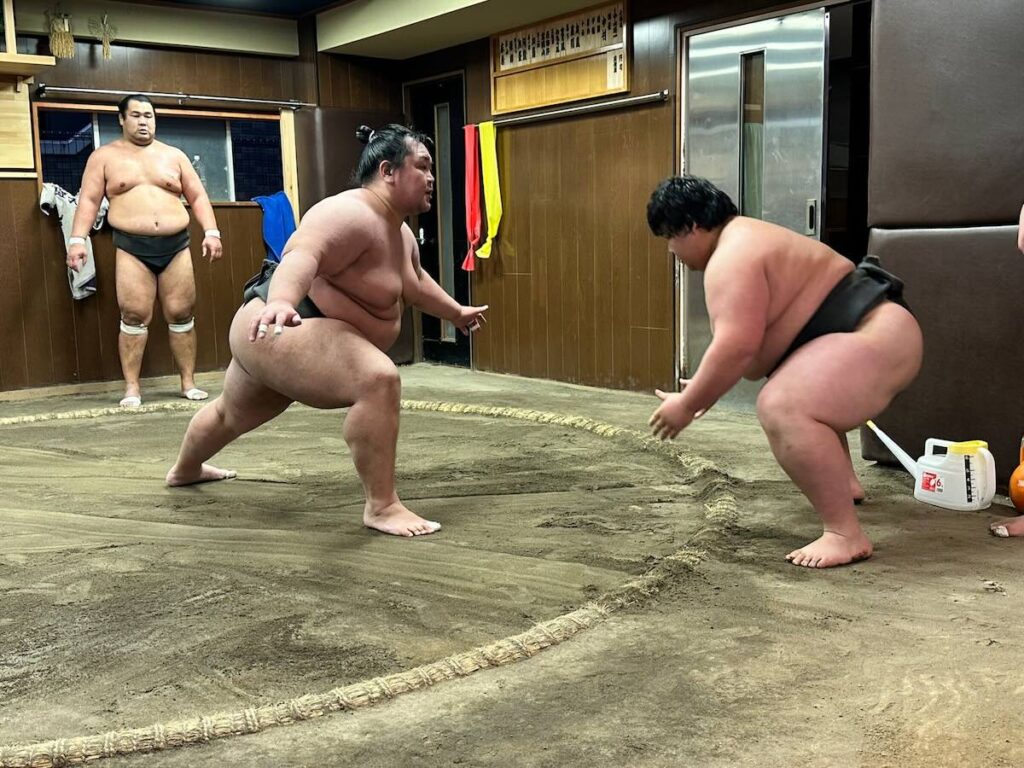
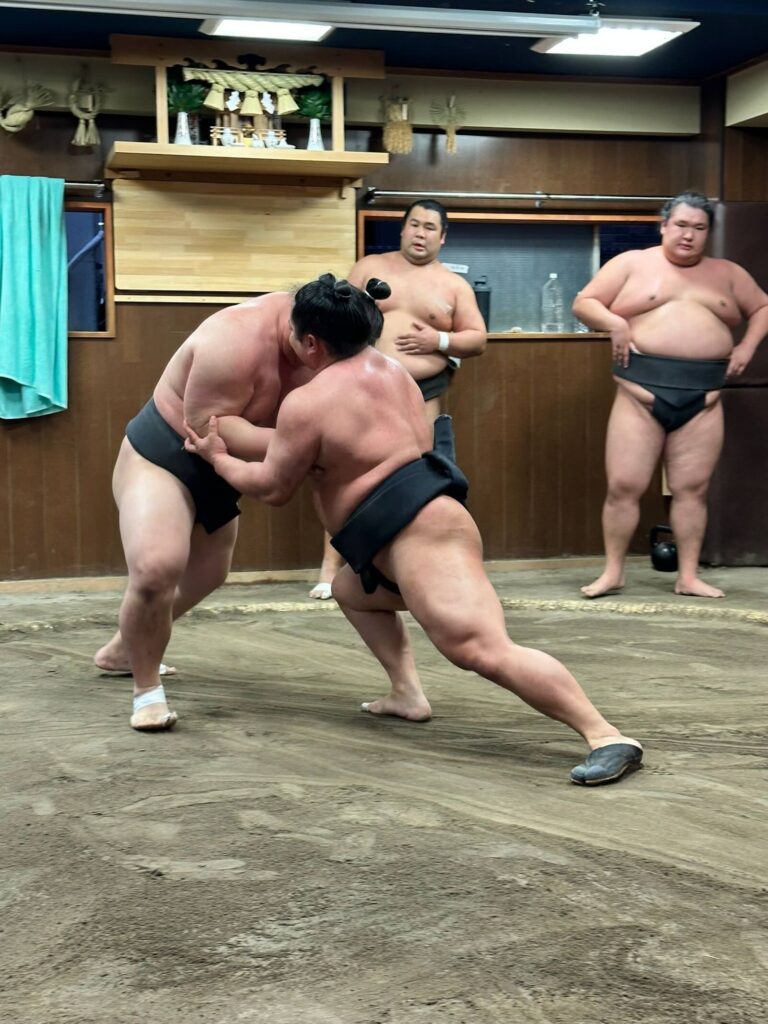
From there, the wrestlers move through a series of training exercises, each one more intense than the last, the effort increasingly visible on their faces and in the sounds that fill the room until the final bouts, where two wrestlers face each other in the dohyo for real.
My Top Tip! The sound is what gets you. Because the room is completely silent on the visitors’ side, every impact carries. The slap of feet on the clay, the grunts of exertion, the thud of a collision. Nothing about watching sumo on a screen prepares you for that.
The guide used a small whiteboard throughout so I could write questions without breaking the silence. She pointed out individual wrestlers by name and explained their stories, which made the session feel personal rather than like watching strangers exercise.
Practical Things to Know
- Seating: You can choose between tatami mats or a chair. If you have any issues with your back, knees, or circulation, take the chair without hesitation.
- Food and drink: Not allowed during training.
- Location: The stable is under two minutes’ walk from JR Ryogoku Station and the Ryogoku Kokugikan.
Things to do in Ryogoku before or after
The training experience runs around 130 minutes, which leaves you most of the day in the area.
Three things worth your time within a 10-minute walk of the stable:
- Chanko nabe for lunch (the hot pot stew sumo wrestlers eat to bulk up, with several restaurants in the area run by retired wrestlers, around ¥2,000 to ¥4,000 per person). Chanko Tomoegata and Chanko. Kirishima are two of the better-known spots. If chanko isn’t for you my guide to the best restaurants in Tokyo covers other options.
- Edo-Tokyo Museum which reopened in March 2026 and is one of the best museums in the city for understanding how Tokyo became Tokyo
- Sumida Hokusai Museum, dedicated to the artist behind The Great Wave off Kanagawa, the iconic image you’ll find on Japan’s 1,000 yen note.
Who should book the Wabunka tour
Book this if:
- You want to understand what you’re watching, not just observe it
- You’ve seen sumo on TV or in a documentary and want to experience it firsthand
- You’d rather pay more for a small private group than save money and feel lost
Skip this if:
- Sumo is only a passing curiosity rather than a genuine interest
- You’re on a tighter budget
- You, or the children, can’t sit silent and still for 90 minutes (this is a real working training session, not an interactive show)
How to Book
If you have read this far, you have probably already decided. The booking page is here: Observe sumo training with Wabunka
Final verdict
I’ve done a lot of cultural experiences in Japan over the years. Some felt packaged, some forgettable. This one stuck with me, and the sound is what I remember most. If sumo is on your radar for your Tokyo trip, this is a good way to get close to it.
Tokyo Sumo FAQs
Training is intimate and quiet: you sit a few feet from the wrestlers in a small room watching their morning routine. A tournament is a full-day stadium event with thousands of fans and competitive bouts. Both are worth doing, but if you only have time for one and want to feel the sport up close, training wins.
Most stables start between 6:00 and 8:00 in the morning. The Wabunka experience at Nakamura is timed to arrive in time for the full session.
Technically yes, but think carefully. Children need to sit silent and still for around 90 minutes during a real working training session. There’s no commentary, no break, no flexibility. If your child can do that, they’ll find it fascinating. If not, this isn’t the right activity for them.
Yes, but with strict rules: no flash, no shutter sounds, and you cannot stand or move around to take them. Most tours include a dedicated photo with the wrestlers at the end.
Smart casual. No hats, no sunglasses, shoes you can slip off easily at the entrance. Avoid anything too revealing as a sign of respect. You’ll be sitting on tatami mats or a chair for around 90 minutes, so dress comfortably for that.
Yes, at Arashio-beya in central Tokyo, but it’s a glance rather than an experience. You stand on the pavement and watch through a street-facing window. If a crowd has gathered, you may not see much at all. There’s no sound, no context, no guide. Fine for a quick look. If you actually want to feel the sport, pay for a stable visit.


4 Comments
Comments are closed.