
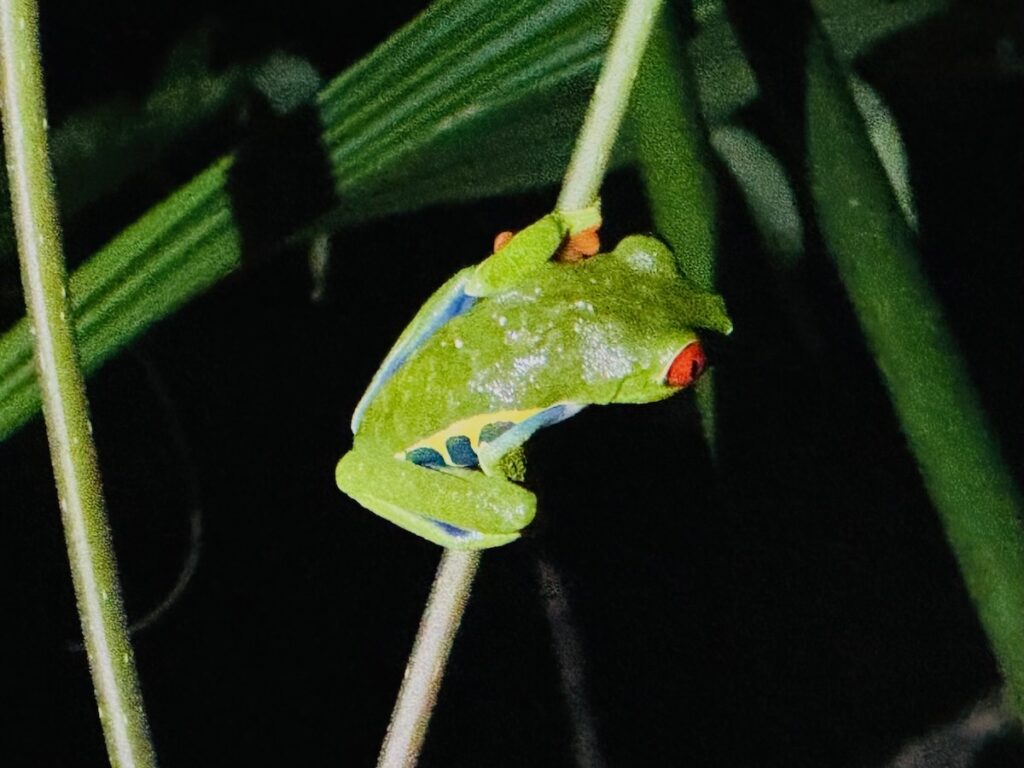
Our guide stopped at a small pool of water, searched the plants around it for a few seconds, and found a red-eyed tree frog on a long stem. We were four minutes into the night walk. That was when I understood how La Fortuna works: the wildlife is all there, you just need someone who knows where to look so you don’t miss it.
There are more things to do in La Fortuna than you can fit into a short stay, which is the real problem: some guides list twenty activities and rank none of them. I spent three nights here and did six of the main ones, so I share my view on what’s worth your time, what each one costs, which to book ahead, and the ones I’d skip if your days are tight.
More of my Costa Rica guides to help plan your trip
- 7 Days in Costa Rica Itinerary: A first-timer route with costs, timings and where to stay
- Where to Stay in La Fortuna: The hotels with hot springs, what they cost and if it’s worth it
- Things to Do in Manuel Antonio, Costa Rica: The best activities ranked and what to book ahead
- Where to Stay in Manuel Antonio: Which area to pick, what each one costs and where I stayed
- Is Manuel Antonio National Park Worth It?: Honest tips on tickets, timing and when to skip it
- La Fortuna to Manuel Antonio: The four ways to travel it, costs and comparison
La Fortuna and Arenal: what’s the difference?
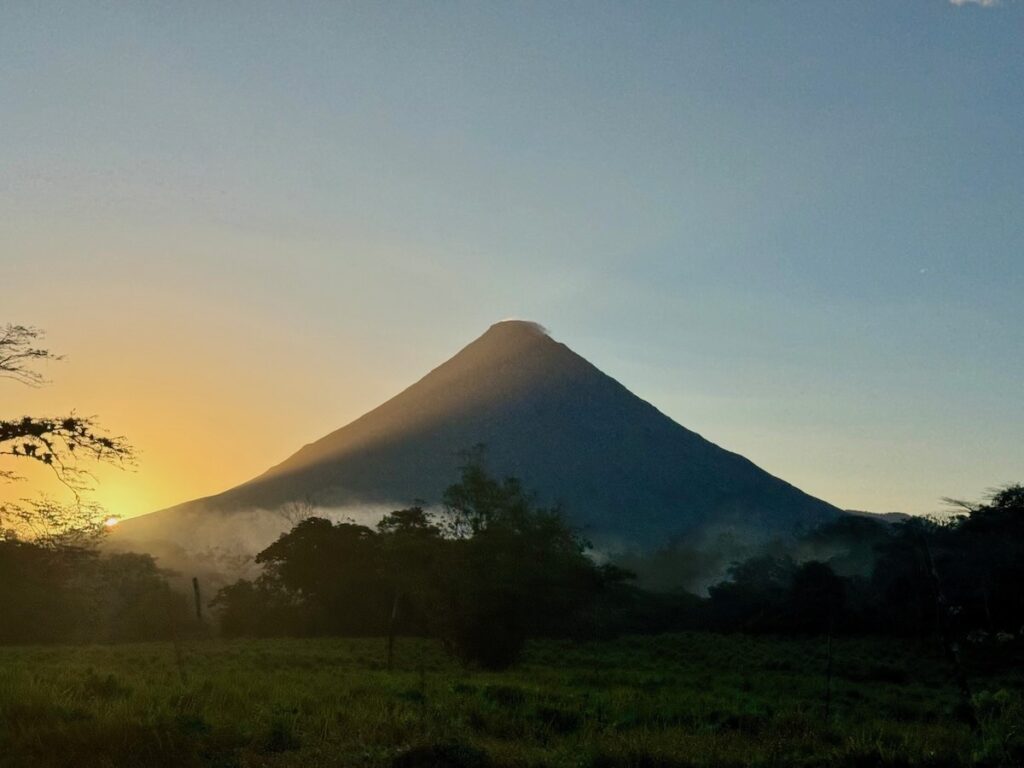
These names get used as if they mean the same thing, and they don’t. La Fortuna is the town, a small, walkable place built around a central park and church. Arenal is the volcano, sitting about 20 minutes away. Arenal Volcano National Park is the protected area at its base, with trails across old lava fields.
Almost everything worth doing sits within about 30 minutes of town. The two genuine day trips, Rio Celeste and Bajos del Toro, are considerably further out and take a whole day to do.
One thing to get clear before you book: there is no beach here. The nearest Pacific coast is several hours away. I paired La Fortuna with Manuel Antonio on the coast, which gave me rainforest for the first half of the trip and beaches for the second. That split works far better than trying to do both from one base. If you’re planning on doing both, here’s the best way to travel from La Fortuna to Manuel Antonio.
How many nights do you need in La Fortuna?
In my opinion, three nights is good for most first-timers. Almost everything here takes a full morning or afternoon once you add hotel pickup and travel time, so you plan in half-days, not hours. Three nights gives you two full days plus your arrival afternoon, which is around six activities without rushing. That’s what I did and it felt like a good amount of time to enjoy the area
Past four nights, most first-timers get more from their trip by moving on and seeing more of Costa Rica.
| Nights | What it gets you | Good for |
|---|---|---|
| 2 | Three activities: the bridges, a night walk, one volcano-view activity. A little rushed. | Tight itineraries where La Fortuna is one stop of several |
| 3 | Everything in this guide’s top tier at a comfortable pace. My pick. | First-timers who want the highlights without racing |
| 4 | The above plus one big day out: Rio Celeste, rafting or canyoning. | Anyone who wants an adventure day or a day trip |
| 5+ | A more relaxed pace, useful if you are staying in a beautiful hotel and want some downtime too. | Slow spa-and-hot-springs trips. Otherwise move to a second region |
Disclaimer: This article may feature affiliate links. If you click these links, and choose to book with that hotel or company, I will earn a small commission at no extra cost to you. I appreciate the support that allows me to continue providing this information.
If you only do three things in La Fortuna
I strongly recommend to everyone you do more than three things when you’re there, but these are my personal favourites of what we did and should be top of everyone’s list if time is tight:
- Mistico hanging bridges. The best walk I did here. The bridges are properly impressive and the jungle you’re walking through is more interesting than the national park trails.
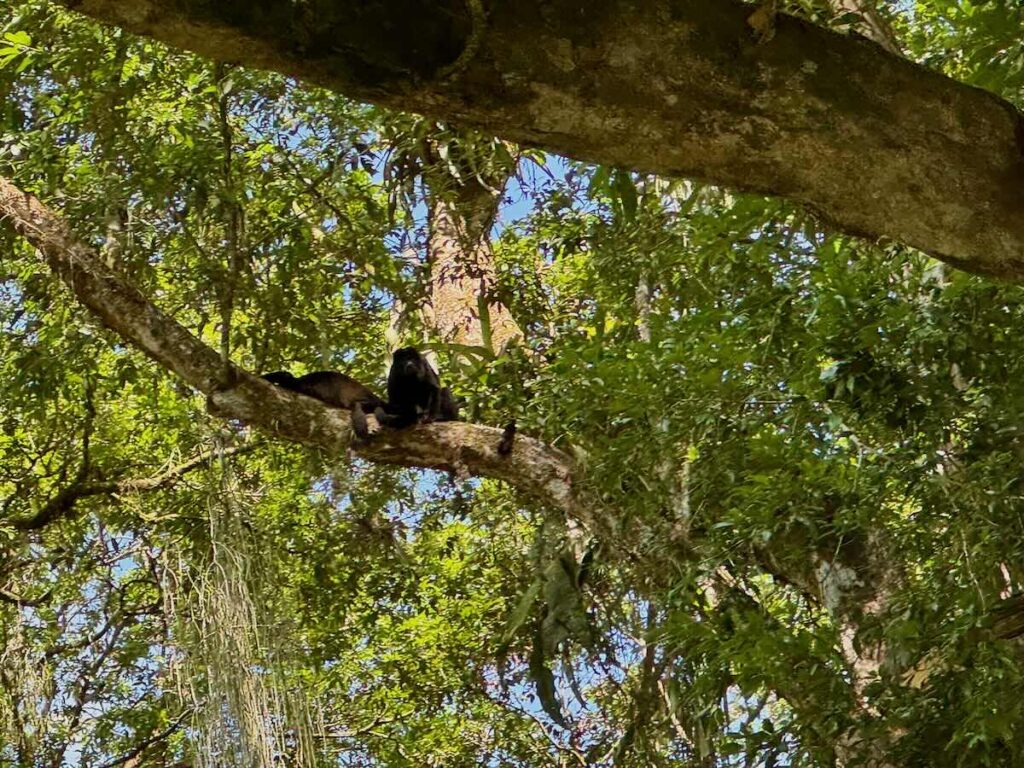
- A guided night walk. The single best wildlife experience of my time in La Fortuna, and not close. You see things during the day, but you see far more variety at night with a guide.
- One volcano-view activity. Seeing Arenal when you’re here is a must in my opinion and usually my recommendation is Arenal Volcano National Park. The exception is if you’ve already had clear volcano views from your hotel or around town, and you don’t want another hike, drop this.
My Top Tip! Getting to Mistico early is a non negotiable, you avoid the crowds and really appreciate it. Make sure you book a slot, I would personally try and get there for opening, we did this and almost had the place to ourselves, even more memorable as I proposed to my other half by the waterfall with no one around.
Quick comparison of the best activities
Booking in advance for these is sensible, I used a mix of our hotel tour desk, Viator and GetYourGuide, depending on best availability and pricing. Check the best prices in the links below.
| Activity | Time needed | Typical cost | Book ahead? | Pick this if |
|---|---|---|---|---|
| Mistico hanging bridges | 2 to 3 hours | about $32 (£25) | Yes for the early slot | You want the best rainforest walk near town |
| Guided night safari | 2 hours | typical $40–$60 (£32–£48) | Recommended | You care about seeing frogs, snakes and small wildlife |
| La Fortuna Waterfall | 1.5 to 2 hours | about $20 (£16) | Optional, but skips the queue | You want a swim and are happy with steps |
| Arenal Volcano National Park | 1.5 to 3 hours | about $17 (£14) | No, tickets at the ranger station | You haven’t had a clear volcano view yet |
| Bogarín Trail sloth walk | 1-2 hours | typical $30–$45 (£24–£36) | Recommended | You want sloths right by town |
| Safari Float | 5 hours total, 2 on the water | typical $80–$110 (£64–£87) | Recommended | You want wildlife without anything strenuous |
| Hot springs day pass | As long as you like | typical $35–$110 (£28–£87) | Yes in high season | Your hotel doesn’t have thermal pools |
Prices and opening times change, so check before you travel.
Walk the Mistico hanging bridges
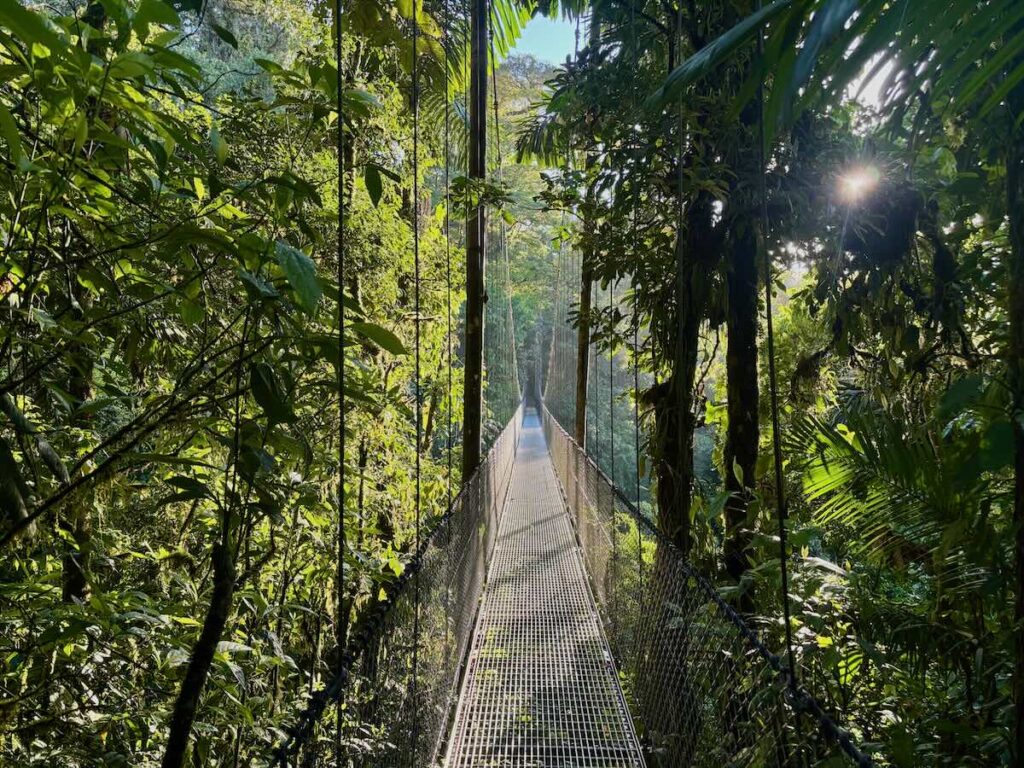
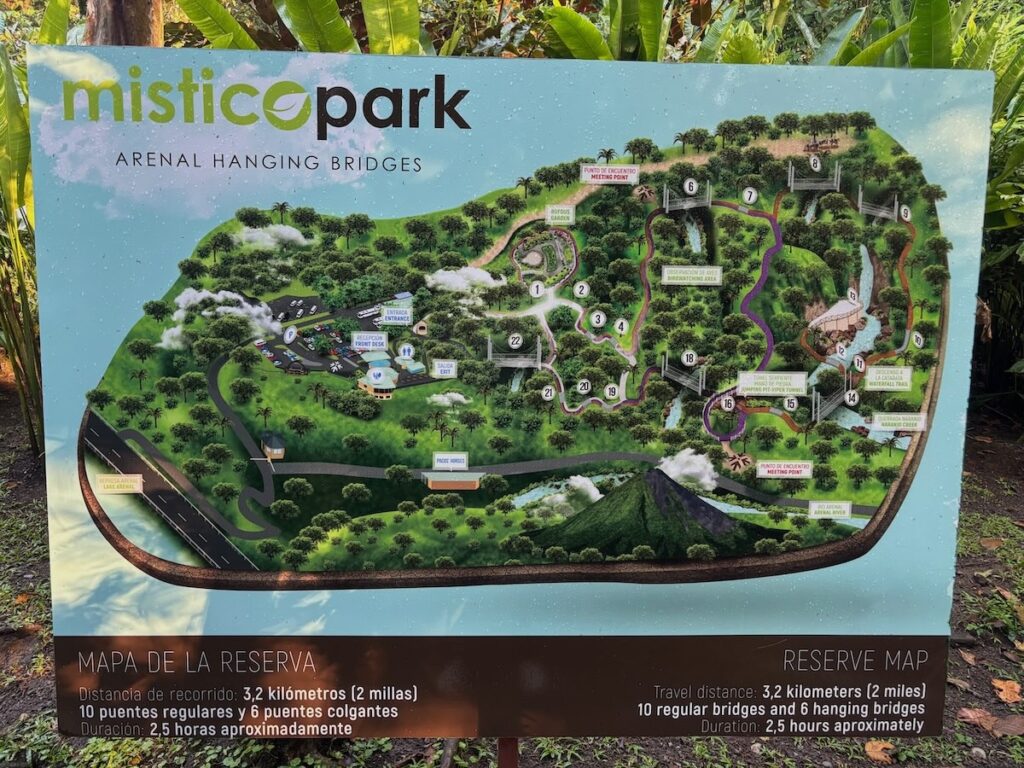
Mistico is a private rainforest reserve with a 3.2km loop trail through primary jungle. Sixteen bridges cross the valleys, six of them suspension bridges that take you right up into the canopy. Hanging bridges, if you haven’t come across the term, are exactly what they sound like: walkways strung between towers so you’re level with the treetops rather than looking up at them. They make for some lovely photos and really make the walk special
Time 2 to 3 hours • Cost about $32 (£25) self-guided entry
We went at the 6am opening and had most of the trail to ourselves until around 7.30am, when the first day-trip groups started arriving. By mid-morning it’s a different experience. If you’re coming from the UK and still on European time, the early start is easy, and it’s the best use of jet lag I’ve found.
The walking is not technical, but it isn’t flat either. There’s a fair bit of up and down and the surface gets slippery after rain.
Guided or self-guided?
You can walk it yourself and it’s still a lovely couple of hours. A guide will show you considerably more wildlife, because most of what’s there is small, still and camouflaged.
Pick self-guided if you’ve already paid for a guide elsewhere on your trip. Pick guided if this is your only proper wildlife walk in La Fortuna.
My Top Tip! Watch out for booking this as a combined day-trip package, which typically arrives mid-morning when the bridges are at their busiest. Instead, book the reserve direct so you can choose your own slot.
Mistico or Arenal Volcano National Park?
If you can only do one, I’d pick Mistico. The bridges are the more memorable walk and the jungle is more interesting. The one exception is if you haven’t managed to see the volcano from your hotel or around town, because seeing Arenal properly is a big part of being here, in my opinion everyone needs to tick it off before they leave.
Take a guided night safari/walk
Most of Costa Rica’s rainforest wildlife is nocturnal, which is why for me this isn’t an optional extra. A night walk is a two-hour torch-lit walk through a private reserve with a guide, looking for the animals that only come out after dark.
Time 2 hours • Cost typical $40–$60 (£32–£48) per person
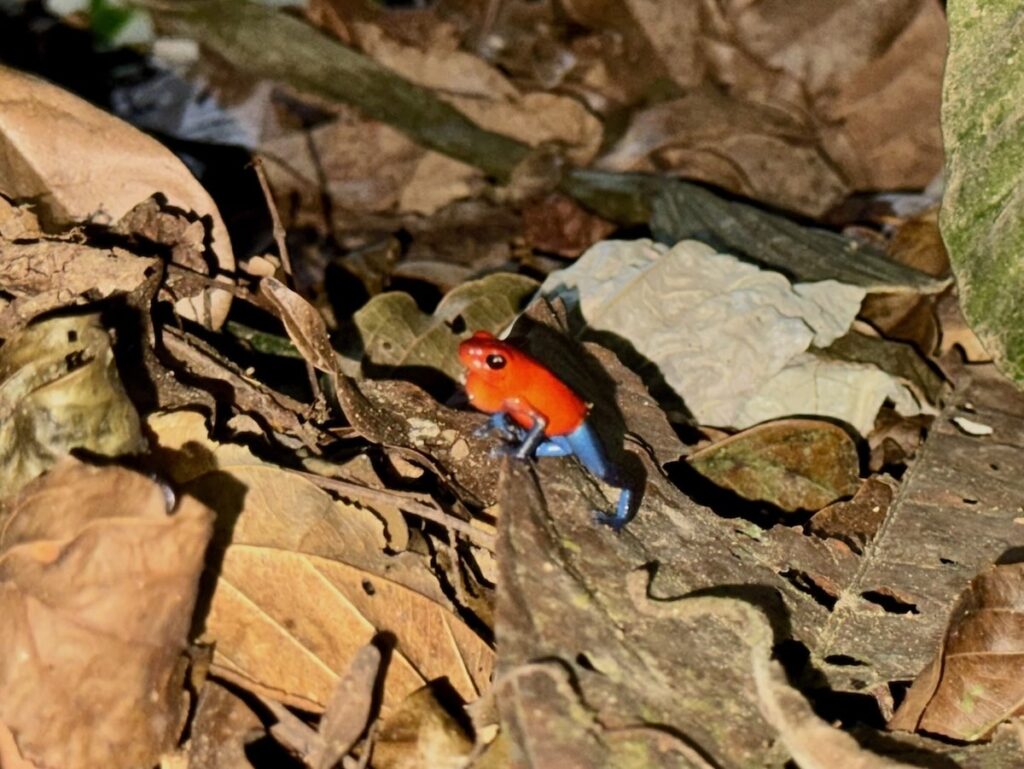
Our guide knew the reserve by habitat rather than by trail. He’d look at a small pool of water and know what should be living around it. That’s how he found the red-eyed tree frog within minutes of setting off, sitting on a long plant stem, arguably the most famous frog in the country. Later he found a blue jeans poison dart frog that was absolutely tiny, the sort of thing I would walk past a hundred times.
He was also careful about how he used his torch. He showed us the angle to light an animal so we could see it and photograph it without the light going straight into its eyes and making it shut them. Small thing, but it changed the photos completely.
My only miss was not seeing a glass frog. He’d seen one the previous day near a larger pond and couldn’t find it for us. He was more disappointed than we were, which tells you something about the guides here.
My Top Tip! Don’t save this for your last evening after a full day of hiking, you’ll likely be too tired to enjoy it properly. Book it for a day when your afternoon is more relaxed.
La Fortuna Waterfall
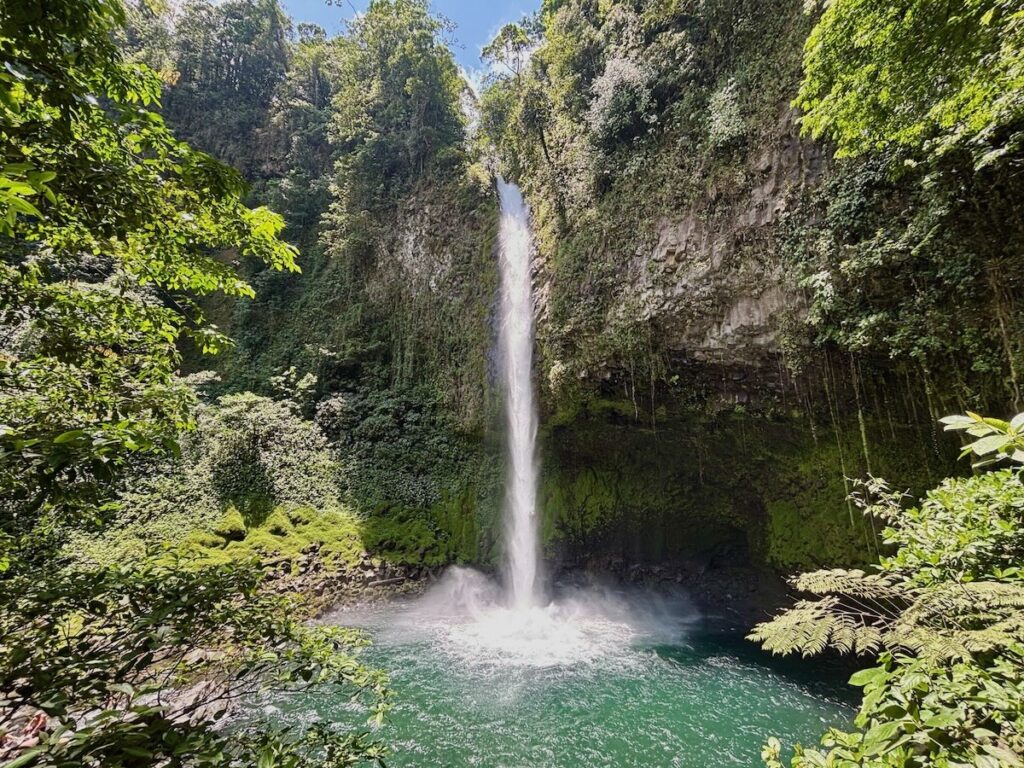
A 70 metre cascade dropping into a jungle gorge, reached by about 530 concrete steps down and the same back up. There’s a pool at the bottom where you can swim.
Time 1.5 to 2 hours • Cost about $20 (£16) entry
The park opens at 7am. My only regret of my time in La Fortuna was that we got there at peak busyness instead. The weather was good and we wanted to make the most of a clear day, which is a reasonable instinct, but with hindsight I’d have gone earlier. The steps are narrow and when they’re full of people going both ways, the descent takes a lot longer than it needs to. We still enjoyed it. It just would have been better when it was quieter.
My Top Tip! There are two swimming areas. The main pool directly below the falls has a strong current, so don’t go far in. The calmer section is where most people swim. If you’re a good swimmer do both as they’re a different experience. I really enjoyed it
The steps, and who should skip them
The staircase is my one caveat here. The steps are well built with handrails and benches to stop on, but 530 of them back up in the humidity is a proper effort. Allow 10 to 15 minutes down and 20 to 30 minutes up. If anyone in your group has mobility or fitness issues, it’s one to consider skipping.
There is a viewpoint at the top where you can see the falls without going down at all. It’s included in your entry. I’ll be honest though: I don’t think the trip is worth it for the viewpoint alone. If you can’t do the steps, spend the money on another activity instead
Hike in Arenal Volcano National Park
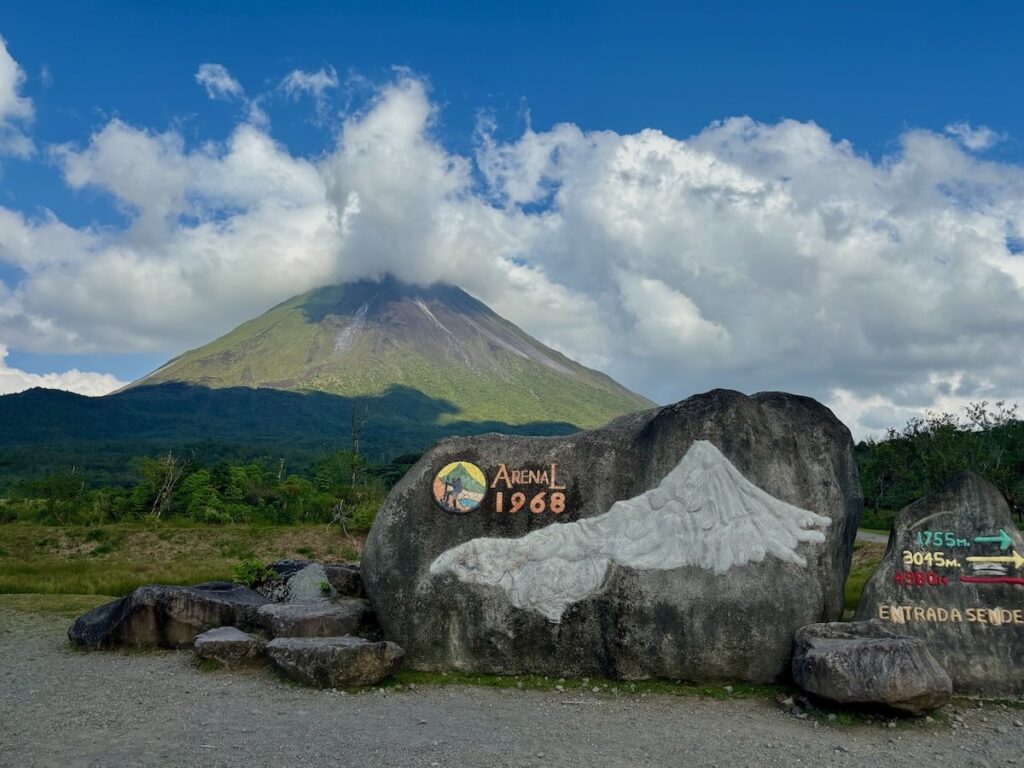
The park protects the land around the base of the volcano. You have the choice of three trails, all of which are quite flat and easy, just differing in length. They cross old lava fields from the 1968 eruption, with wide views of the cone when the cloud lifts. Unfortunately for the adventurous among you, you cannot climb Arenal. That’s forbidden.
Time 1.5 to 3 hours • Cost about $17 (£14) entry including tax
Be clear about what you’re paying for: this is a volcano-view activity, not a wildlife one. You’ll see some birds and lizards, but the reason to come is the view and the lava fields. If the volcano is under cloud, and it frequently is, the trails are pleasant rather than memorable.
The park is open 8am to 4pm daily with last entry at 2.30pm, so it doesn’t work as a late-afternoon filler. Tickets are bought at the ranger station on arrival, payment is by card only, so don’t turn up with just cash.
When to skip it
This is my honest skip candidate for a two-night stay. If you’ve had good clear views of Arenal from your hotel balcony or from around town, and you’re choosing between this and the hanging bridges, take the bridges.
Bogarín Trail sloth walk
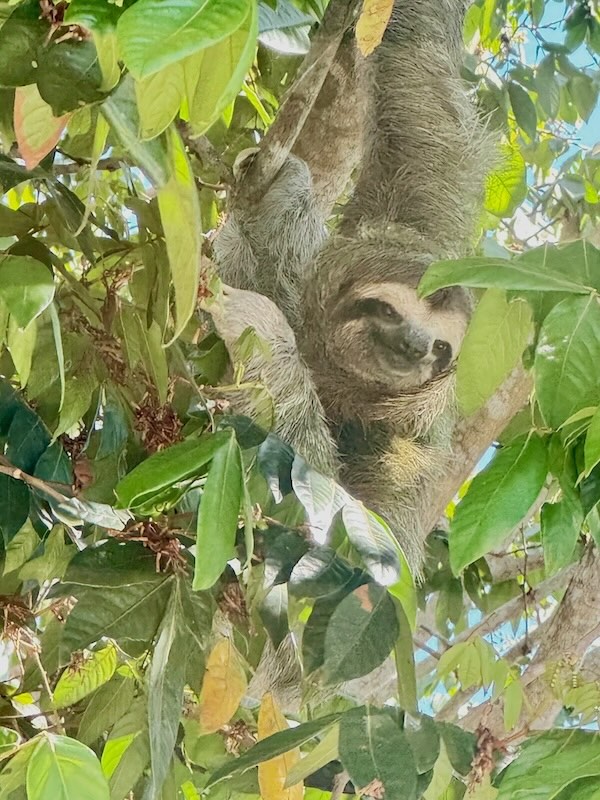
Bogarín is a small reserve on the very edge of La Fortuna town, set up to regenerate a patch of local rainforest. It worked: sloths moved back in, along with toucans, frogs and coatis. Because it’s in town, you don’t lose half a day getting there.
Time 1-2 hours • Cost typical $30–$45 (£24–£36) per person
Our guide found three sloths in two hours, plus a sleeping owl and a tree frog the size of a fingernail. I would have walked past every one of them. Sloths sit high in the canopy and look exactly like a clump of dead leaves, which is the entire point of being a sloth.
The afternoon departures suit an arrival day, and that’s how we did it. We came in from San José, dropped our bags, ate, and went straight out. It’s a gentle way to start without needing an early alarm on your first morning.
Why a guide makes the difference
I recommend you don’t walk this one alone. Without someone who knows the individual trees the sloths use, and without a scope, you’ll get a pleasant thirty-minute walk and see very little.
My Top Tip! Buy a pair of binoculars before you fly. I picked up a basic pair for around £30 and used them every single day, on guided walks, from the hotel pool, even at breakfast. It’s the best value upgrade you can make to a Costa Rica trip.
Sloth’s Territory is the other well-known sloth option nearby. I didn’t visit that one, so check the booking terms before you turn up.
Safari Float on the Río Peñas Blancas
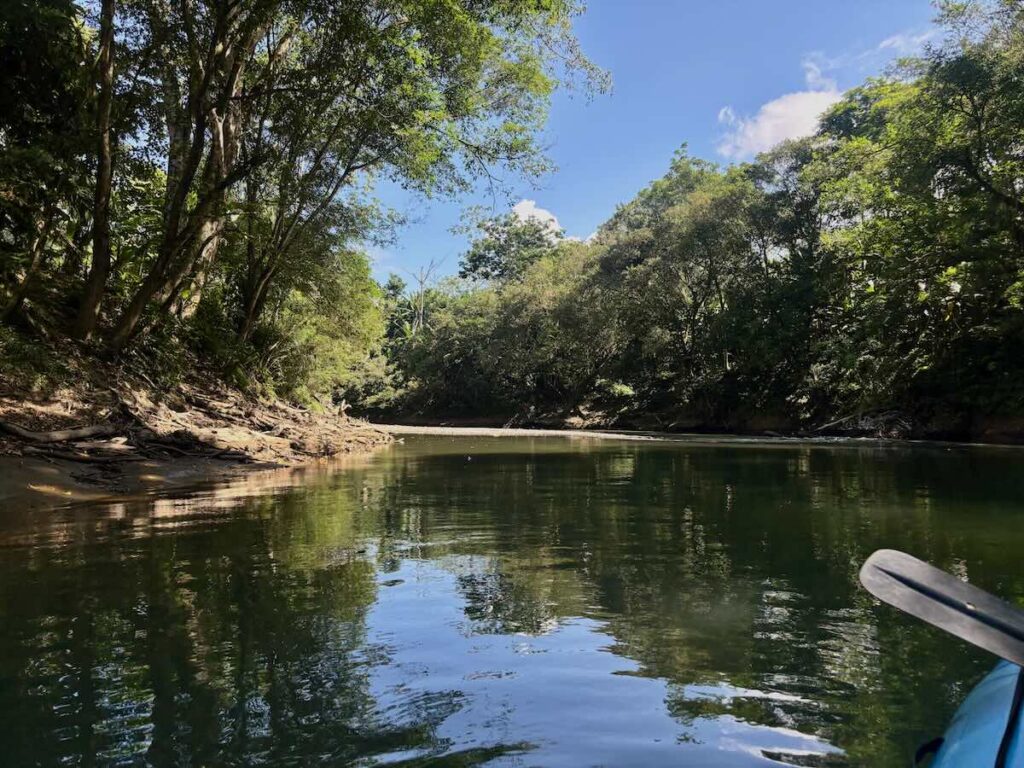
A safari float is a gentle drift downriver in a stable inflatable raft, looking for wildlife on the banks. No rapids, and barely any paddling. It’s the opposite of white water rafting.
Time 5 hours total, 2 hours on the water • Cost typical $80–$110 (£64–£87) per person
The gap between those two numbers is what surprises people. The float itself is two hours, but the full outing includes hotel pickup, the drive out, lunch, and the drive back. We took the early morning departure and were back at the hotel by mid-afternoon.
We saw plenty of birds, several types of monkey, and iguanas, but we didn’t see caimans, which appear in every tour description I’ve read, so treat those as a bonus rather than a guarantee. Nobody can promise you a specific animal, but it was a lot of fun.
Who it suits
This is great for families, older travellers, and anyone who doesn’t fancy something more physical. There’s no scrambling, no steps, and you’re sitting down for the whole thing. If you want adrenaline, this is not your activity and you’ll find it slow.
Some float tours set a minimum age. Confirm that with your operator when you book if you’re travelling with young children.
Hot springs in La Fortuna
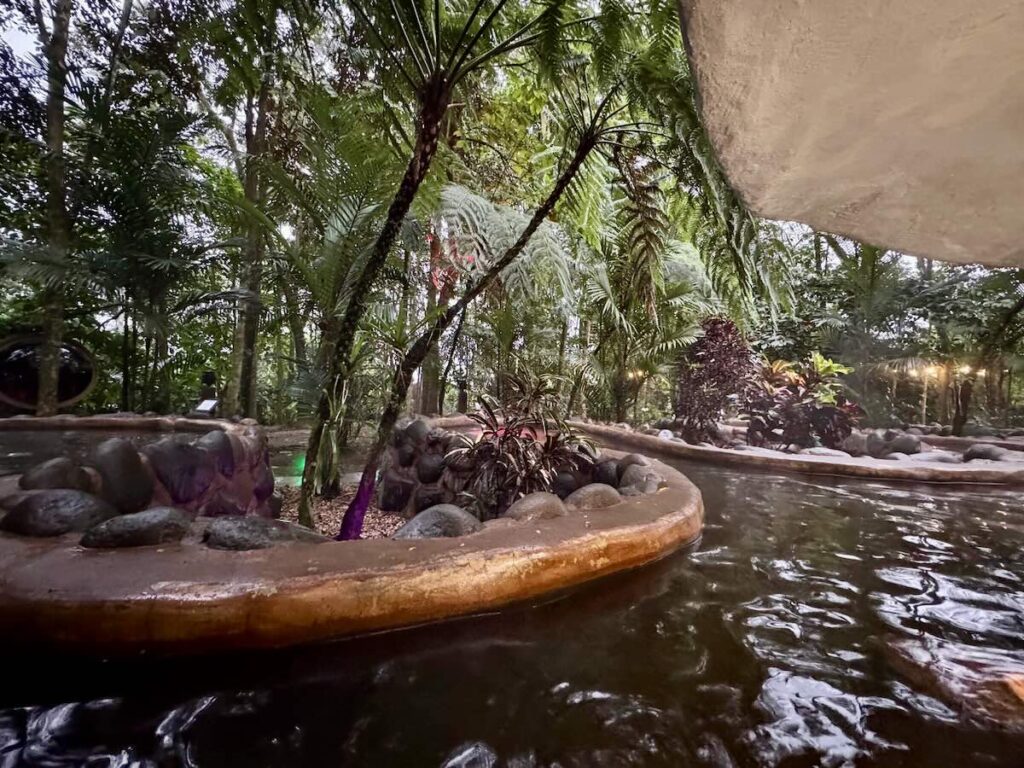
La Fortuna sits on geothermally heated water, and soaking in it is one of the things people come here for. There are three routes in, and picking the right one saves you a lot of money.
I should be upfront: I used the thermal pools at my hotel, a decision I was very happy with, and didn’t buy a day pass anywhere. So the resort comparison below is research rather than experience.
Your hotel’s pools, a day pass, or the free river
Plenty of hotels around La Fortuna have their own thermal pools included in the room rate. We stayed somewhere with its own thermal pools and used them most evenings after activities, it meant we never felt the need to pay separately for a hot springs visit.
If you’re still choosing where to stay, this is worth factoring in to your hotel choice. I’ve broken down the best hotels with hot springs in La Fortuna in a separate guide.
A day pass at one of the dedicated resorts gets you landscaped pools, restaurants and bars, and a more polished experience. The price spread is wide:
- Local and cheap. Termalitas, Relax Termalitas and Los Laureles, roughly $7 to $12 per adult
- Simpler resorts. Titokú and Paradise, roughly $33 to $47 per adult
- Mid-range. Baldi and EcoTermales, roughly $45 to $50
- Top end. Tabacón about $99, The Springs about $141 for a two-day pass
The free hot spring river
There’s a free stretch of naturally heated river near the main resort where locals and travellers soak. You park on the roadside and walk in. From what I’ve read, someone unofficial will usually offer to watch your car for a small payment. The setting is more rough and ready rather than manicured. I didn’t go, so I can’t tell you how it felt on the day, only that it exists and costs nothing if you’re on a budget.
My Top Tip! If your heart is set on the best-known resort, for a day pass or a hotel stay, get a slot well in advance between December and April. It sells out a long way ahead.
Other things to do in La Fortuna I didn’t get to
Three nights meant choosing, and these are the ones I didn’t fit in. I didn’t choose them as I’ve done many of these on my travels elsewhere. I’m listing them because they’re genuinely popular and might suit you better than something I did.
Adventure activities
Ziplining and canopy tours. Several operators run zipline circuits with volcano and lake views, ranging from gentle family courses to fast, high lines. Worth knowing: two independent writers who’ve done both say ziplining is cheaper and better in Monteverde, so if your trip includes both places, you might save this for there.
Cost typical $60–$100 (£48–£79) per person
White water rafting or tubing. The Balsa River near town runs class II and III rapids suited to beginners and families, with about two hours on the water and lunch afterwards. The Sarapiquí and Pacuare offer class III and IV water for experienced rafters, and some operators will run the Pacuare as your transfer onward to San José or the Caribbean coast rather than a return trip.
Cost typical $65–$85 (£52–£67) per person on the Balsa
Canyoning and waterfall rappelling. Abseiling down waterfalls on ropes, with a harness and a guide. Most tours run four to five hours with four or five descents, and you should expect to finish wet, tired and full of adrenaline.
Cost typical $85–$125 (£67–£99) per person
Slower and wet weather options
Chocolate, coffee and cooking tours. Hands-on farm visits where you see how cacao or coffee is grown and processed, usually with plenty of tasting. These run rain or shine, which makes them a sensible reserve for a wet afternoon.
Cost typical $35–$55 (£28–£44) per person
Horseback riding. Countryside rides with volcano views, often combined with a trip to the waterfall.
Cost typical $70–$95 (£56–£75) per person
El Salto rope swing. A free swimming spot on the river a couple of minutes from town where locals swing in off a rope. It costs nothing and takes as long as you want, but it closes when the current runs strong after heavy rain, so don’t build an afternoon around it in green season.
Day trips from La Fortuna
Rio Celeste. A bright blue river inside Tenorio Volcano National Park, coloured by a natural mineral reaction. It’s about 1.5 to 2 hours each way and the hike is roughly 6 to 7km, so it’s a full day whichever way you do it. Guided tours include transport, park entry and lunch. If you drive yourself, park entry alone is about $15 and the park caps daily visitor numbers, so book in peak season. If I’d had a fourth night, this is what I’d have added.
Cost typical $90–$135 (£71–£107) per person on a guided day trip
Planning your days around the weather
The best advice I was given before flying to Costa Rica was this: book anything that depends on views or good weather as early in the morning as you can.
It held up completely. Across our three days in La Fortuna, the mornings were consistently the clearer half of the day and the rain we did get came in the afternoons.
Most of the tour sites offer free cancellation as well, so booking your slots before travelling and then cancelling if it’s not looking good doesn’t cost you.
Do you need a hire car in La Fortuna?
No. We spent three nights here without a car and never once felt limited.
Two things make that work. Most tours include hotel pickup and drop-off, which covers the big activities without you doing anything. And Uber works fine at the common tourist spots around town.
The one honest exception was coming back from the Volcano national park, where we waited a while for a pickup. It’s the furthest out of the places we went and the least reliable for a quick car. Not a problem, just allow for it rather than expecting an instant ride.
When a car does make sense
A hire car works if you’re self-driving the wider country anyway, or if you want the further-out spots on your own schedule. Some of those need a 4WD.
If you’re only basing yourself here for a few nights and booking tours, don’t bother. Put the money towards a guide or more activities instead.
For the detail on getting to and from La Fortuna, including transfers from San José, I’ve covered that separately.
Where to eat between activities
You’ll see the word ‘soda’ everywhere. It’s a small, family-run local restaurant serving Costa Rican home cooking, and it’s where you eat well for very little. The standard order is a casado: rice, black beans, plantain, salad and a protein on one plate.
We ate at Soda Viquez in town between activities and it did exactly what we needed, a proper lunch at a fair price without wasting precious time. There are lots of options like this, or alternatively pick a hotel with onsite restaurants.
Cost typical $6–$10 (£5–£8) for a casado
My Top Tip! If you’ve got a 1pm pickup, don’t sit down at 12. Service across Costa Rica is unhurried by design, Pura Vida and all that! You’ll be watching the clock rather than enjoying lunch. Plenty of the smaller sodas are cash only too, so carry small notes.
FAQs about things to do in La Fortuna
Yes. La Fortuna is a small tourism town in a rural region with a low crime rate, and it’s one of the safer places in Costa Rica for first-timers. Take the usual precautions with valuables, but walking around town in the evening is generally fine. The main thing to watch is petty theft from parked cars at trailheads, so leave nothing visible.
Widely, in the tourism trade. Guides, hotel reception, drivers and most restaurant staff speak functional English, so you’ll manage easily without Spanish. A few basic phrases are appreciated but not needed. Away from tourism, in local shops or with taxi drivers, English thins out, so a translation app is handy.
Both work. Tours, hotels and larger restaurants quote and accept US dollars and cards happily. Small sodas, local shops and taxis prefer colones in cash, and you’ll get a fairer rate paying in the local currency than in dollars. Carry some small colón notes for the cheaper end and use ATMs in town rather than airport exchange desks.
About 2.5 to 3 hours by road from San José (SJO), and a similar 2.5 hours from Liberia (LIR) via the Lake Arenal route. Neither needs a 4WD. Most visitors take a shared or private shuttle, which you can book to collect you straight from arrivals.
The dry season, roughly December to April, gives you the clearest volcano views and the least rain, but it’s the busiest and priciest. May to July and September to October are quieter and cheaper, with rain usually falling in short afternoon bursts rather than all day. The rainforest is at its greenest then, and mornings are often still clear.
Yes, on a clear day Arenal is visible from most of the town and from many hotels. Cloud cover is common, especially in the afternoon.



7 Comments
Comments are closed.