
I went into Rio expecting the photos to be doing some heavy lifting. They aren’t. Christ the Redeemer is dramatic up close, Sugarloaf at sunset is properly stunning, and the beaches really are the centre of daily life rather than a thing you do on the side.
But Rio is bigger and a bit more spread out than first-timers expect, and a 4 to 5 day trip needs a real plan if you want to come away feeling you’ve done it well.
This guide covers what to do in Rio de Janeiro on a first visit. Sights first, planning after.
Rio de Janeiro at a glance: what to expect on a first visit
Rio is busy, beautiful and a bit messy. The headline sights live up to the hype, the beaches are epic, and the city is more spread out than it looks on a map. You’ll Uber a lot.
A few quick numbers to set expectations:
- Trip length: 4 to 5 days for a comfortable first visit
- Daily spend: roughly £60 to £120 per person depending on tours and meals out
- Language: Portuguese, not Spanish. A few phrases go a long way
- Currency: Brazilian Real (R$). Cards are widely accepted, but carry some cash
- Plug type: Brazilian type N. A universal adapter usually covers it
This guide is for first-timers with limited time off who want a clear plan. Sights are ordered roughly by priority. Watch out for treating Rio as a beach holiday with sights bolted on. The city, the hikes and the music are as much of the trip as the sand, so build the itinerary around all of it from day one.
Disclaimer: This article may feature affiliate links. If you click these links, and choose to book with that hotel or company, I will earn a small commission at no extra cost to you. I appreciate the support that allows me to continue providing this information

More of my Brazil guides to help plan your trip
- Where to Stay in Rio de Janeiro – The best areas and hotels for first-timers at every budget
- How to Get to Ilha Grande – Every route from Rio, Paraty and São Paulo with times and cost
- Ilha Grande Travel Guide – How to get there, what to do and where to eat
- Ilha Grande Pousadas and Hotels – The best areas to stay on the island
- Paraty Brazil Travel Guide – The best activities, things to see and how to get there
- Restaurants in Paraty – My favourite restaurants in Paraty across different budgets
- One Day in São Paulo Itinerary – A plan for São Paulo with map, lunch options and afternoon picks
- Brazilian Side of Iguazu Falls – Costs, how long you need and the order to walk it in
- Where to Stay in Iguazu Falls – Brazil or Argentina, nine hotels compared
How many days do you need in Rio?
Short answer: 4 to 5 days for a first visit. Less than 3 and you’ll feel rushed. More than 7 and you’ll be repeating yourself, unless you’re using Rio as a base for trips further out.
3 days in Rio (the rushed version)
Doable, but tight. You’ll cover Christ the Redeemer, Sugarloaf, one or two beaches, Selarón and probably Santa Teresa. You’ll skip the hikes, the offbeat picks and most of the nightlife. Fine if Rio is a stop on a longer Brazil trip. Not ideal if it’s the whole trip.
4 to 5 days in Rio (my recommendation)
This is the sweet spot, and it’s what we did. You get the big sights, an unhurried beach afternoon or two, one hike, a proper night out in Lapa or Santa Teresa, and time for one or two of the smaller picks like Pedra do Sal or the Real Gabinete library. It’s also enough time to lose a day to weather without panicking.
6 to 7 days in Rio (the unhurried version)
If you want to add Pedra da Gávea or another big hike, an overnight in Vidigal, a day trip to Niterói, or just slower mornings, this is the version. Ilha Grande works too, it’s around four hours each way, so give it a night rather than trying it in a day. Also the right choice if you’re visiting in summer and want proper beach time built in.
If you’re going for Carnival, add 2 to 3 days on top of whichever tier you pick. The city slows down for the festival and you’ll want time to recover.
My Top Tip! Watch out for trying to cram Christ the Redeemer and Sugarloaf into the same day. Both deserve a half-day each, and the queues will eat any time you think you’ve saved by combining them.

Best time to visit Rio for first-timers
Rio is enjoyable all year, but the experience changes a lot by month. The short version: April, May, September and October are the best balance of weather, crowds and price.
Summer (December to March)
Summer in Rio is hot, humid and very lively. Prices are at their highest, especially around New Year and Carnival, and the beaches are at their busiest. Afternoon rain is common. Worth it if you specifically want the summer Rio experience, but you’ll pay for it.
Winter (June to September)
Mild rather than cold, with daytime temperatures usually in the low 20s. Quieter beaches, lower prices, fewer tour groups. Some days are overcast, which can affect Christ the Redeemer visibility. The official site does let you move a ticket if the weather is bad, but does charge to move it, 10% more than 24 hours ahead and 30% inside 24 hours, and it doesn’t refund at all.
Shoulder months (April, May, October and November)
These are the months that sit between the two seasons above, and they’re often a nice time to go. I visited Rio for the first time in November and it worked well. Warm days without the summer humidity, beaches that fill up at weekends rather than every day, and hotel prices below both the summer peak and the Carnival spike. Rain is possible in any of them, more so towards November as the wet season builds.
Carnival and New Year’s Eve windows
Carnival is in February or March each year and it’s the busiest week of the year by far. Hotels often require 4 or 5-night minimum stays and prices can double. New Year’s Eve at Copacabana is a separate event with its own logistics. Both are amazing, but neither is a calm first visit.
For me, May or September are the easy picks. The weather is reliable, the city is quieter, and you’ll spend less.
My Top Tip! Whatever month you choose to go, don’t lock Christ the Redeemer to a slot in your itinerary. We went in November and there were mornings when the summit sat in cloud, so we left it as a more flexible plan and booked once we could see it was clear. This worked really well and I recommend to all my friends going.
Downloadable map of the best sights in Rio
The headline sights: what to do in Rio de Janeiro
These are the sights that make Rio Rio. Most first-timers will want all of them on the list. I’ve ordered them roughly by priority, with the time and cost for each so you can plan around your day rather than stack everything on top of itself.
Christ the Redeemer

The statue on top of Corcovado mountain, and the most recognisable view in Brazil. The statue itself is dramatic up close, but the real draw is the wide view: Sugarloaf, the beaches, the lagoon and the favelas all in one sweep.
Time 2 to 3 hours • Cost about R$134 (£19) for the official train ticket
Trains depart every 20 minutes, Monday to Sunday, first at 08:00 and last at 18:00. Times can change for weather and maintenance, so check the day before.
The standard way up is the Trem do Corcovado, a small cog train that climbs through Tijuca Forest. Book on the official site (tremdocorcovado.rio) rather than via a tour aggregator. The official site lets you reschedule for free if visibility is poor on your chosen day, which is the kind of thing the aggregators won’t do for you.
My Top Tip! Get the first tram at 8am. Gates open at 8 and the first train goes shortly after. You’ll get the statue almost to yourselves for a window before the tour buses arrive. We did this and it made a huge difference.
My Top Tip! Either book your return Uber before you arrive, or stay near the base of the train station, there is no service where the taxis pick up and drop off. Taxis sit there knowing this and quote whatever they like. We saw prices 3 to 4 times the Uber rate, and people with no phone signal had no way to compare.
If you’d rather have it all sorted with hotel pickup and a guide, this guided Christ the Redeemer tour is a no-fuss option. Slightly more expensive than doing it yourself, but it removes the Uber, ticket and timing logistics in one go.
Access works until May 2027. Since 3 August 2026 all four escalators up to the statue platform have been switched off while they’re replaced, and two inclined lifts are going in. Visits carry on as normal, but two things change. The number of people allowed up at once is capped at half the usual level, so queues are longer whichever way you travel up. And everyone walks the last 80 stone steps from the second floor to the platform. The lifts between the first and second floors are new and unaffected. If you have knee trouble or use a wheelchair, staff at the ICMBio visitor centre on the second floor have stair-climbing chairs, though they don’t operate in the rain. Due to finish around the end of May 2027.
Sugarloaf Mountain

Two cable cars from Praia Vermelha in Urca, first up to Morro da Urca, then up to Sugarloaf itself. The 360-degree view from the top is a real instagram moment that makes taking good photos easy! Christ the Redeemer on one side, the Atlantic on the other, no hike required. We absolutely loved it.
Time 2 to 3 hours • Cost about R$205 (£29) for the round-trip cable car
Sunset is the obvious timing here. Go up about an hour before, take the photos, and stay for the first lights coming on across the city. The cable car operates every day from 08:30 to 21:00, but last boarding is 19:30, so check that against sunset for your dates before you plan the evening around it.
My Top Tip! When you arrive, ignore the queue at the manned ticket booths. Walk inside the building and look on the right for the self-service card machines. We had no queue at the machines, and the manned booths had a 30-minute wait. Easy win.
Copacabana, Ipanema and Leblon beaches: how to choose

Three beaches in a row, all famous, all different. My quick advice:
One thing that’ll help you find your bearings. The sand is split into numbered lifeguard stations called postos, and locals use the numbers as addresses. They start at Posto 1 in Leme at the eastern end of Copacabana and carry on to Posto 12 in Leblon. If someone says meet at Posto 9, that’s Ipanema.
- Copacabana is the biggest and busiest. Long, lively, lots of bars and kiosks. The classic Rio postcard
- Ipanema is more polished, with the best sunset view at its western end. My favourite of the three for a first-timer
- Leblon is quieter and more residential, popular with families and locals. Less of a scene, nicer if you want a calm beach day
Time half a day minimum • Cost Free for the beach itself, R$10 to R$30 (£1.50 to £5) for a chair and umbrella
If you’re heading to the beach alone, leave your watch and jewellery at the hotel and bring only what fits in a small dry bag. Lost-property thefts happen at all three beaches. They’re opportunistic, not violent, but they happen.
Sunset at Arpoador Rock

The rocky outcrop (Pedra do Arpoador) between Copacabana and Ipanema, and the city’s daily sunset gathering. Locals turn up an hour before sunset, sit on the rocks, and clap when the sun drops behind Dois Irmãos at the end of Ipanema beach. Free, simple, and one of those Rio rituals you should do at least once.
Time 1 to 1.5 hours • Cost Free
Get there a good 45 minutes before sunset to find a spot. Bring a drink from one of the kiosks on the way down.
Escadaria Selarón

The colourful tiled staircase between Lapa and Santa Teresa, decorated by Chilean artist Jorge Selarón over 20 years with tiles from more than 60 countries. Smaller than the photos suggest, but worth a look on the way to Santa Teresa or before a night out in Lapa.
Time 30 to 45 minutes • Cost Free
My Top Tip! Walk through, take the photos, then move on. It’s a see it and tick it off site, not somewhere to linger. By mid-morning the central photo area is rammed, so aim for before 9am or after 6pm if you want a clear shot.
Santa Teresa neighbourhood
A hilltop neighbourhood of cobbled streets, old colonial mansions, small art galleries and some of the best independent restaurants and bars in the city. Lovely during the day for a wander, lively at night. Lapa sits at the base of Santa Teresa, so you can roll one into the other for a full day plus dinner plus drinks.
Time half a day, plus an evening if you want dinner and drinks • Cost Free to wander, R$50 to R$150 (£8 to £24) for a meal
Uber up to somewhere around Largo dos Guimarães, then wander downhill. Watch out for trying to walk up from Lapa in the heat, the hill is steeper than it looks and you’ll arrive sweating. Walking down is fine.
Lapa and the Arcos da Lapa after dark
Rio’s nightlife heart, anchored by the white arches of the old aqueduct. Samba clubs, bars and street parties spill across the streets, especially Friday and Saturday. Gritty in places, lively everywhere.
Time an evening • Cost Drinks from R$15 (£2.50), club covers R$30 to R$60 (£5 to £10)
Go in a small group, leave the watch and the good camera at the hotel, and Uber both ways. Lapa is fine to enjoy with a bit of common sense, but it’s not the place for valuables on display.
Mirante Dona Marta for the panorama

A viewpoint above Botafogo with the best wide shot of the Christ statue, Sugarloaf, the bay and the beaches in one frame. Less famous than the headline sights, but for me, the wide shot from here beats the view from Christ the Redeemer itself. Sunrise is the standout time, the light hits Sugarloaf at the right angle and the city is properly quiet.
Time 1 hour • Cost Free
My Top Tip! Mirante Dona Marta sits at the top of a favela. It’s safe to visit, but a guide or a driver who knows the area is the right call, not a self-drive or a random Uber that doesn’t know the route. We used a guide and it took the stress out of it. This sunrise tour to Mirante Dona Marta is the kind of thing I’d book if I was going again.
Parque Lage and Jardim Botânico

Parque Lage is a free public park at the foot of Corcovado, built around a 1920s mansion and a courtyard with the famous view of Christ the Redeemer above. Jardim Botânico is a 10-minute Uber away, a 200-year-old botanical garden with avenues of royal palms, monkeys, and the occasional toucan if you’re lucky.
Time 2 to 3 hours for both • Cost Free for Parque Lage, about R$80 (£11) for Jardim Botânico
The garden opens at 08:00 most days but not until 11:00 on Wednesdays. Book your ticket online in advance if you can, the desk on the day takes only cash or Pix.
Inside Parque Lage, look out for the Grutas (small caves) and the Lago das Fadas, a quiet pond with small waterfalls and surprisingly large fish. Most visitors stay near the famous courtyard and miss them entirely. We almost did. Both are a 5-minute walk from the main building and well worth it.
Museum of Tomorrow and the Olympic Boulevard mural

A futuristic Santiago Calatrava-designed museum on the harbour, with interactive exhibits on climate, sustainability and the future. The building itself is the real draw. A short walk away is Mural das Etnias, a giant Eduardo Kobra mural that was the largest in the world when it was painted.
Time 2 to 3 hours • Cost about R$40 (£6) for the museum, free for the mural
The museum is closed on Wednesdays and opens 10:00 to 18:00 the rest of the week, with last entry at 17:00. Tickets are for a set hour, so get a slot before you go rather than turning up. A good slower stop on a hot afternoon or a rainy morning.
Hang gliding from Pedra Bonita
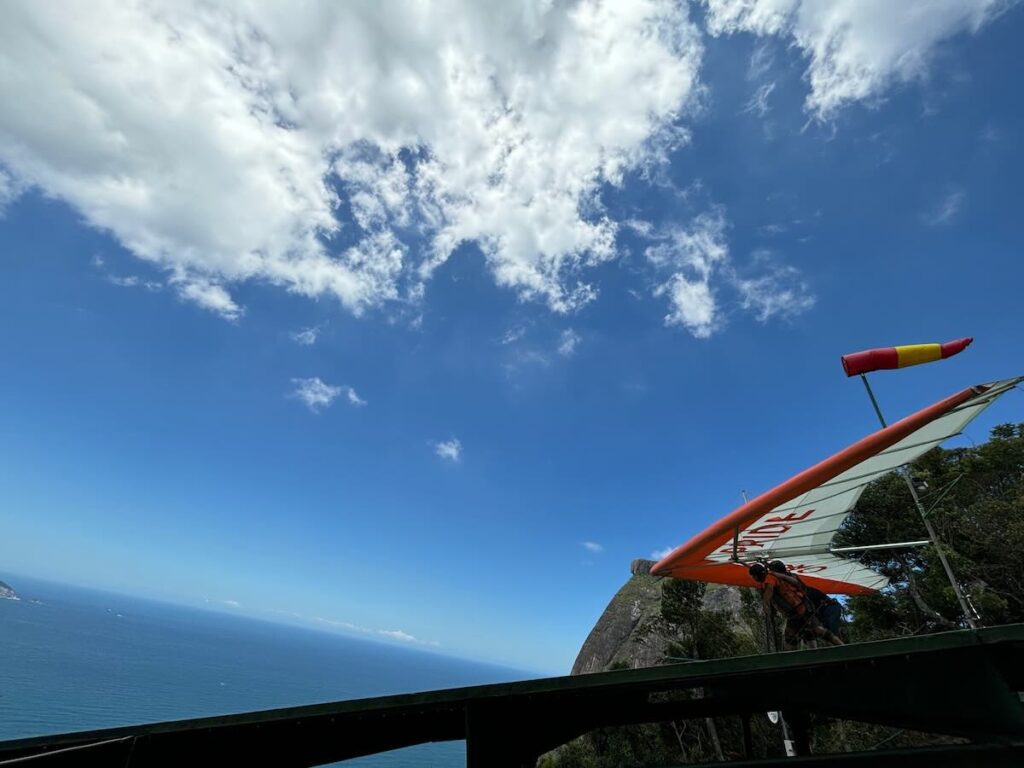
Tandem hang gliding off Pedra Bonita, landing on São Conrado beach. About 10 to 15 minutes in the air, with the city, the forest and the coast all underneath you. This was one of the best things we did in Rio, and you don’t need any experience.
Time half a day including pickup and waiting for the wind • Cost about R$700 to R$900 (£110 to £140)
It’s not cheap, but it’s the one big-ticket activity I’d actually push you towards. Operators usually pick you up from your hotel, drive you to the launch point, and wait for the wind to be right. This is the tandem hang gliding tour I’d book, and the morning slot is the one to go for, afternoons get cancelled more often when the conditions shift.
The actual run off the ramp is the only nervy bit, and it lasts about three steps. The flight itself is calm.
Worth your time if you have an extra day or two
These are the picks that turn a 3-day trip into a 4 or 5-day one. Most are quieter than the headline sights, and a few are the stops we ended up enjoying most. If you only have one extra day, I’d add Vidigal beach plus a Pedra Bonita hike. They cover a side of Rio you don’t get from Copacabana and Ipanema.
Pedra Bonita: the easy hike with a big view

A short, well-signed hike up to the launch ramp where the hang gliders take off. About 40 minutes uphill, not technical, with a view across São Conrado and the coast at the top.
Time 1.5 to 2 hours total • Cost Free
Wear trainers, bring water and a bit of insect repellent. The bugs don’t mess about.
Pedra do Telégrafo for the cliff-hanging photo
The rock that looks like you’re hanging off a sheer cliff, but is actually a low overhang with a long drop behind it. You’ll have seen the photo. The hike is 30 to 40 minutes through coastal scenery, with photographers at the top who’ll help you nail the pose for a small tip.
Time half a day including the drive out • Cost Free, plus tip for the photographer
My Top Tip! Go early. By 10am the queue for the photo spot is 30 to 60 people deep and you’ll be standing in the sun waiting your turn. We arrived at 7:30am and walked straight up.
Pedra do Telégrafo is a long way out of central Rio and the public transport is awkward. If you don’t fancy figuring out the journey, this guided hike with transfers gets you there and back without the faff.
Praia do Vidigal: the locals’ tip for a quieter beach
A small beach tucked between Leblon and São Conrado, technically inside the Vidigal favela community. Calmer water, fewer tourists, and a friendly feel. Three different locals recommended it to us when we were there, which is usually a good sign.
Time half a day • Cost Free, R$10 to R$20 (£1.50 to £3) for a chair
Uber both ways, go in daylight, bring the same beach kit you’d take to Ipanema. It’s not a hidden corner in the secret sense, but it’s a long way from the postcard beaches in feel. For me, it was the best beach day we had.

Pedra do Sal on a Monday night
A small square near the old port, the historic birthplace of samba in Rio, a free open-air street party from Friday through to Monday, starting around 18:00 each night. Live samba, cheap caipirinhas, locals and tourists mixed. Monday is the most famous and the busiest, so get there early if you want a spot on the steps.
Time an evening • Cost Free entry, drinks from R$10 (£1.50)
Uber there and back, leave the watch at the hotel, keep an eye on your phone. The vibe is friendly, but the crowd is dense and pickpockets work the edges. We had a great night, but kept things in our front pockets the whole time.
BipBip in Copacabana for live music
It’s the kind of place you’d walk past without realising. A tiny, scruffy bar a few blocks back from Copacabana beach, known across Rio for its samba and bossa nova jam sessions. Twenty seats, beer from the fridge, and musicians playing inches from your face.
Time an evening • Cost Drinks from R$10 (£1.50)
This is not a polished night out. The owner is famously prickly, the rules are strict (no clapping, no talking over the music) and you go for the music, not the comfort. Behave yourself, and you’ll have one of the most distinctive evenings of the trip.
Largo do Boticário: the rebuilt corner most tourists miss
A small, colourful colonial square tucked into the forest at the foot of Corcovado, abandoned for decades. Five or six pastel-coloured houses around a fountain, with no shops or tourists in sight.
Time 30 to 45 minutes • Cost Free
Easy to combine with a Christ the Redeemer trip, since it’s near the train station. A quiet 20-minute walk-around rather than a destination in itself, but a nice contrast to the bigger sights.
Real Gabinete Português de Leitura library

A 19th-century reading room in central Rio, with floor-to-ceiling carved wood, three storeys of books and an ornate stained-glass ceiling. Often called one of the most beautiful libraries in the world, and it’s free to walk in.
Time 30 to 45 minutes • Cost Free
It’s open Monday to Friday only, 10:00 to 17:00, and closed at weekends and public holidays. Entry is free and you don’t need to book, but queues build, so get there for opening if you want to walk straight in.
Parque da Cidade for sunset just out of the city
A large park on the edge of the city with one of the best wide sunset views looking back over Rio. Quieter than Arpoador, with grass to sit on rather than rocks, and a different angle on the city.
Time 1 to 2 hours • Cost Free
A good no-fuss alternative to Arpoador if you’ve already done that, or if you want something calmer.
Lagoa Rodrigo de Freitas by bike
The lake behind Ipanema, with a flat 7.5km path that loops the whole way around. Mountains on every side, kiosks for drinks, paddle boats on the water. A nice slower stop on a busy itinerary.
Time 1.5 to 2 hours • Cost Bike rental about R$30 (£5) per hour
The Bike Itaú app works for short rides if you can get it set up with a foreign card, otherwise rent from one of the kiosks at the lakeside.
Feira Livre da Glória if you’re in town on a Sunday

A Sunday morning street market in the Glória neighbourhood, popular with locals and largely undiscovered by tourists. We ate and drank very well here, for very little and really enjoyed it. Tropical fruit, fresh juices, hot pastel filled with cheese or beef, and sugarcane juice (caldo de cana) pressed in front of you.
Time 1.5 to 2 hours • Cost Snacks from R$10 (£1.50)
Order a pastel and a caldo de cana from the same stall. The combination is a Brazilian breakfast in itself, costs almost nothing, and is worth planning a Sunday morning around.
If you’ve got more time than that and you’d rather add a second destination than a fourth beach, Foz do Iguaçu is a two-hour flight from Rio. The Brazilian side of Iguazu Falls only needs half a day, so two nights covers it comfortably, and I’ve written up where to stay in Iguazu Falls separately, covering both the Brazilian and Argentinian bases.
Niterói for the views back at Rio
A short ferry across Guanabara Bay to Rio’s neighbour city, with Oscar Niemeyer’s flying-saucer Museum of Contemporary Art and the best view of Rio’s skyline from across the water.
Time half a day • Cost Ferry R$5 (£0.70) each way on the Arariboia line, museum R$20 (£3)
Take the ferry from Praça XV in Centro rather than driving around. The crossing is half the fun, the boat passes Sugarloaf on the way. Two things to get right. There are two landing points, and they suit different plans: Arariboia drops you in the centre a short ride from the art museum, while Charitas at R$7.70 (£1.10) is closer to Niterói’s beaches. And the museum closes on Mondays, opening 10:00 to 18:00 the rest of the week with last entry at 17:30, so don’t make this your Monday.
A simple day-by-day plan for first-timers
This is how I’d order a 5-day first trip, grouping sights by geography so you’re not zigzagging across the city. Build in a slower stop each day. The plan assumes a clear day for Christ the Redeemer, so treat that one as flexible and book it when the weather forecast looks good. The official site charges to move a booking and doesn’t refund, so it’s cheaper to book late than to book early and change.
Day 1: Christ the Redeemer, Parque Lage and Lagoa
Up early for the first tram to Christ the Redeemer at 08:00. Down by late morning, then a 10-minute Uber to Parque Lage for the courtyard, the caves and a coffee. Walk or Uber over to Lagoa for a slow lap on a bike, dinner near Ipanema.
Day 2: Sugarloaf, Urca and Copacabana sunset
Late afternoon at Sugarloaf so you’re up there for golden hour. Earlier in the afternoon, a wander around the Urca neighbourhood at the bottom, which is one of the prettiest and quietest parts of the city. Down by sunset, then dinner and a drink along Copacabana.
Day 3: Santa Teresa, Selarón and Lapa nightlife
Morning at Selarón before the crowds, then up into Santa Teresa for lunch and an afternoon wander. Stay up there for dinner at one of the local restaurants, then drop down into Lapa for the nightlife. Uber both ways.
Day 4: a hike plus an afternoon at Ipanema and Arpoador
Early start for Pedra Bonita or Pedra do Telégrafo, back in town by lunch. Afternoon at Ipanema beach, then walk to Arpoador for the sunset.
Day 5: Little Africa walk, Museum of Tomorrow, Olympic Boulevard mural and the Real Gabinete library
A walking-tour day in Centro and the old port. Start at the Real Gabinete at 10:00, then a Little Africa walking tour through the historic Black neighbourhood that gave Rio its samba. Finish at the Museum of Tomorrow and the Mural das Etnias on the Olympic Boulevard.

Where to stay in Rio: a quick steer for first-timers
Ipanema is my pick for a first visit. It’s a bit smarter than Copacabana, feels calmer, and Arpoador is a short walk away for the sunset.
Copacabana is the cheaper alternative and works well if you book the Posto 6 end near the fort. Leblon is quieter and more residential, better for families and quieter beach days.
Botafogo and Flamengo are the budget answer, though the bay beaches there aren’t for swimming. Santa Teresa is lovely but you’ll Uber everywhere, so save it for a second trip.
I’ve written all of that up properly, with sixteen hotels across the five areas, typical nightly prices and the areas I wouldn’t sleep in, in my full guide to where to stay in Rio de Janeiro.
Getting around and getting in from the airport
Rio is bigger than it looks and the sights are spread out. Uber is the default for most journeys, the metro is useful in a few specific places, and taxis are best avoided unless you have no other option.
Arriving at GIG airport
Most international flights land at Galeão (GIG), about 45 minutes to an hour from the main tourist neighbourhoods. The smaller Santos Dumont (SDU) is for domestic flights and is much closer to Centro and Copacabana.
From GIG, expect roughly:
- Copacabana: R$90 to R$120 (£14 to £19) by Uber, 45 to 60 minutes
- Ipanema: R$100 to R$130 (£16 to £21) by Uber, 50 to 65 minutes
- Santa Teresa: R$90 to R$110 (£14 to £17) by Uber, 40 to 50 minutes
Pre-book an Uber on the airport Wi-Fi before you walk out. Avoid the official taxi desks unless you’re stuck, they often quote two to three times the Uber price.
Getting around the city
Uber is cheap (most rides between sights are R$15 to R$40, £2.50 to £6) and works almost everywhere. Drivers usually have working air conditioning and the in-app cashless payment removes any haggling.
The metro is genuinely useful for one stretch: Centro through Botafogo and into Copacabana, then onwards to Ipanema. If you’re going from Copacabana to the Museum of Tomorrow or to Lapa, the metro is faster than an Uber stuck in traffic.
My Top Tip! If your trip lands on a Sunday or a public holiday, the beachside carriageway closes to cars from about 07:00 to 18:00 and the seafront turns into a pedestrian and cycling lane. It’s the best free thing you can do in Rio. And it isn’t only Copacabana, the same closure covers Vieira Souto in Ipanema and Delfim Moreira in Leblon, so you get one continuous car-free stretch across all three beaches. Locals come out in force, joggers, skaters, families. Rent a bike at any of the beach kiosks and ride the length of it.
What to skip and why
Skip the local buses unless a guide tells you which one to use. They’re cheap, but routes change, signs aren’t tourist-friendly, and the safety reputation isn’t great. The metro and Uber together cover everything you’ll need.

Is Rio safe? An honest, practical take
Rio has a reputation for crime that puts a lot of first-timers off. The honest version: most of what tourists worry about is opportunistic theft, not violence, and a few simple careful habits cut your risk dramatically.
What to actually worry about
Pickpocketing on busy streets, phone-snatching from people walking with their phone in their hand, and bag theft on the beach if you leave things unattended. Violent crime against tourists is rare. The risk that affects most visitors is small-scale, fast, and largely preventable.
Six rules I follow in Rio
- No phone in the hand on the street. Stop, step into a shop or a hotel lobby, then check your map
- No watch, no jewellery. Leave them at the hotel. If you wouldn’t be relaxed losing it, don’t bring it out
- Uber after dark, every time. Even short walks. The cost is trivial
- A small dummy wallet. R$50 to R$100 in cash and an expired card. If something does happen, you have something to hand over
- Two cards in two places. One in the hotel safe, one on you. If one gets lost or skimmed, you’re not stranded
- Trust the locals on neighbourhoods. If a bar tells you to get an Uber rather than walk three blocks, get the Uber. We had that 2 times and appreciated it.
Beach safety in plain English
Don’t leave anything on a towel while you swim, full stop. Either go to the beach with someone who can watch your stuff, take turns with a friend, or use a small dry bag clipped to you in the water. If something does happen, the tourist police (DEAT) have an English-speaking station in Leblon, worth knowing before you need it.
Visa, money and other small stuff (UK travellers)
A few UK-specific bits the bigger Rio guides tend to skip.
Visa for UK passport holders
UK passport holders do not currently need a visa to enter Brazil for tourist stays of up to 90 days. This has changed before and may change again, so check the latest position on gov.uk before you book your flights.
Money, cards and tipping
Cards are widely accepted, including contactless. Bring a card with no foreign transaction fees (Chase, Starling, Revolut and similar) and use it as your default. Carry some cash for small bars, beach vendors and the Sunday market, but you won’t need much.
Tipping is straightforward. Restaurants almost always add a 10% service charge, called ‘serviço’, as a separate line on the bill. It’s legally optional and you can ask for it to be taken off if the service was poor, but locals leave it on and so should you. That 10% is the tip. Don’t add more on top.
Phone, water and a few useful Portuguese phrases
A local SIM or eSIM is worth it for the data. Claro and Vivo both work well, and an eSIM from Airalo or similar avoids the queue at the airport kiosk. I personally always use Airalo eSIM as it’s very simple.
Tap water isn’t drinkable. Bottled or filtered water in restaurants is the norm. Most hotels have a filtered water dispenser somewhere on the floor.
A handful of Portuguese phrases that go a long way:
- Bom dia / Boa tarde / Boa noite: Good morning / afternoon / evening
- Por favor / Obrigado (m) / Obrigada (f): Please / Thank you
- Quanto custa?: How much is it?
- A conta, por favor: The bill, please
- Fala inglês?: Do you speak English?
A genuine attempt at Portuguese, even broken, gets a much warmer response than English first.
FAQs about visiting Rio de Janeiro
Is Rio worth visiting for a long weekend?
Just about. Three full days is enough to cover Christ the Redeemer, Sugarloaf, the beaches and one nightlife evening, but you’ll feel the rush. If a long weekend is all you have and you’re already in South America, yes. If you’re flying from the UK specifically, give it 5 days.
Can I do Christ the Redeemer and Sugarloaf in one day?
Possible, but I wouldn’t recommend it, and less so than usual until the Corcovado access works finish around May 2027. Visitor numbers at the top are capped at half the normal level while that’s going on, so queues are longer than they’d otherwise be. Both deserve a half-day each with a relaxed pace. Spread them across two days if you can.
What should I pack for Rio?
Light layers, a swimsuit, walking shoes, a smaller daypack you don’t mind getting sandy, and a dry bag for the beach. Skip the smart watch, the heavy camera and any visible jewellery. A light rain jacket is useful December through March.
Is the metro safe?
Yes, in daylight and during normal hours it’s fine and well-used by locals. Avoid it late at night, and keep your phone in your pocket on the platform. Uber is so cheap, I recommend you consider that for the majority of trips.
What’s a typical daily budget for Rio?
Roughly £60 to £120 per person per day for a comfortable mid-range trip, covering hotel, food, drinks, Uber and one paid sight per day. Hang gliding, fancy dinners and big tour days push it higher. Hostel and street-food trips bring it lower.
Is Rio good for solo travellers?
Yes, with the same safety habits everyone else should be using. The hostel scene is good, group tours are easy to join, and the city is friendly to people travelling alone. The six rules in the safety section above are the whole answer: phone out of your hand on the street, Uber after dark, nothing on you that you’d hate to lose. Aware, not afraid.
Can I visit Ilha Grande from Rio?
Yes, and plenty of people build it into a Brazil trip, but my recommendation is not as a day trip. It’s around four hours each way, so give it two nights minimum. I’ve written up every route from Rio to Ilha Grande with current fares, boat times and the tourist tax you now pay before you land.






9 Comments
Comments are closed.