
Which reef fish of the Maldives will you actually see, and how do you tell them apart?
I’ve snorkelled two Maldives house reefs for a week each, and the honest answer is that a couple of dozen regulars make up most of what you’ll see. You’ll know those by day two, and from then on every swim is a hunt for the rarer ones.
When you’ve finished reading you’ll be able to name what you saw, know which fish to give room to, and have a printable checklist to tick off in the water.
More of my Maldives guides to help plan your trip
- Maldives seaplane transfer: What it costs and what to expect when you fly
- Best time to visit the Maldives: The months to book and the one I’d avoid
- V Villas Maldives at Mirihi review: One of the best house reefs in the Maldives
- Best house reef in the Maldives: Top quality snorkelling straight from your villa
- Sharks in the Maldives: Which sharks you’ll see and how to find them
Disclaimer: This article may feature affiliate links. If you click these links, and choose to book with that hotel or company, I will earn a small commission at no extra cost to you. I appreciate the support that allows me to continue providing this information.
How many fish are there in the Maldives, and how many will you actually see?
FishBase, the main scientific database of fish, lists 1,126 species as confirmed present in the Maldives. You don’t need to know most of them for a holiday, so my Maldives fish guide sticks to the ones a house reef actually shows you.
I’ve grouped the fish by how they look: the striped ones together, the bright ones, the odd shapes, and the few to be careful around in their own section. Each entry gives you the one thing to look for, where on the reef it lives and how often to expect it.
Scientific names are there so you can look a fish up afterwards. Sharks have their own page, so you’ll find them in my guide to sharks in the Maldives rather than here. If you haven’t booked yet, my guide to the best house reefs in the Maldives will help you pick an island where all of this is on your doorstep.
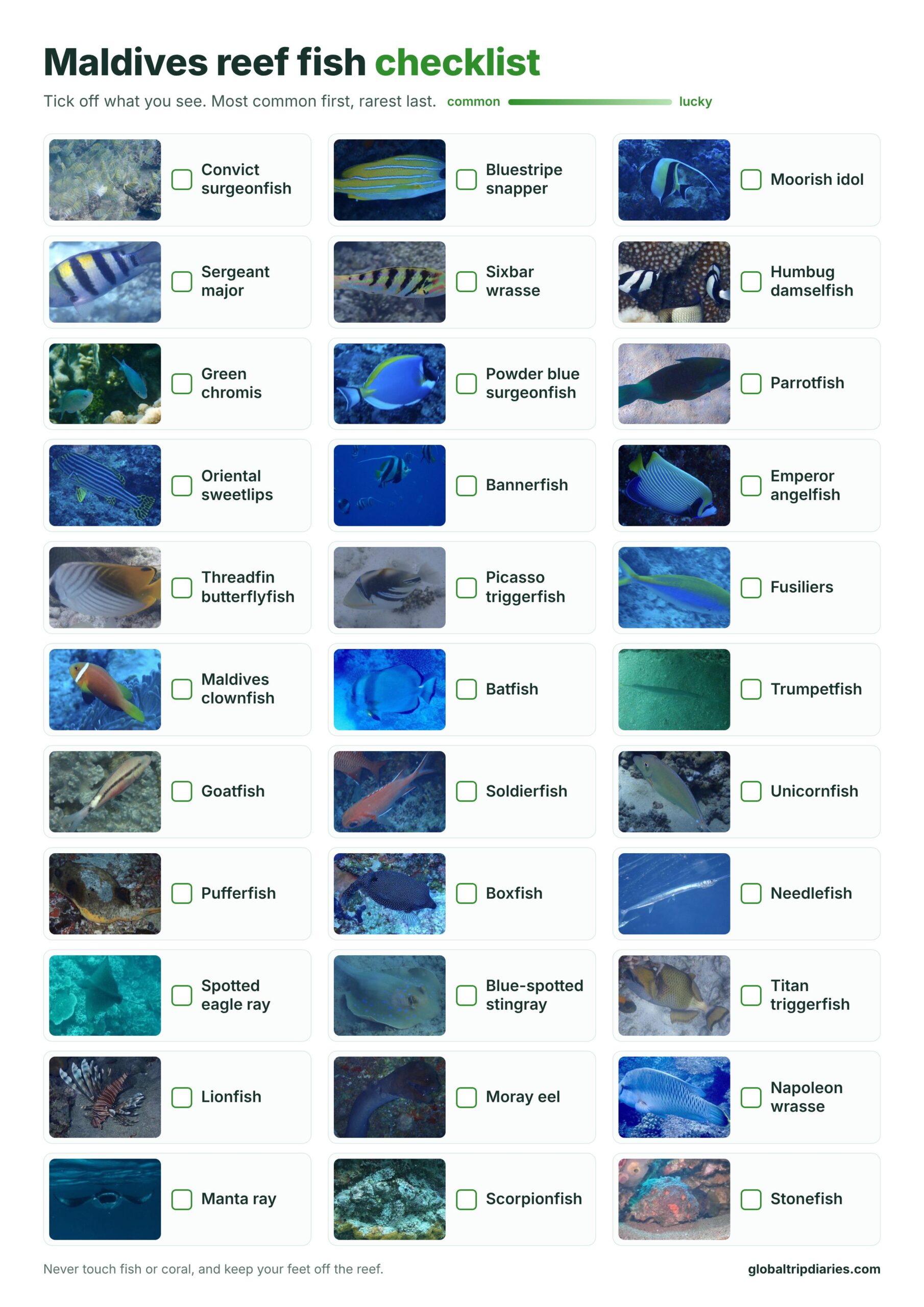
Don’t try to memorise the lot before you fly. Save this page and come back to it when you’re there, or grab my printable checklist and tick them off as you go.
Maldives reef fish checklist
Tap the checklist to open it full size, then screenshot it, or download the PDF by clicking on the green button below to print in high quality.
The fish order is the ones you’ll see on almost every swim down to the ones you’ll be lucky to meet, so the further down the page you tick, the more successful you’ve been.
Striped and patterned fish you’ll see on every snorkel
Convict surgeonfish (Acanthurus triostegus)
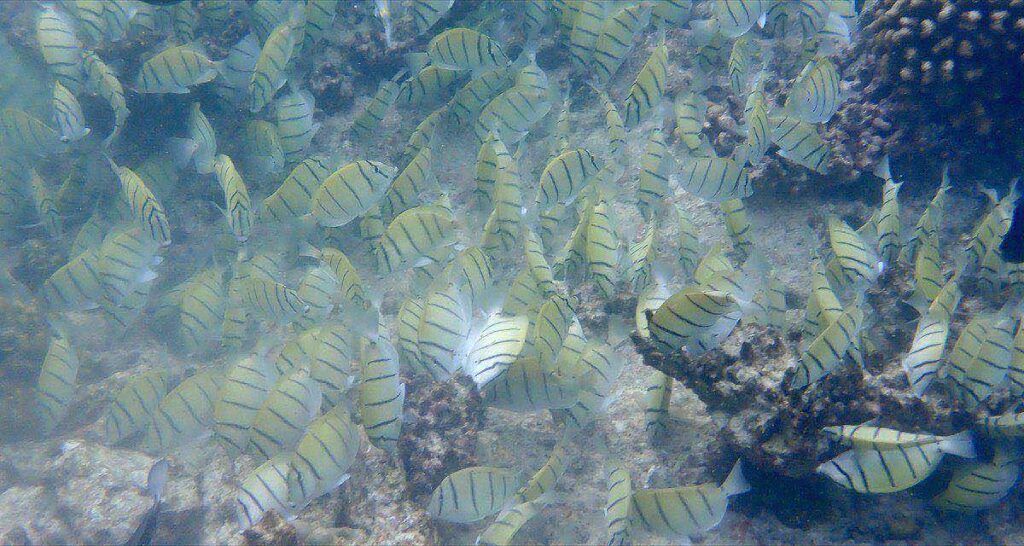
Spot it by the five or six thin black bars down a pale grey body, one of them straight through the eye. They’re small, about 17 cm as adults, and they graze algae in loose groups on the reef flat and the shallow lagoon, so you’ll see them in the first minute of any snorkel. Like all surgeonfish they have a small, sharp spine on each side of the tail base. It’s for defence and you’ll never get near enough to find out, but it’s why you don’t try to touch one. I’ve seen plenty of these in the Maldives.
Bluestripe snapper (Lutjanus kasmira)
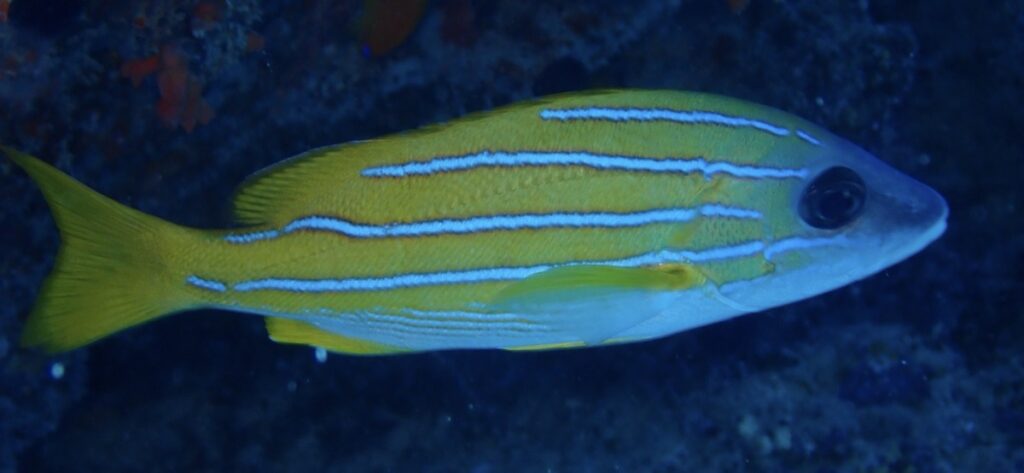
Look for four thin electric-blue lines along a bright yellow body. They hang in tight, stationary schools in daylight, usually packed against a coral head, under a ledge or around a jetty leg, and they barely move as you float over them. About 25 cm long. They’re the yellow wall of fish in so many Maldives snorkelling photos, and the easiest school to find because they don’t go anywhere.
Oriental sweetlips (Plectorhinchus vittatus)
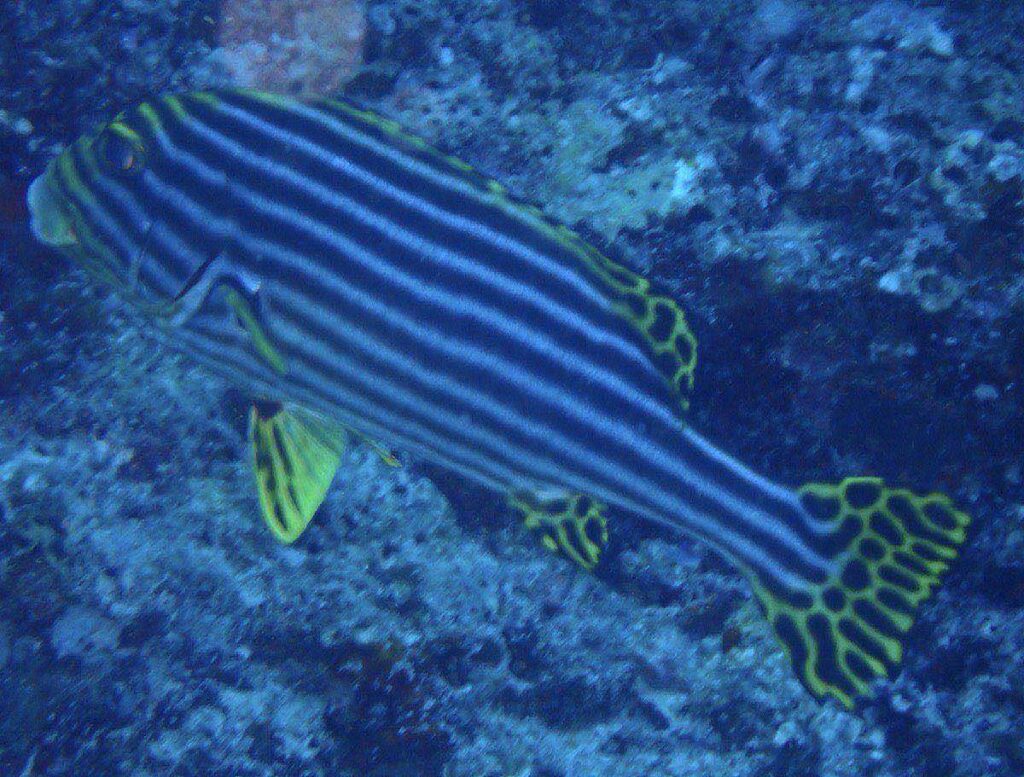
The giveaway is the fat lips, with horizontal black and white stripes and yellow fins. Adults are big, up to 70 cm, and they hover almost still during the day, so they’re easy to get a good look at. At Mirihi, where I stayed at V Villas Maldives, there were several large ones under the end of the jetty every single day, which is as reliable a sighting as I’ve had in the Maldives. Juveniles look like a different fish: dark blotches rather than stripes, and a wobbly swimming style. If you see a small one, it’s the same species and it grows into the stripes. They’re one of my favourites on the reef as the adults are very striking to look at.
Moorish idol (Zanclus cornutus)
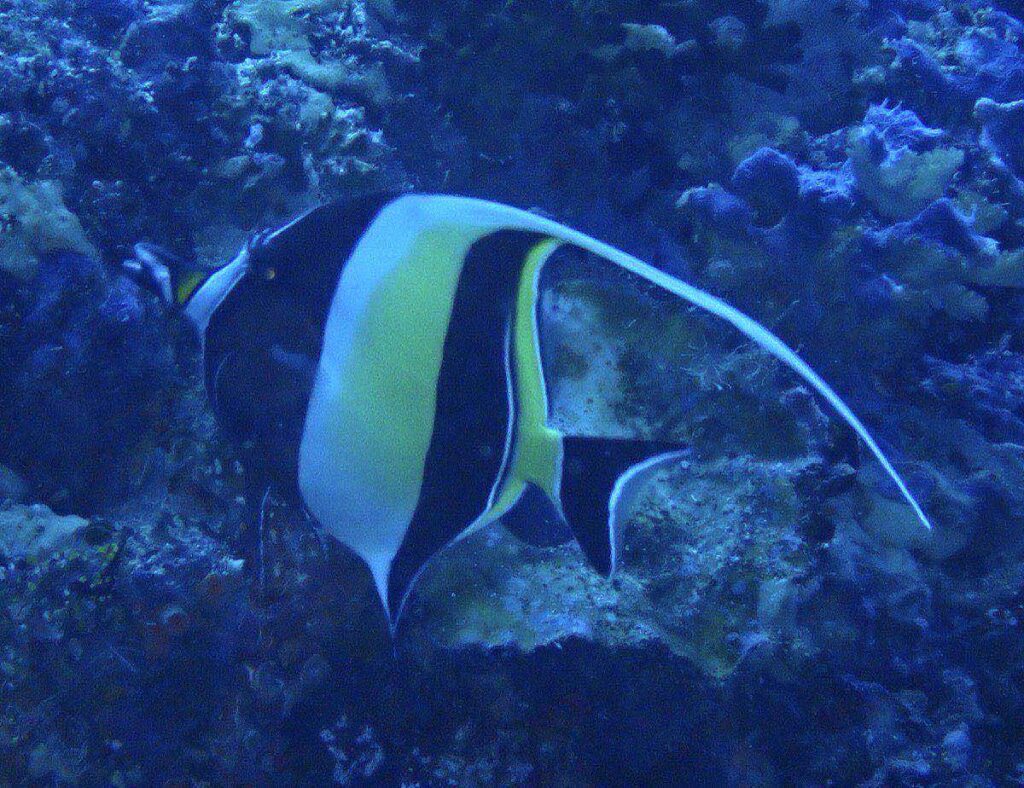
Spot it by the long white sickle-shaped dorsal fin trailing behind, two broad black bars on a white and yellow body, and a yellow saddle across the snout. About 21 cm. They move in twos and threes over the reef flat and the drop-off, and they’re one of the fish people most want to see because of the film. The look-alike is the bannerfish, and the table further down settles it.
Bannerfish (Heniochus species)
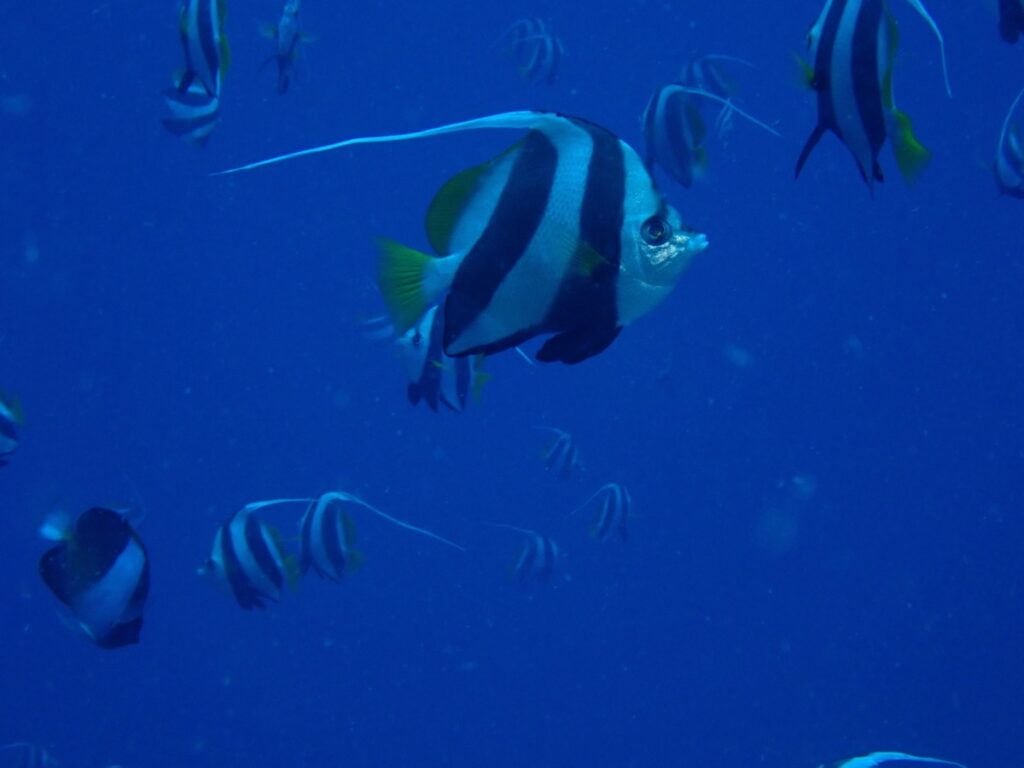
It has the same long white fin as the Moorish idol, but on a body with two black bands on white and a plain yellow tail, no yellow saddle on the nose. The schooling bannerfish gathers in big groups above the reef in current, and the longfin bannerfish is usually in pairs closer to the coral.
Emperor angelfish (Pomacanthus imperator)
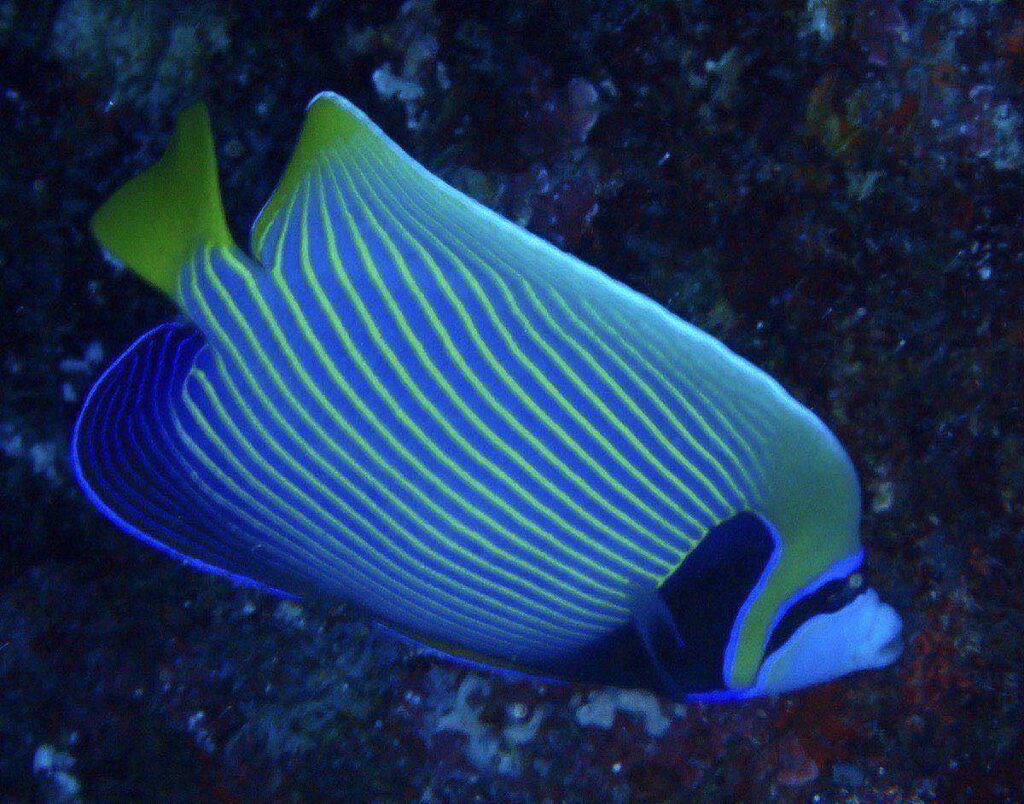
Spot it by the diagonal yellow and blue stripes and the black mask over the eye. Up to 40 cm, usually alone or in a pair, and usually near a ledge or cave on the deeper part of the reef rather than in the shallows. The juvenile looks nothing like the adult. If you see a small dark blue fish covered in white rings, that’s a baby emperor.
Threadfin butterflyfish (Chaetodon auriga)
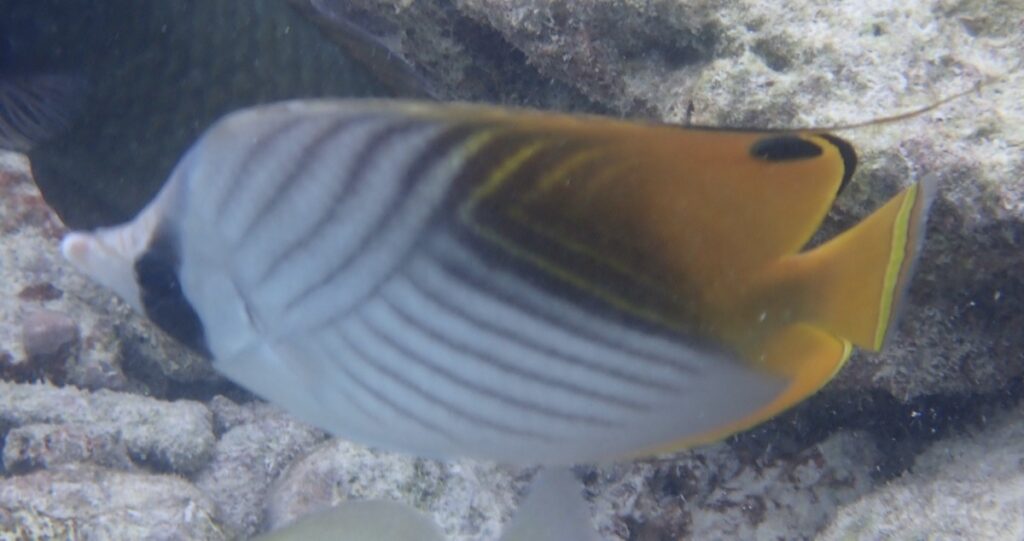
You’ll know it by the white body with a chevron pattern of dark lines, a yellow rear end, a black bar through the eye and a thread trailing off the back fin. About 20 cm. Butterflyfish are the small, flat, neat-looking fish picking at the coral, usually in pairs, and the threadfin is the one you’ll see most. There are many butterflyfish species on a Maldives reef and most of them have a black eye bar, so the chevrons and the thread are what make this one.
Sergeant major (Abudefduf vaigiensis)
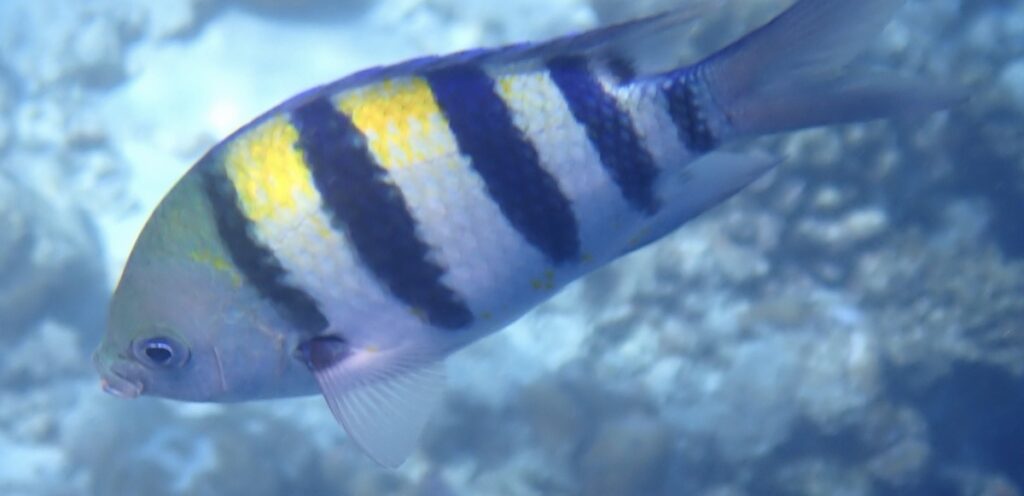
Spot it by the five black bars on a silver body with a yellow wash along the back. Small, about 15 cm, and everywhere. They feed in loose clouds just below the surface, they come to the villa steps, and they’ll come to you. Males guard patches of eggs on the rock and will dart at anything that comes near, including a snorkeller, but they’re far too small to worry about.
Picasso triggerfish (Rhinecanthus aculeatus)
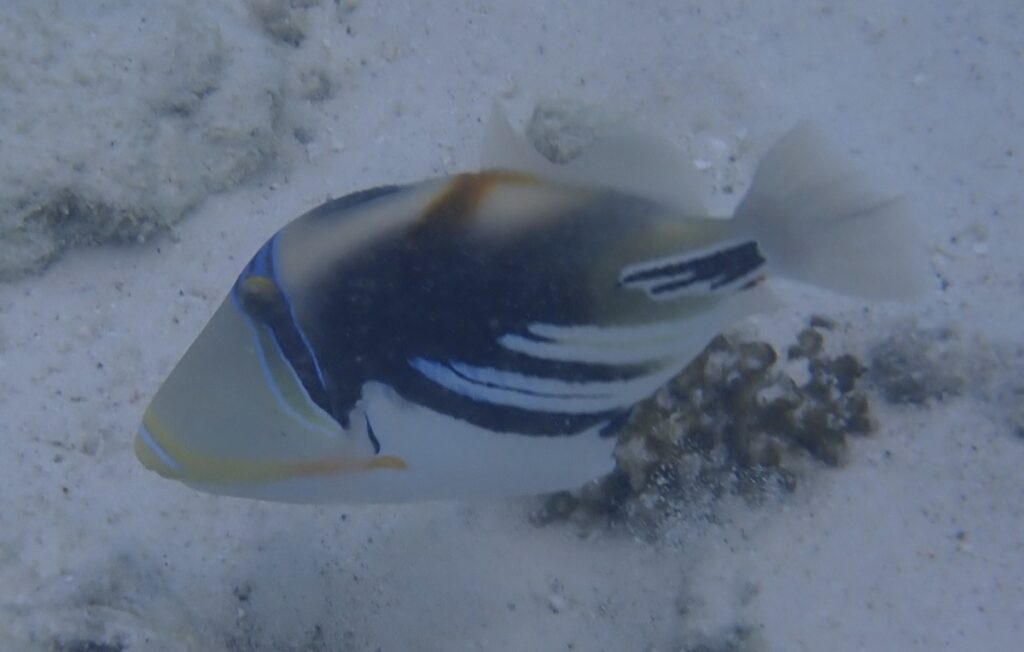
The patchwork of lines and colours gives it the name, on a small fish about 15 cm long. It lives on the sandy, rubbly shallows rather than the coral. It’s shy, it swims off as you approach, and at night it sleeps lying on its side. Despite the name it’s a very different animal from the titan triggerfish further down.
Sixbar wrasse (Thalassoma hardwicke)
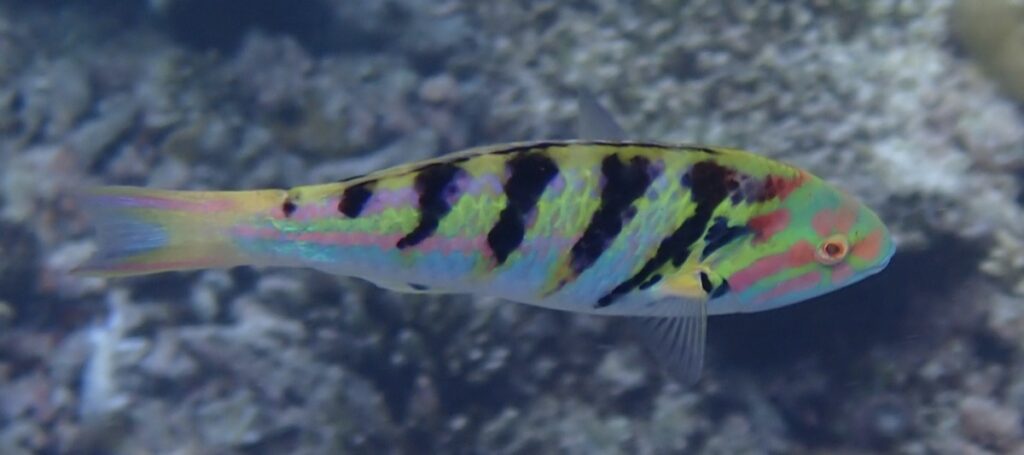
Spot it by the six dark bars on a pale green body, the last two sitting like saddles over the tail, and by the fact that it never stops moving. About 15 cm. Wrasse are the busy little fish zig-zagging over the shallow reef and the lagoon, and this is the one you’ll see most. Big adults have pink lines fanning out from the eye. I’ve seen plenty of them in the Maldives.
Humbug damselfish (Dascyllus aruanus)
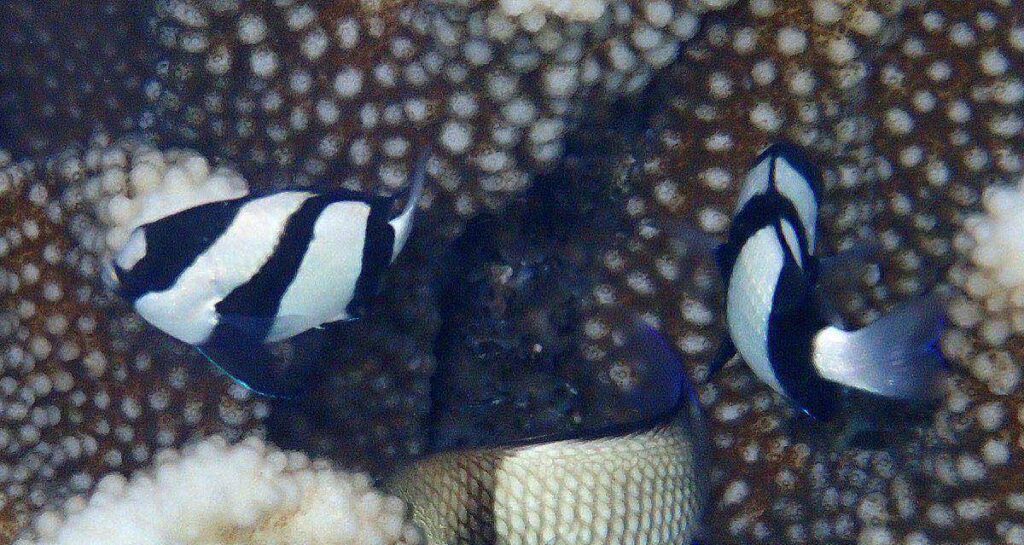
Spot it by the bold black and white bars, three of them, on a tiny fish about 6 cm long. Humbugs hover in a little group over a single branching coral head and drop into the branches the moment you get close, then pop back out once you’ve gone still. The males guard eggs and will chase off other fish many times their size.
Green chromis (Chromis viridis)
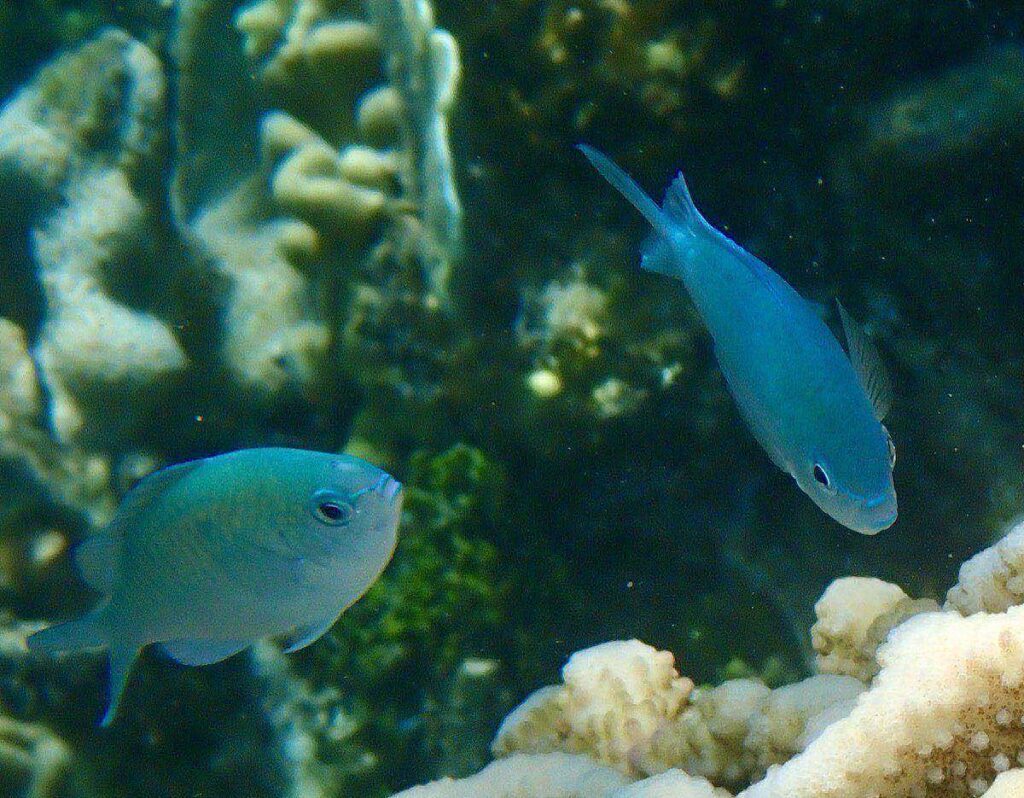
Look for a cloud of tiny pale blue-green fish over branching coral, often dozens of them together. Each one is under 10 cm, and the whole group dives into the coral when you get close, then rises again as one. They’re easy to swim straight past because they’re so small. Once you know to look for them, you’ll find them over lots of the branching coral. I find them really fun to watch dart in and out.
Bright fish
Powder blue surgeonfish (Acanthurus leucosternon)
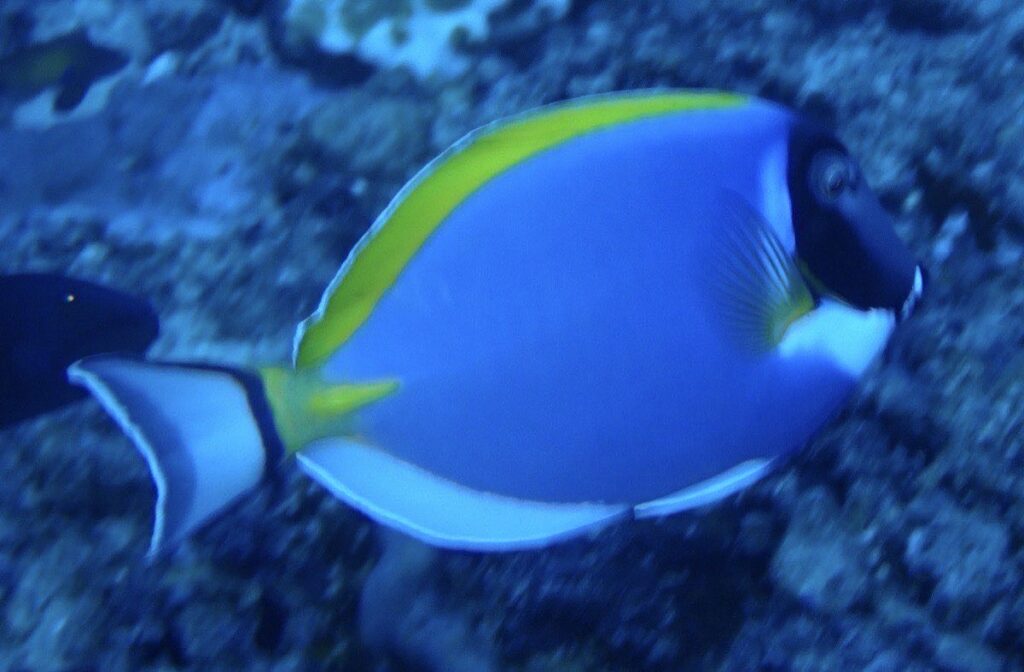
Spot it by the flat powder-blue body, black face, white throat and a yellow fin along the back. About 19 cm. This is the one people call Dory, though the film fish is a different species. It grazes the reef flat and the upper slope, singly or in big feeding groups, and it has the same tail spine as every surgeonfish.
Parrotfish (Scaridae)
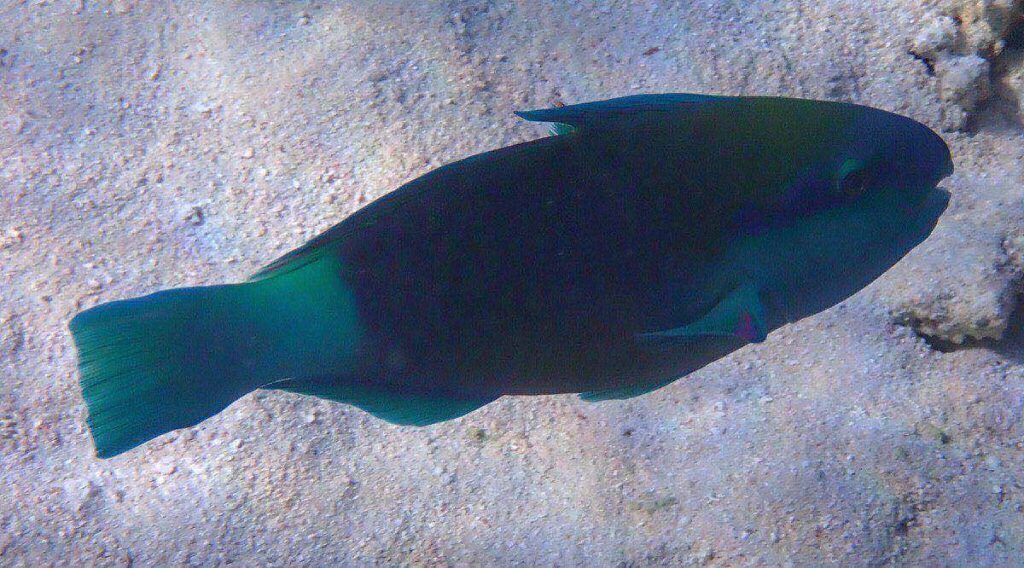
The beak is the giveaway. Parrotfish have fused front teeth that look like a parrot’s bill, and the colours are all over the place, green, blue, pink and brown on the same fish, because they change as they grow. Big ones are 40 cm plus. They graze algae off the coral in daylight and you’ll often hear them before you see them, a crunching sound carrying through the water. All parrotfish are protected by law in the Maldives, and you’ll see plenty of them.
Fusiliers (Caesionidae)
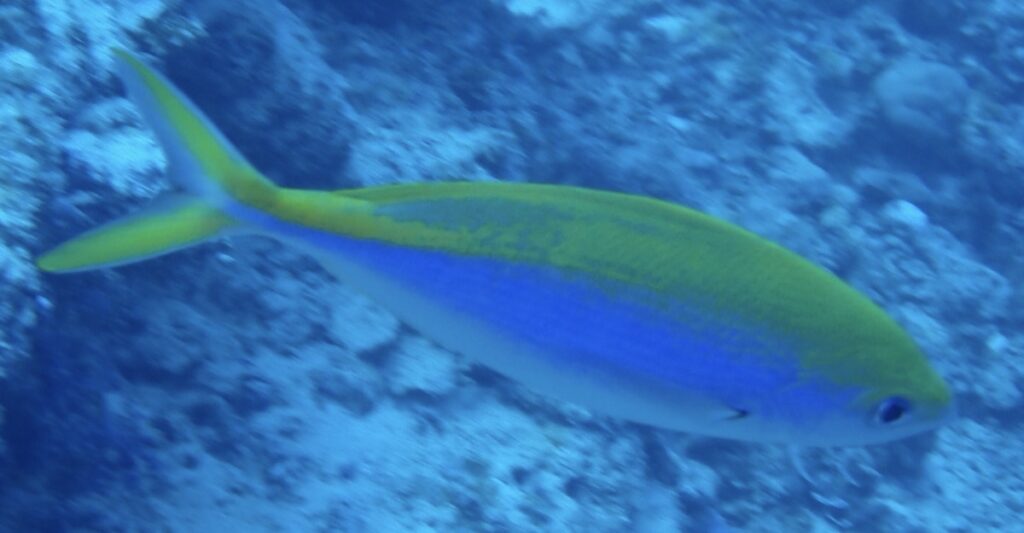
Look for torpedo-shaped blue fish in a fast-moving school in open water off the reef edge, often with a yellow back or tail. About 25 cm each. They feed on plankton in mid-water, so you see them at the drop-off rather than over the coral, streaming past in their hundreds. At Mirihi there were big schools along the drop-off on every swim out from the villa side.
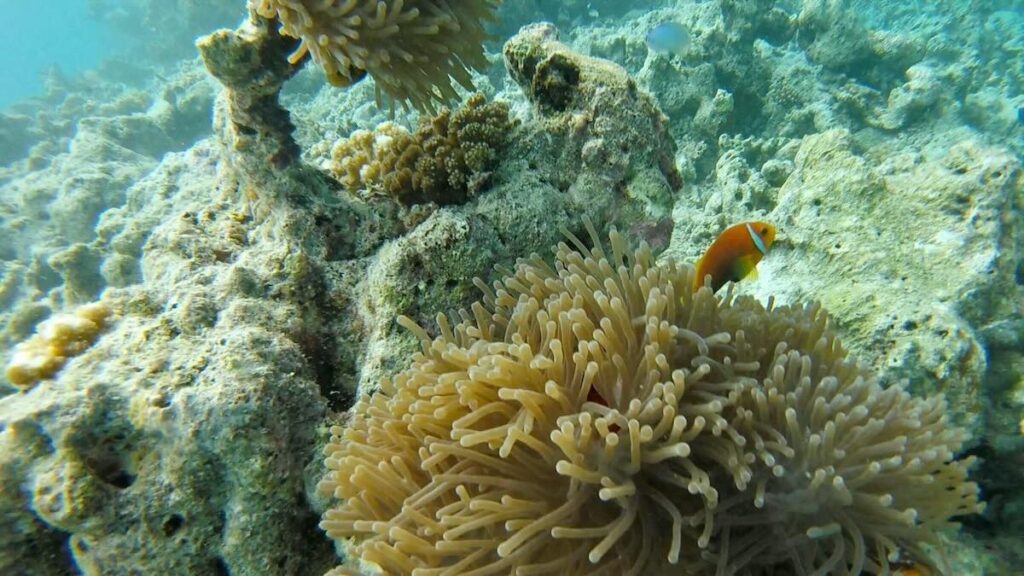
Maldives clownfish (Amphiprion nigripes)
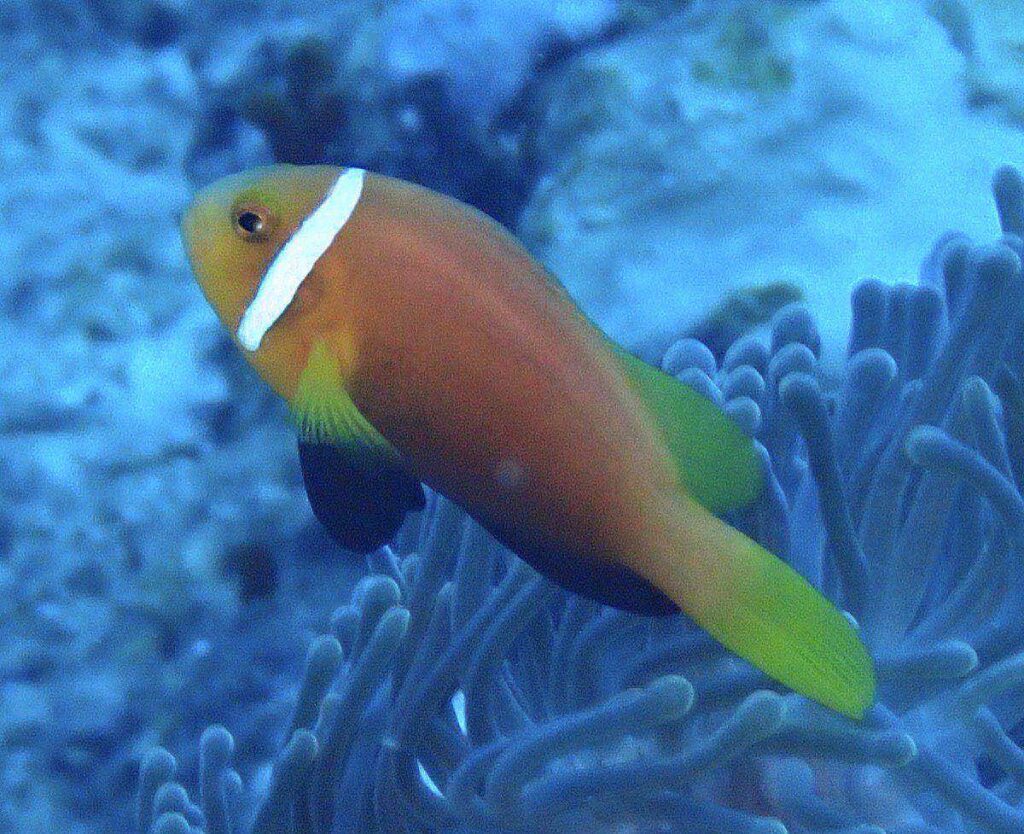
Spot it by the orange body with a single white bar behind the head and black pelvic and anal fins. Up to 11 cm, and it never leaves its anemone. This is the Maldives’ own clownfish, found only here and in Sri Lanka, and it isn’t the Nemo species, which doesn’t live in the Maldives. Look for an anemone on the reef edge and you’ll find a family of them tucked in it. They are one of the easiest to photograph because they stick to their anemone.
Oddly shaped fish that are easy to name
Batfish (Platax species)
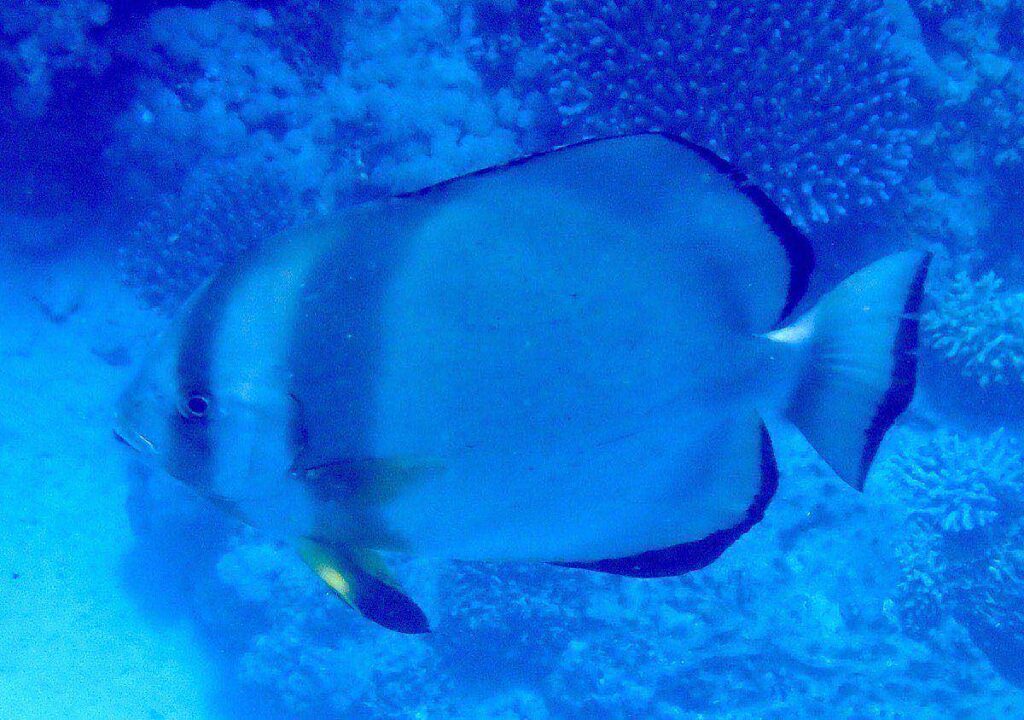
Spot it by the round, flat, silver body deeper than it is long, with a dark bar through the eye and yellow fins. Adults reach 60 cm. They’re curious and slow, they like sheltered water and anything they can hang around, and they come in small groups. At Mirihi the end of the jetty had several big ones under it all week, they were fun to just sit and watch at the end of a big snorkel.
Trumpetfish (Aulostomus chinensis)
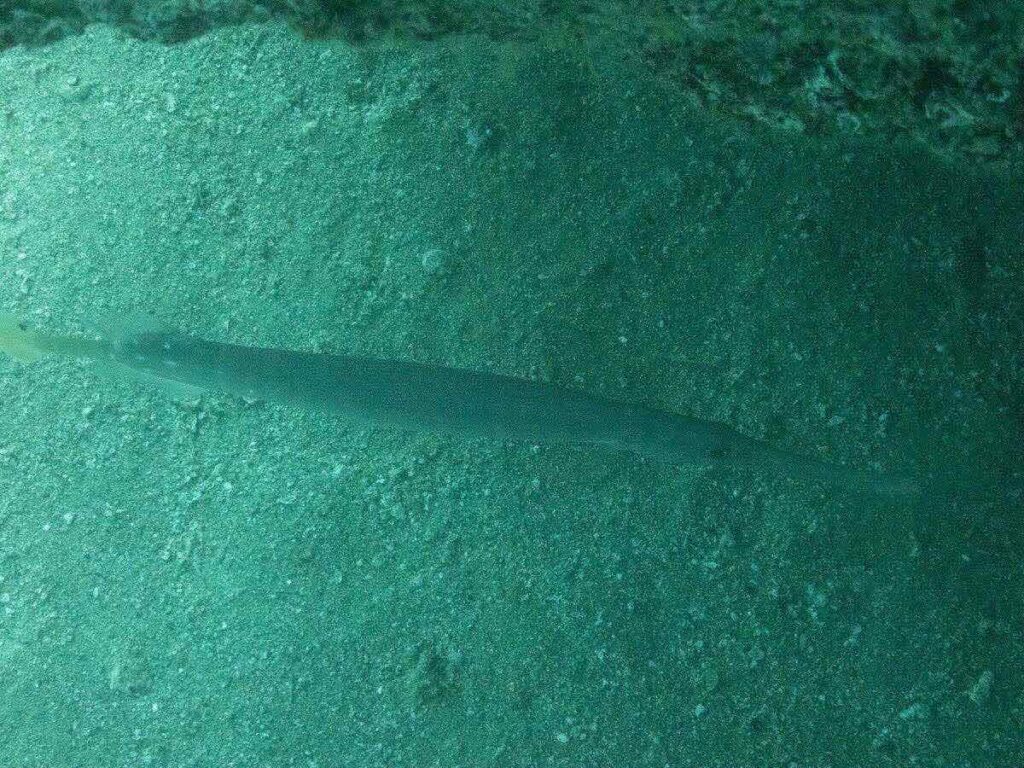
A long thin body, up to 80 cm, with a trumpet-shaped mouth, usually hanging head-down or motionless next to a jetty leg or a coral head. Usually brown, sometimes bright yellow. It hunts by sneaking up on small fish, and it will sometimes ride alongside a bigger fish to get close. One of my daily sightings at Mirihi, hanging next to the jetty legs.
Unicornfish (Naso species)
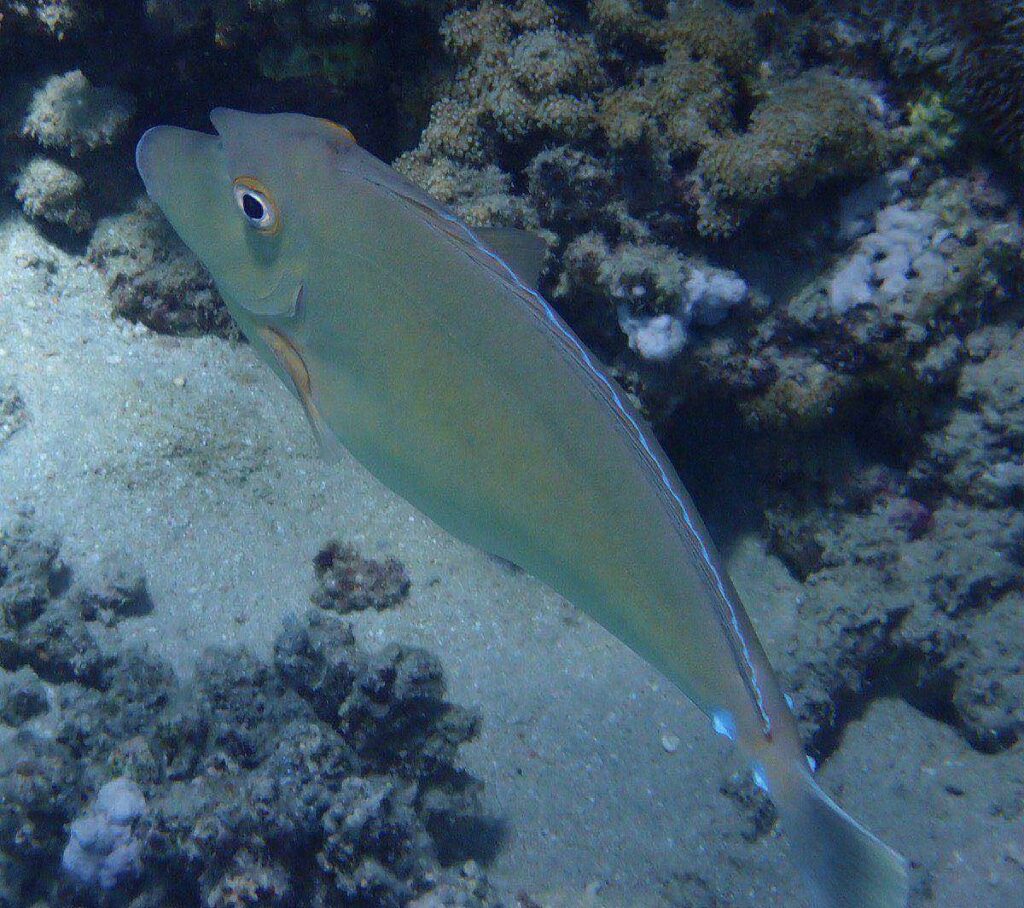
Spot it by the horn on the forehead and the grey body, on a fish shaped like a big surgeonfish. Up to 60 cm. They swim in small groups in mid-water along the drop-off and along the reef edge in current. The horn starts as a bump on young fish and grows with age.
Pufferfish (Arothron species)
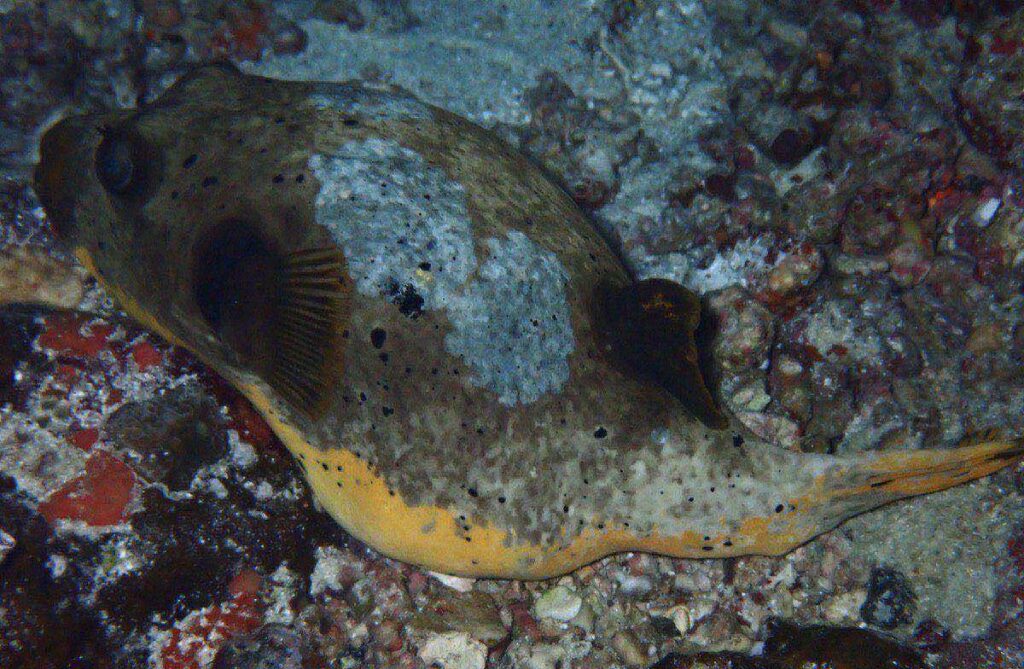
Spot it by the fat, slow body, the beak-like mouth and the big eyes, often with black spots. About 30 cm. They potter about on their own or in pairs over the reef and the sand, and they’re poisonous to eat but harmless to be near. At Machchafushi one came and floated on the bottom step of our bungalow every night after dinner, which is the most reliable fish sighting I’ve ever had.
Boxfish (Ostracion species)
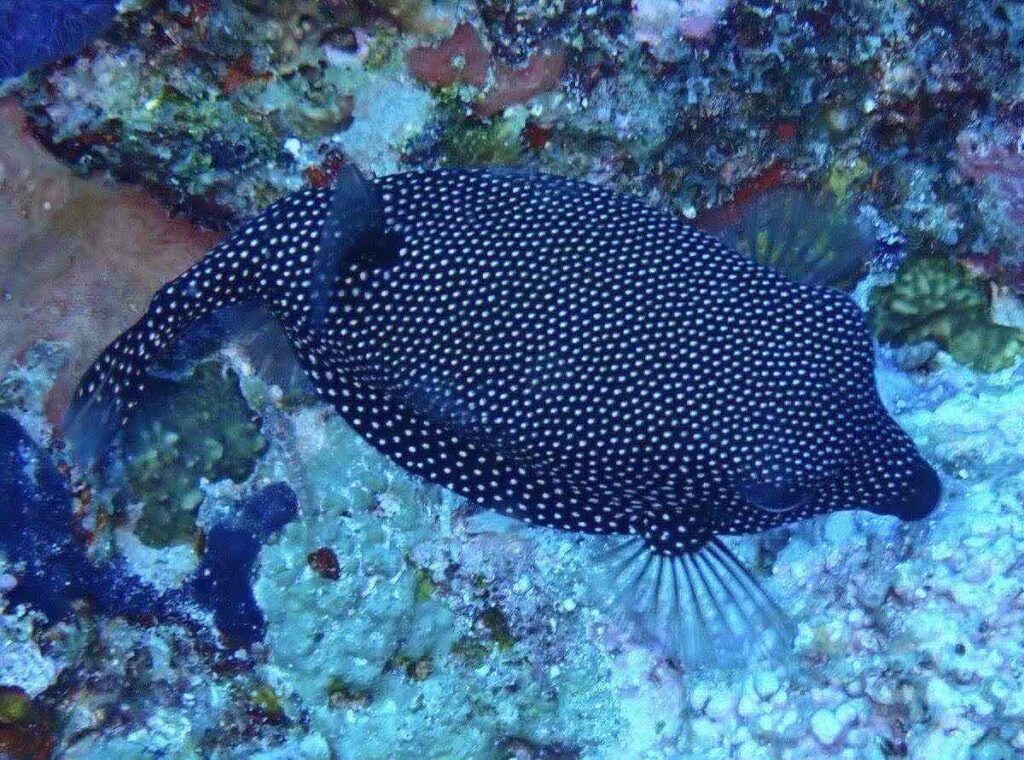
My favourite fish in the Maldives. Look for a small, square, slow fish, built like a box with fins stuck on, moving in little bursts over the reef. The yellow boxfish is bright yellow with black spots when young and a dull mustard as it grows, up to 45 cm but usually much smaller. The spotted boxfish is dark with white spots, and the males have blue sides with orange markings. Both live alone on the reef flat and the slope. They’re not common enough to count on, which is what makes finding one so good.
Goatfish (Mullidae)
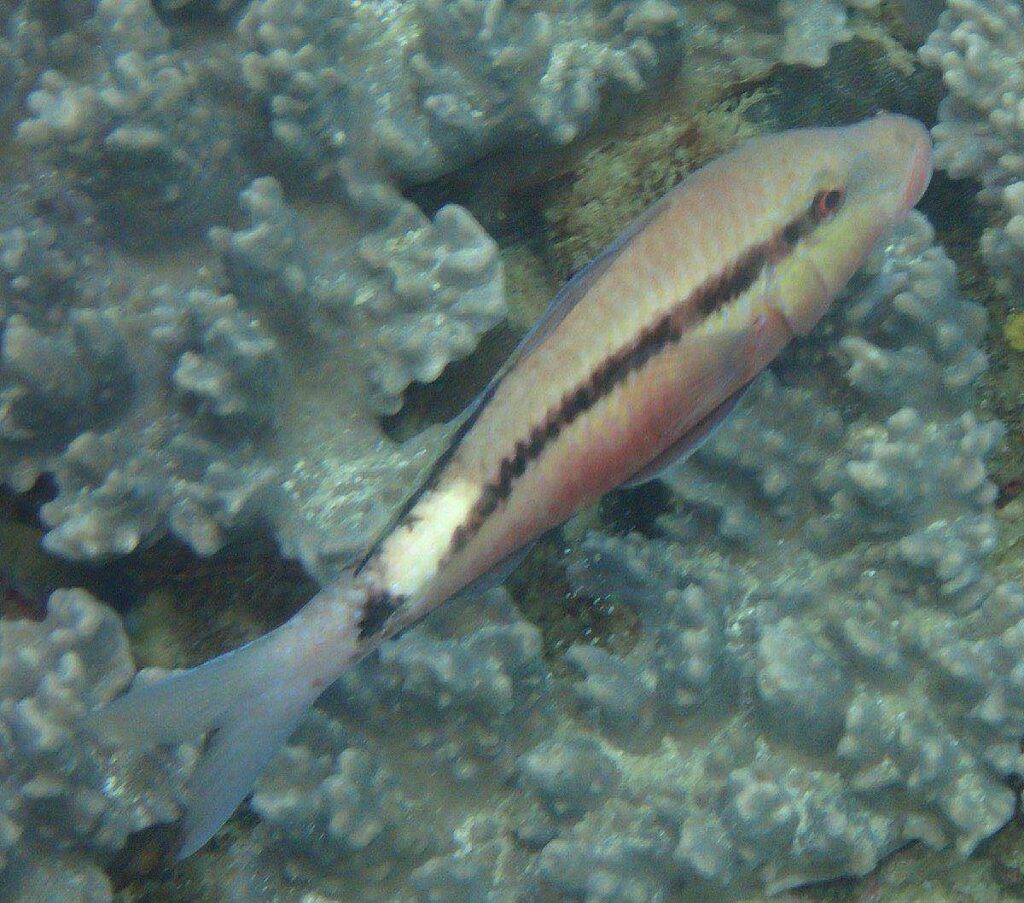
The two whiskers under the chin are the giveaway, and it uses them to dig through the sand for food. About 20 cm, with a dark stripe along the side on the common long-barbel goatfish. You’ll see them on the sand between the villa steps and the reef, nose down, with other fish following them to grab what they stir up.
Napoleon wrasse (Cheilinus undulatus)
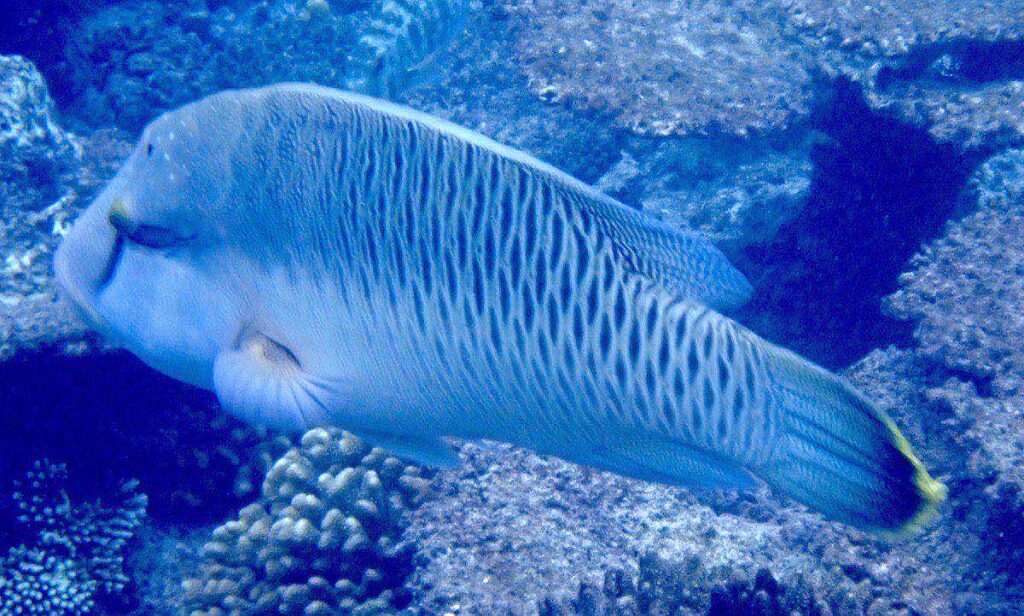
The size and the hump on the forehead tell you. This is the biggest reef fish you could meet, with a thick-lipped face, wavy lines on the cheek and a green body, and adults are over a metre. It’s rare on a house reef and I haven’t seen one in the Maldives, only in Egypt. It’s protected by law here and listed as endangered, so if one does cruise past you, that’s a day to remember.
Soldierfish (Holocentridae)
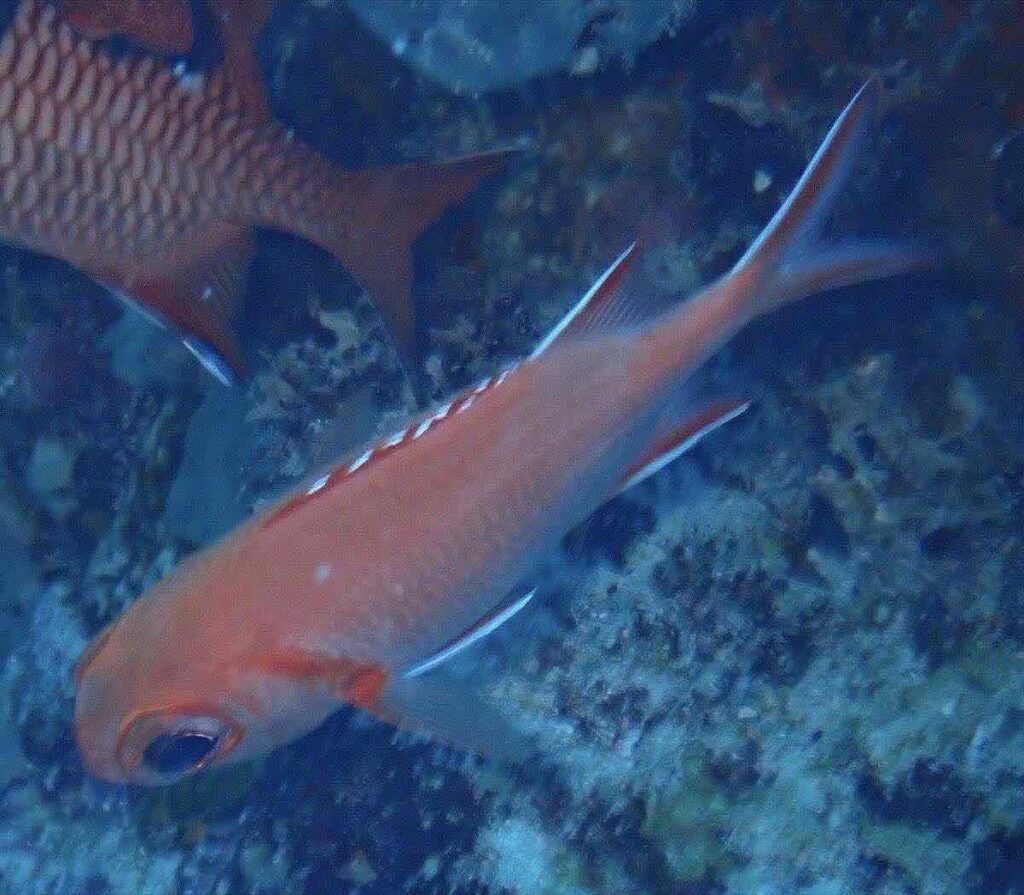
Red, with big dark eyes and white edges on the fins, hanging in the shade under a ledge or in a cave mouth. About 18 cm. They’re night feeders, so by day they sit in groups in the dark bits of the reef and look out at you. Swim along the reef wall and look into every overhang and you’ll find them.
Needlefish (Belonidae)
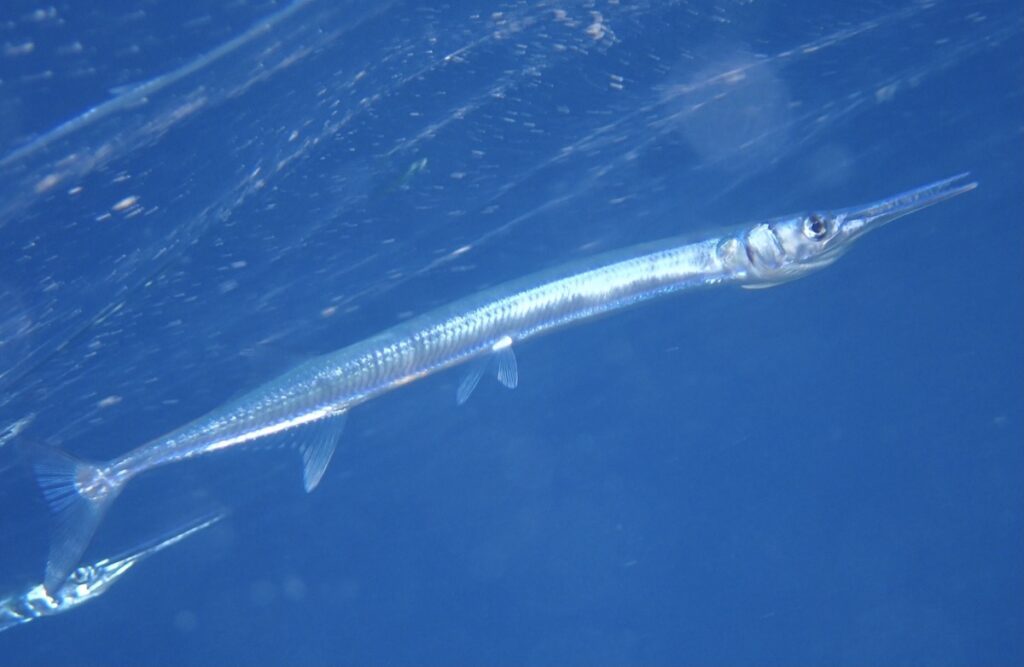
A long silver body and a thin beak, right at the surface, often so close to it that you see it from above before you see it in the water. Most are 30 to 90 cm. They hang motionless in small groups in the shallows, and they’re easy to miss until one moves. The beak is full of sharp teeth and they can leap when startled, especially at lights after dark.
Rays you might see
Rays are cousins of sharks, and three turn up on Maldives reefs. You can hope for two of them on any swim. The third is the one everybody wants, and on a house reef you need a big slice of luck.
Spotted eagle ray (Aetobatus ocellatus)
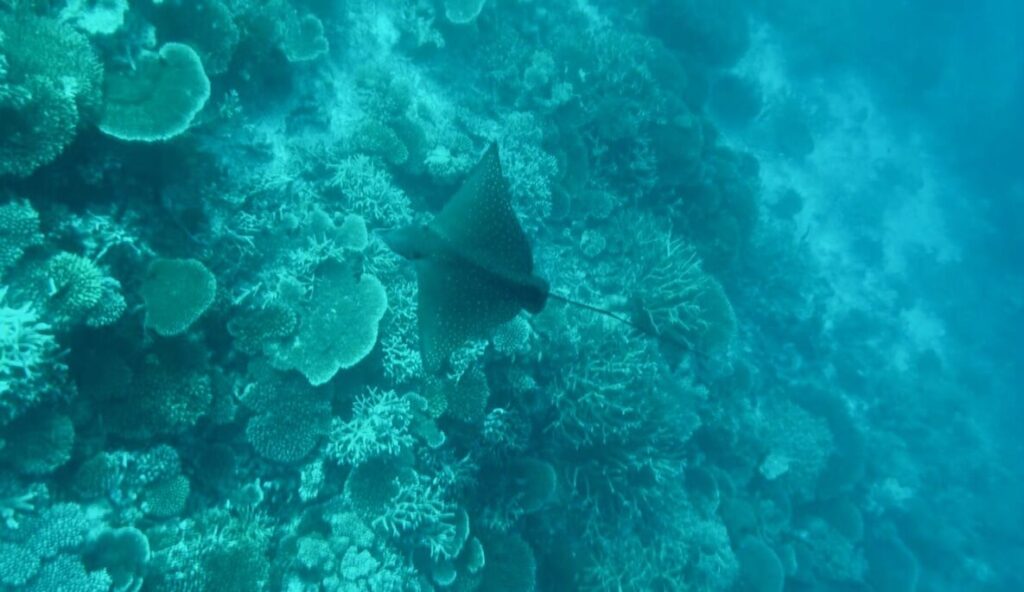
Look for a dark diamond covered in white spots, flying through the water rather than swimming, with a long thin tail trailing behind. They’re big, commonly about 1.8 m across, and they glide along the reef edge and over the sand looking for shellfish. On my last snorkel at Mirihi, six of them came past on the same swim. They’re listed as endangered, so every one is worth stopping for.
Blue-spotted stingray (Taeniura lymma)
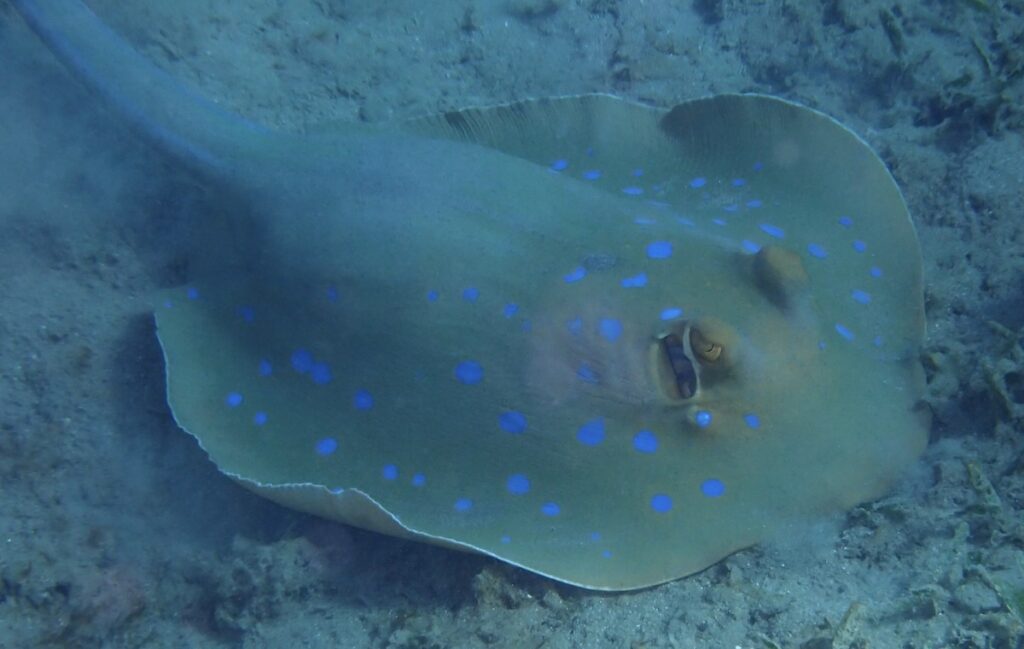
Spot it by the bright blue spots on a brown or olive oval body, with blue stripes down the tail. It’s small, about 35 cm across. They move onto the shallow sand to feed as the tide comes in, then shelter in caves and under ledges as it drops. At Machchafushi we saw them under our bungalow several times. The tail has a venomous spine, and stings happen to people who step on one in the shallows, so keep your fins on and stay off the sand.
Manta ray (Mobula alfredi)
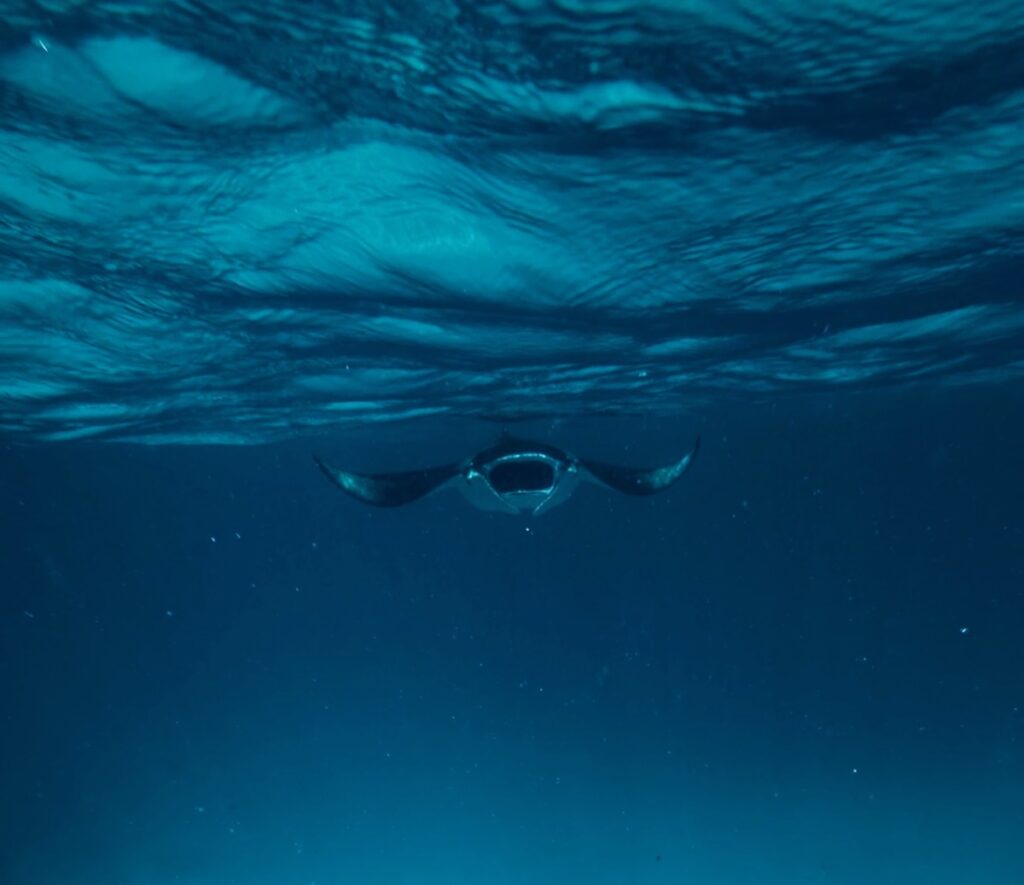
You’ll know it by the size: a huge dark diamond that can be well over 4 m across, with two curled flaps at the front of its head. It feeds on plankton and is completely harmless, and the Maldives is one of the places in the world where they gather. One came past me on the Mirihi house reef, which the dive shop said is rare. The reliable way to see one is a boat trip to a cleaning station, a spot on the reef where small fish pick the mantas clean. Ours found them at all four stations it tried. Mantas are seasonal, which my guide to the best time to visit the Maldives covers.
Fish to give space to
A handful of reef fish can hurt you if you touch them, stand on them or crowd them. None of them is interested in you, so this comes down to knowing what they look like and being sensible. The one rule for the whole reef is simple: don’t touch anything, fish or coral, ever.
Titan triggerfish (Balistoides viridescens)
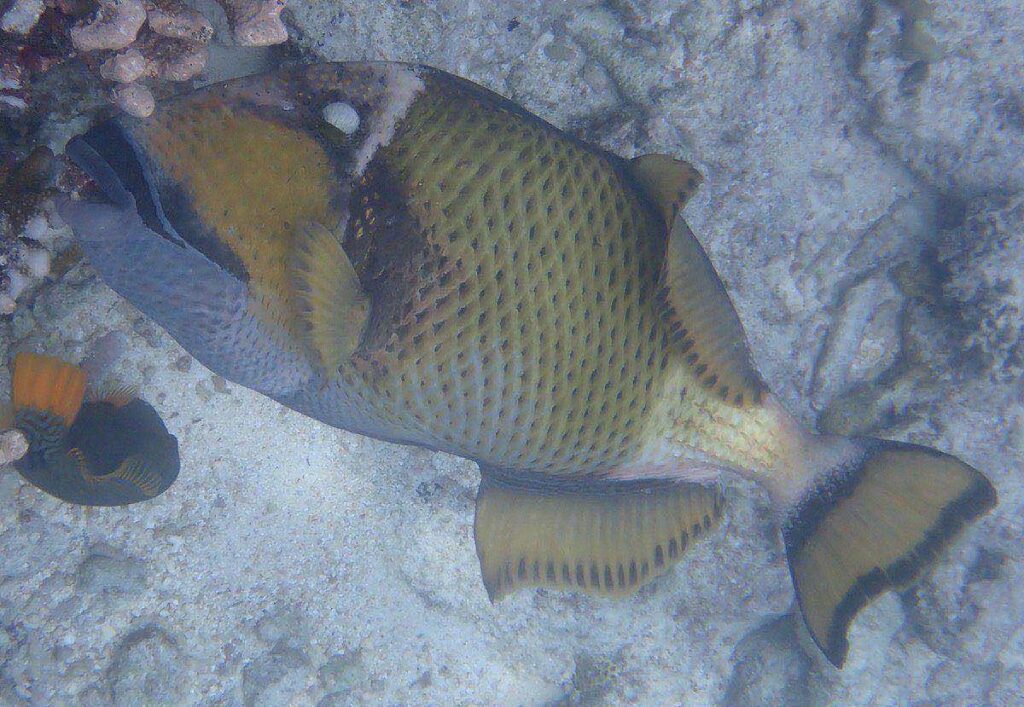
Spot it by the size. At up to 75 cm it’s by far the biggest triggerfish you’ll meet, a deep, thick-bodied fish with heavy lips that moves by rippling its top and bottom fins rather than its tail. Most of the time it ignores you. I’ve swum past plenty that carried on eating and never gave me a look. The exception is a female guarding a nest, usually a patch of sand in the shallows, who treats the water above it as hers and can charge anything that enters, snorkellers included. She gives a warning first: the big spine on top of her head, the trigger, goes up, and she turns to face you. If you see that, move off sideways and away, not up, because the nest territory widens towards the surface.
Lionfish (Pterois miles)
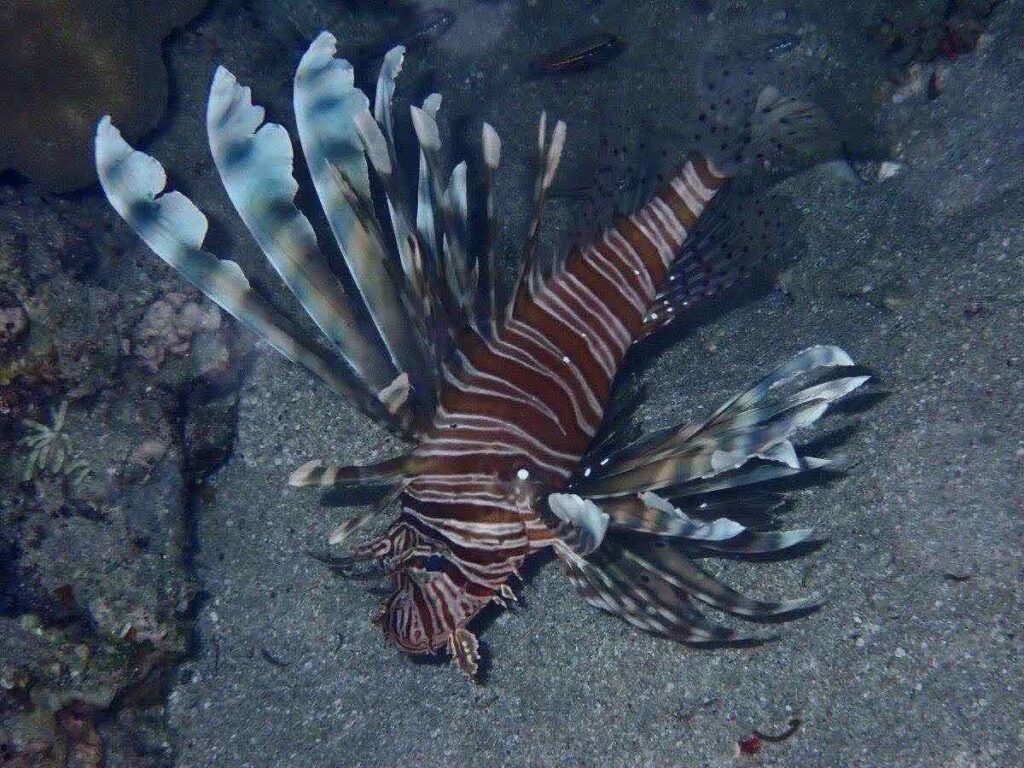
You’ll know it by the fan of long striped fins and the brown and white bars. Up to 40 cm. It hides under ledges and in holes by day and drifts out at dusk, and it never chases anyone. The spines are highly venomous and the sting is extremely painful, so the rule is simple: look, don’t reach into holes, and don’t try to shoo it. I haven’t come across one in the Maldives, only in the Red Sea.
Scorpionfish (Scorpaenidae)
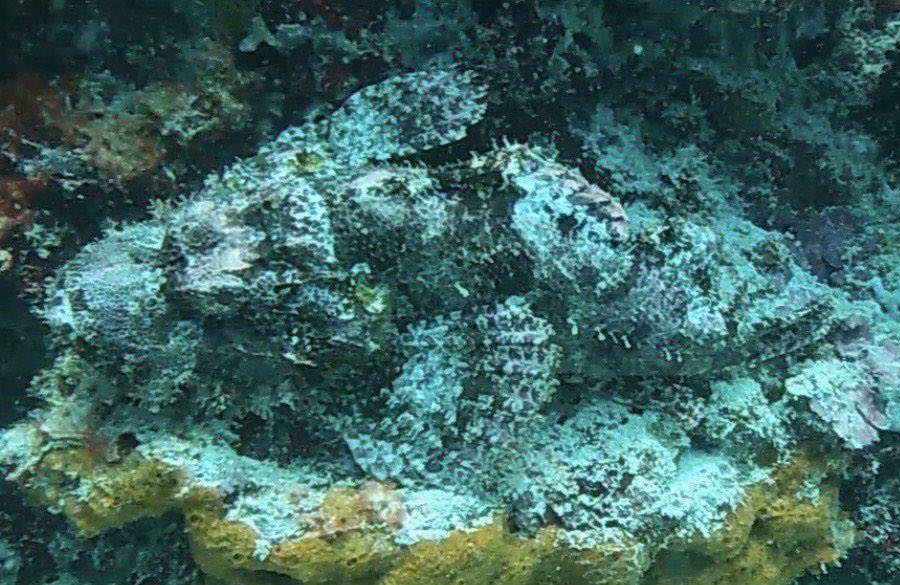
Look for a lumpy, mottled fish sitting dead still on the coral or rock, with a big head, a frilly mouth and colours that match whatever it’s lying on. About 30 cm. The spines along its back are venomous and the sting is painful, but it only happens to people who touch or stand on one, and it isn’t moving anywhere. Finding one is a proper achievement because the camouflage is that good. I’ve seen one in the Red Sea and never yet in the Maldives.
Stonefish (Synanceia verrucosa)
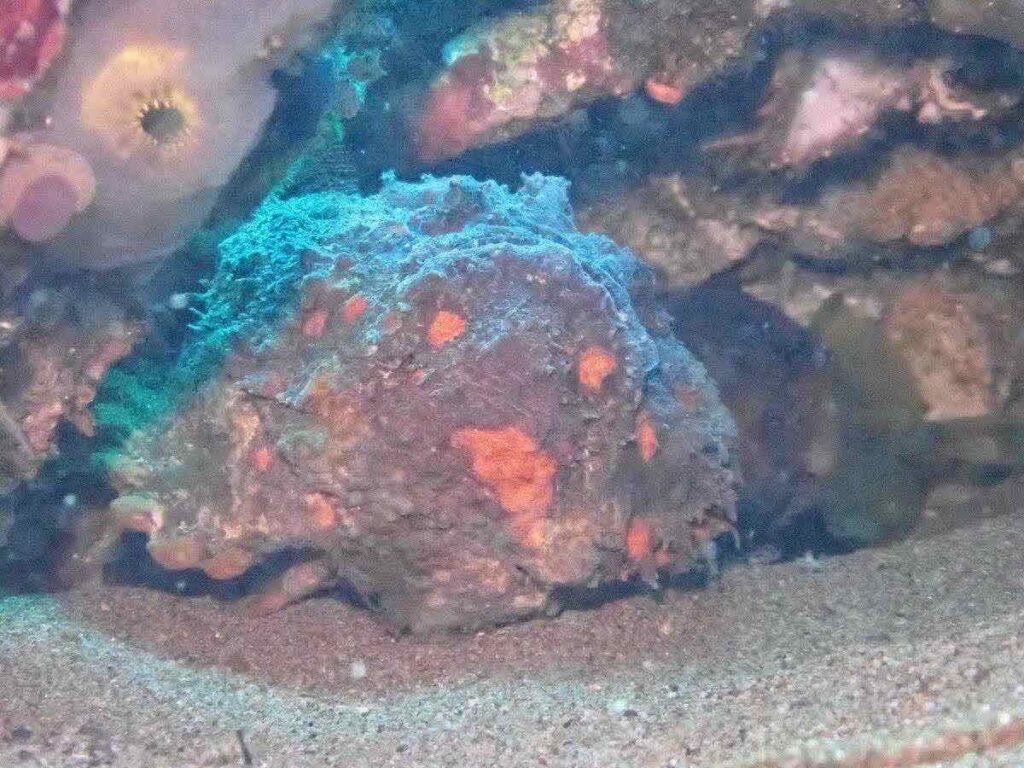
A relative of the scorpionfish and the one to take seriously. It looks like a stone, which is the whole problem, and it sits on sand and rubble in the shallows and on reef flats, sometimes half buried, sometimes with algae growing on it. About 27 cm. Its spines carry the most dangerous venom on this list, the sting can be fatal, and it happens to people who stand on one. Fins on, never put a foot down on the reef or in the shallows, and never put a hand on a rock. Do that and you won’t have a problem. I’ve never seen one myself.
Moray eel (Gymnothorax species)
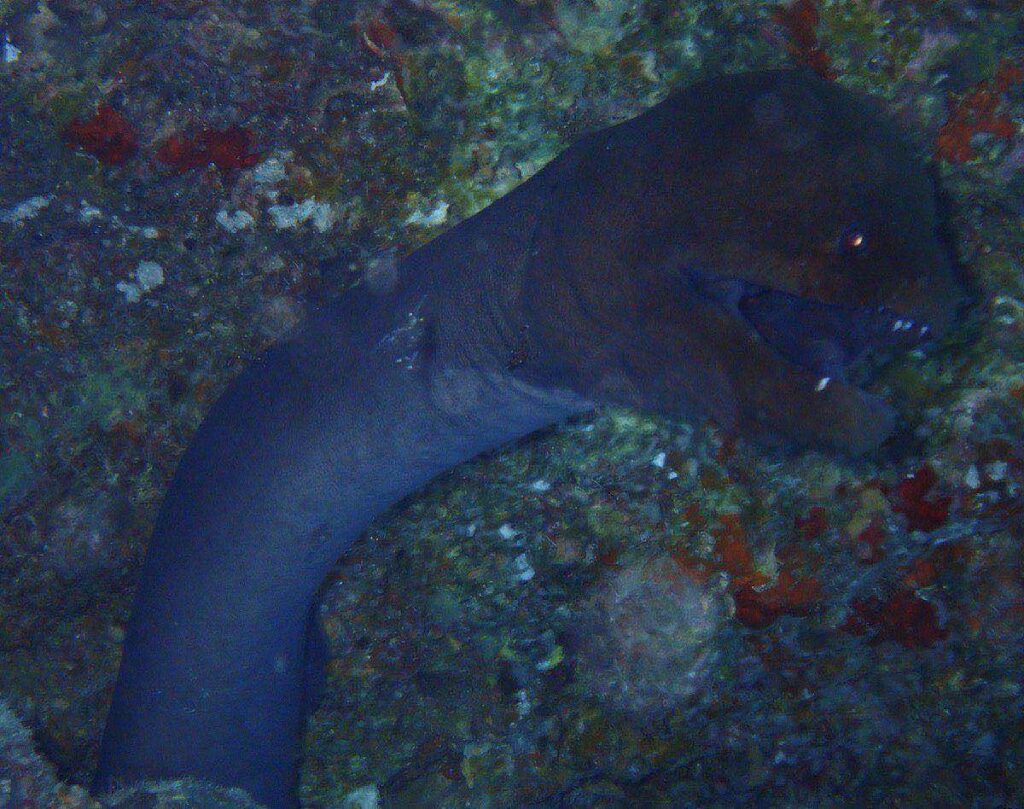
Look for a head poking out of a hole in the reef wall, mouth opening and closing. That’s breathing, not a threat. Giant morays reach 3 m but you’ll only ever see the front half. They stay in their hole by day and bite only if something goes in after them, so keep hands out of holes and you’re fine. The one I saw at Machchafushi was exactly that, a head in the reef wall.
If you get stung or cut
Get out of the water and tell the resort straight away. On a remote island the resort is your medical help, so don’t try to tough it out in the villa. While you wait, rinse the area with seawater, not fresh water, and if a spine is visible, lift it out with tweezers.
Hot water is the first aid for fish stings: soak the area in water as hot as you can comfortably stand, around 45°C, for up to 90 minutes, which breaks down the venom and takes the pain off. Any breathing difficulty, swelling spreading beyond the sting, or a stonefish sting at all, means hospital, and the resort will arrange that.
Fish that look alike: how to tell them apart
| Pair | The mark that settles it | Which you’ll see more |
|---|---|---|
| Moorish idol vs bannerfish | Yellow saddle across the nose means Moorish idol; a crowd of them means bannerfish | Both, most days |
| Powder blue surgeonfish vs Dory | Powder blue has a black face and yellow back fin; the film fish is a different species that doesn’t live in the Maldives | Powder blue |
| Juvenile vs adult sweetlips | Blotches and a wobbly swim means juvenile; clean stripes and fat lips means adult | Adults |
| Lionfish vs scorpionfish | Long fanned fins means lionfish; a lump you nearly didn’t notice means scorpionfish | Lionfish, if you look under ledges |
| Sergeant major vs convict surgeonfish | Yellow back and silver body means sergeant; grey body with a bar through the eye means convict | Both, every swim |
Where to look on a house reef, and when
Most house reefs follow the same pattern, so once you know the zones you can go looking for particular fish.
Under the jetty
Fish gather around anything that gives shade and shelter, and on most islands the jetty is the biggest structure in the water. Walk to the end and look down before you get in anywhere. Batfish, sweetlips, trumpetfish and schools of smaller fish like to hang around the legs, and at Mirihi I saw all of them there every day without swimming a stroke. If you or someone with you isn’t a confident swimmer, start here.
Off the villa steps
At some resorts the reef sits right under the water villas, and at others the villas sit over sand and you reach the reef from the beach or a jetty. My guide to the best house reefs in the Maldives tells you which is which. If your coral starts at the bottom step, you’ll have fish there from the first morning, and sitting on the steps with your feet in is a snorkel without the snorkel. At Machchafushi turtles and rays passed under our bungalow, and a pufferfish visited the step every night.
The reef edge and the drop-off
This is where the big schools are. Fusiliers, snapper and surgeonfish stream along the edge where the reef drops into the blue, and rays, sharks and turtles cruise the same line. On many islands the swim out to the drop crosses a shallow reef flat that becomes too shallow at low tide, so ask for the resort’s tide chart and plan your swims around it. Mirihi was exactly like that, and the full layout is in my V Villas Maldives review.
Late afternoon and after dark
The reef changes late in the day. Lionfish come out, soldierfish start to feed, triggerfish settle down to sleep on their sides, and anything with a light over it draws a crowd. If your resort has an overwater restaurant or bar lit from below, look over the edge after dinner. At Mirihi the sharks and fish gathered under it every night. Night snorkelling itself is a guided trip, not something to do alone off the villa.
Protected reef fish in the Maldives
Maldives law protects all parrotfish and the Napoleon wrasse, which means they can’t be caught, kept or sold. For you as a snorkeller that changes nothing in the water, since you weren’t going to touch them anyway, but it’s why there are so many parrotfish on every reef, and it’s worth knowing before someone offers you one on a menu or at a market.
What else you’ll see that isn’t a reef fish
Blacktip and whitetip reef sharks are common, and nurse sharks are easy to spot if you know where to look. They’re all covered in my guide to sharks in the Maldives. I’ve also been lucky enough to see hawksbill turtles often in the Maldives.
Reef fish of the Maldives FAQ
What is the most dangerous fish in the Maldives?
The stonefish. It looks like a rock, sits still on sand and rubble in the shallows, and its sting can be fatal, but only to someone who stands on or grabs one. Keep your fins on and your feet off the reef and you won’t have a problem. The other fish worth knowing about are in the section on fish to give space to.
Will fish bite you while snorkelling?
Almost never. The one reef fish likely to come at a snorkeller is a titan triggerfish guarding its nest, and it warns you first by raising the spine on its head. Sergeant majors guarding eggs may dart at you, but just make sure you give them distance. Moray eels can bite but normally only people getting too close, or putting their hands into their hole.
Can you see Nemo in the Maldives?
Not the film’s species, but you’ll see its local cousin. The Maldives clownfish is orange with a single white bar behind the head and black fins, and it’s found only in the Maldives and Sri Lanka. Look for a big anemone on the reef edge and there’ll usually be a family living in it.
Is the coral in the Maldives still worth seeing?
On the two house reefs I’ve snorkelled, yes. The drop-off on the far side of Mirihi had some of the best coral I’ve seen anywhere, and both reefs had plenty to see on every swim. Reefs vary from island to island, so read recent guest reviews of the house reef before you book.
Do you need a boat trip to see the best fish?
Not for reef fish. Everything in this guide lives on house reefs, so you can see all of it without leaving your island. Boat trips are for the big animals. My manta trip from Mirihi found them at all four spots it tried, and whale sharks need a boat too.
Can you touch or feed the fish?
No to both. Touching damages the fish and the coral, and feeding changes how they behave around people. Several fish on this list have spines or teeth that will make the point for you.




3 Comments
Comments are closed.