
I’m often asked are there sharks in the Maldives? I’ve snorkelled with them most days across two resort stays, so the simple answer is yes, if you’re lucky you’ll see them multiple times on your trip.
They’re small, shy reef sharks that mostly shoot off the moment they spot you, and I was over my nerves after the first one.
After reading this you’ll come away knowing which shark is swimming past you, what to do when one comes close and whether a whale shark trip is worth your money.
More of my Maldives guides to help plan your trip
- Maldives seaplane transfer: What it costs and what to expect when you fly
- Best time to visit the Maldives: The months to book and the one I’d avoid
- V Villas Maldives at Mirihi review: One of the best house reefs in the Maldives
- Best house reef in the Maldives: Top quality snorkelling straight from your villa
Disclaimer: This article may feature affiliate links. If you click these links, and choose to book with that hotel or company, I will earn a small commission at no extra cost to you. I appreciate the support that allows me to continue providing this information.
What sharks are there in the Maldives?
The Maldives has 37 recorded shark species and has banned shark fishing across all of its waters since March 2010. The one change since then came in November 2025, when the government reopened a small deep-water fishery for gulper sharks. The reef sharks and whale sharks you’ll meet on holiday are still protected, and whale sharks have been since 1995.
At a glance: what you’ll see snorkelling from a resort
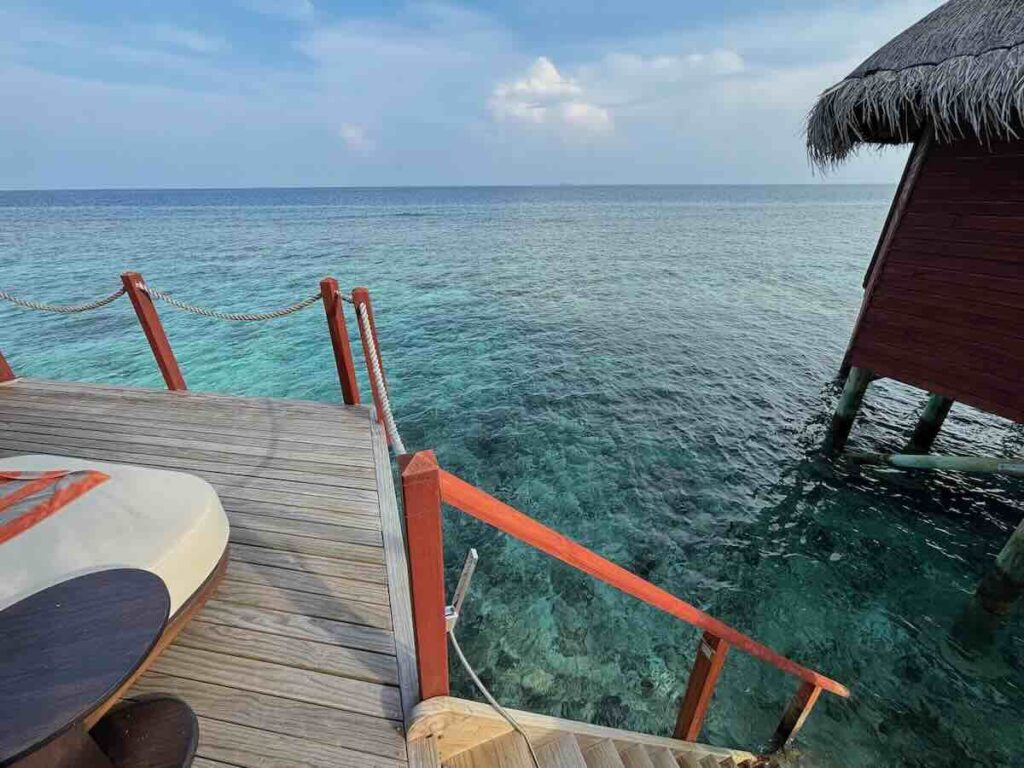
At a resort with a decent house reef you’ve a good chance of seeing a shark on most swims. The first shark of our recent trip was from the villa deck, swimming over the coral below our steps.
None of this is guaranteed, and that’s part of the pleasure. Sharks are wild, they go where they like, and every one you see is a bonus. I still get excited whenever I see one.
| Shark | How you’ll see it | Where | Risk to snorkellers |
|---|---|---|---|
| Blacktip reef shark | House reef snorkel, or from the beach | Shallows and reef edge at most resorts | Low |
| Whitetip reef shark | House reef snorkel | Resting on sand and in caves by day | Low |
| Nurse shark (tawny) | House reef snorkel, or from a jetty or deck | Under jetties and overwater restaurants, resting by day | Low. Will bite if harassed |
| Grey reef shark | Mostly diving | Drop-offs and channels | Low |
| Whale shark | Boat trip | Across the Maldives, year round in South Ari | None. Filter feeder |
The sharks you’ll actually meet snorkelling
Blacktip reef sharks
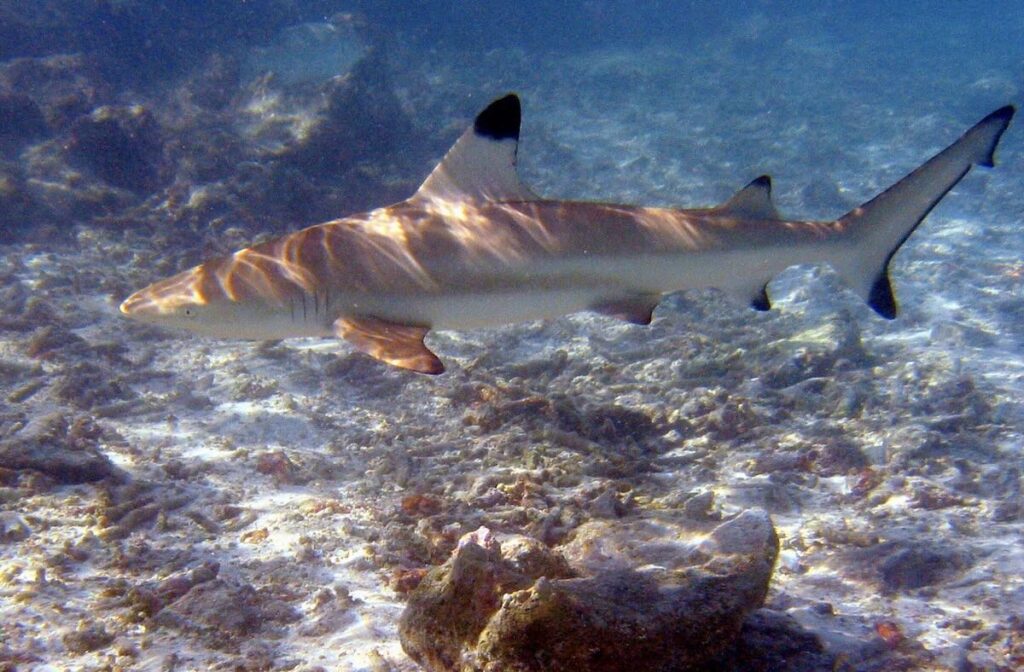
This is the shark of the Maldives for a snorkeller. Pale grey, black tips on the fins, and at home in shallow clear water over reef flats and along the drop-off. Most are under 1.6 m long.
We saw lots at both resorts. The adults were curious and gave us a wide berth, staying close enough that we could watch them without ever coming in. A couple saw us and darted straight off. The first time a bigger one appeared my adrenaline went up, and then I realised it was more frightened of us than we were of it. The biggest we saw looked about my own length, though that was one of the ones that shot off the second it clocked us. We got over the nerves fast and ended up spending a good chunk of each swim seeking them out.
Whitetip reef sharks
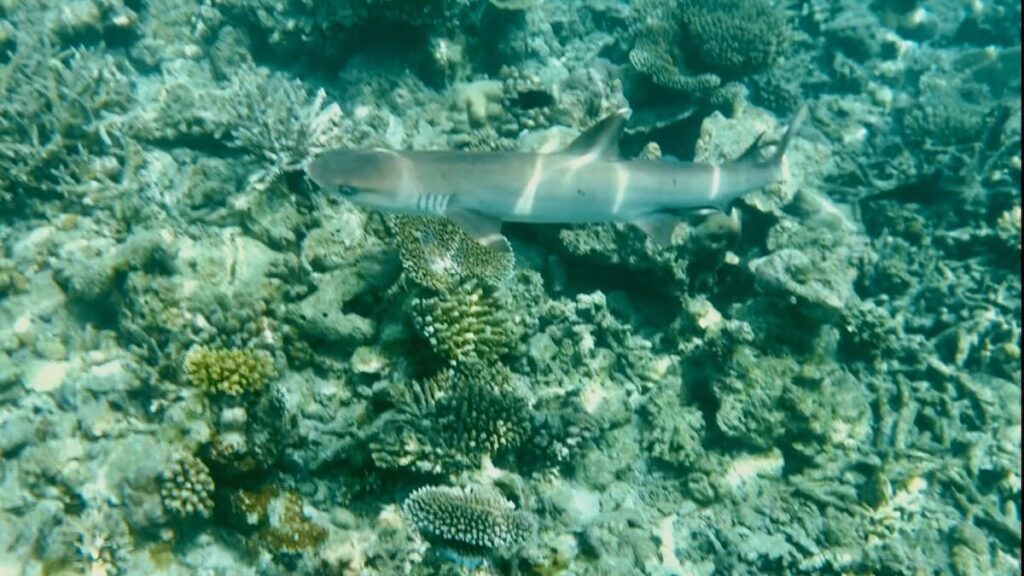
White tips on the first dorsal and tail fins, and more often lying on the bottom than swimming past, because they’re most active at night. The Marine Research Section counts them among the most common Maldivian sharks. We saw several on the reef at both resorts, not as many as the blacktips, but enough that we stopped being surprised.
Nurse sharks
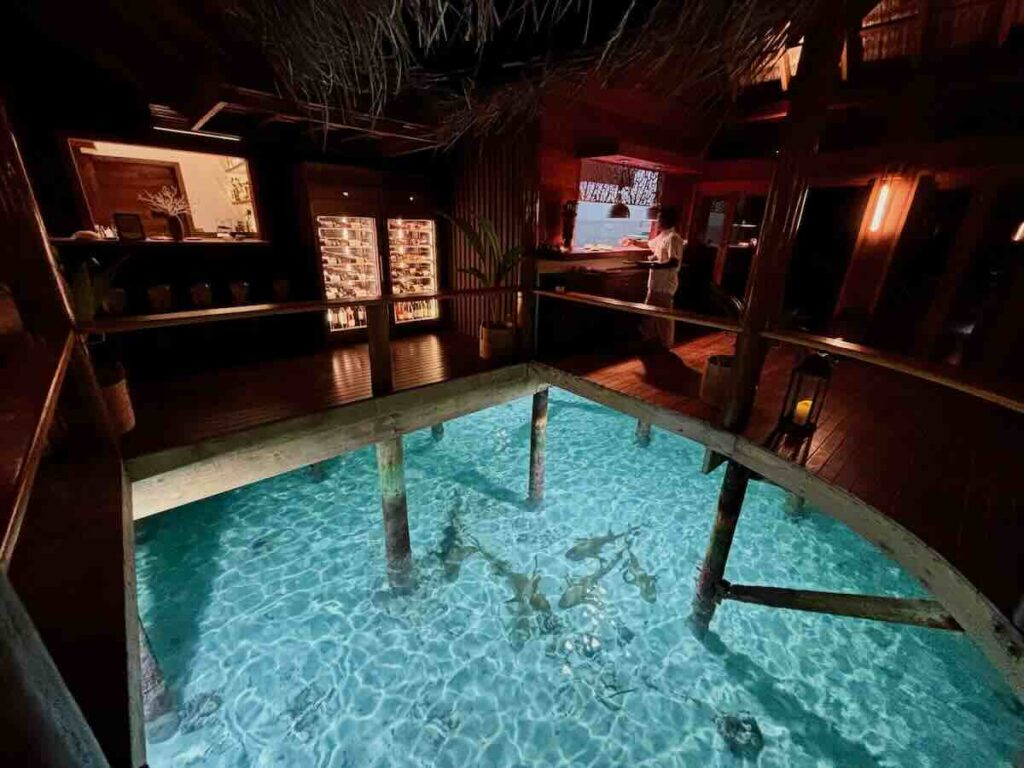
The big, slow one lying on the sand or tucked under a jetty. They’re bigger than the reef sharks and far less bothered by you. Nurse sharks get their own section below because they’re the shark most people end up watching for longest as they’re happy to sit with you nearby.
Grey reef sharks
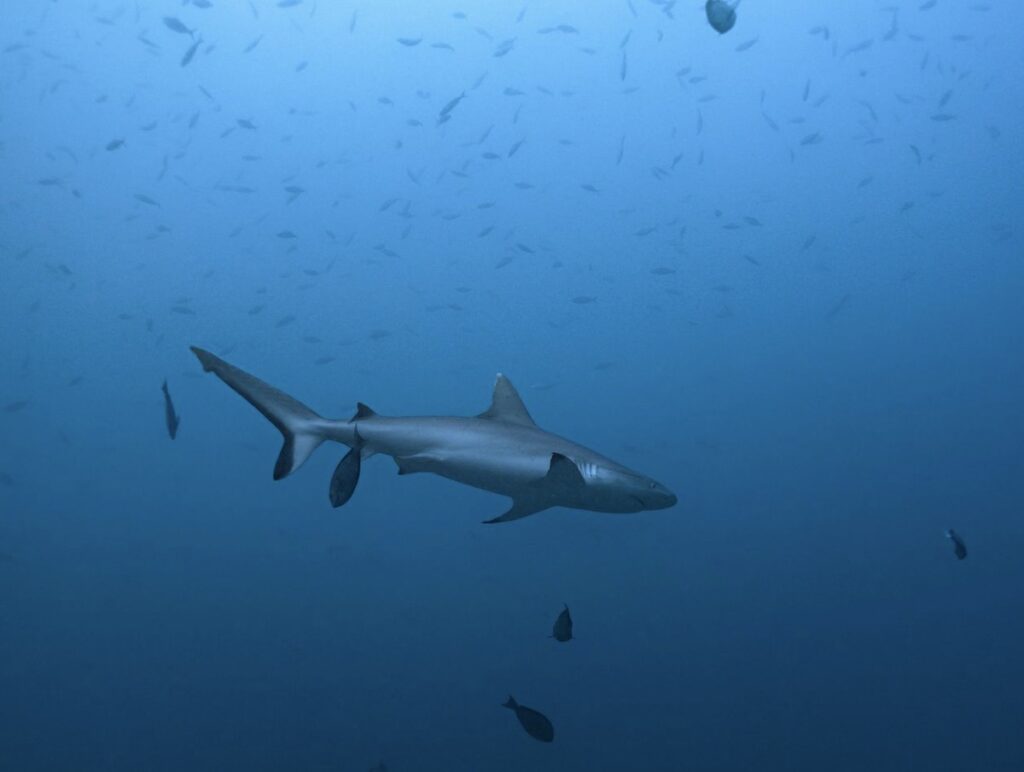
One of the most common reef sharks in the Maldives and the one divers see on drop-offs and in channels. The Marine Research Section notes they’re less aggressive in the Indian Ocean than in the Pacific. Snorkelling from a resort you’re unlikely to meet one unless your house reef drops straight into a channel. The same goes for the hammerheads, silvertips and thresher sharks on the Maldives list: they’re deep-water sharks that divers travel for, not something a snorkeller meets.
Are sharks in the Maldives dangerous?
Not the ones you’ll meet on a normal snorkel, and the figures back that up. The International Shark Attack File recorded 65 unprovoked shark bites worldwide in 2025, nine of them fatal. The Maldives had one, not fatal.
The handful of incidents in the Maldives over the last few years have involved fishing, a military exercise at sea, or sites where fish waste is dumped into the water and draws in larger sharks. None was a resort house reef during a snorkel, and none involved the blacktips, whitetips or nurse sharks you’ll be swimming with.
The Maldives Fisheries Ministry asks divers, the public and the tourism industry not to feed or chum to attract sharks. If an excursion is sold on sharks gathering reliably in one spot, ask what brings them there, and if the answer involves fish waste or feeding, my advice is to give it a miss.
Great whites, tiger sharks and bull sharks in the Maldives
The International Shark Attack File names white, tiger and bull sharks as the species behind most serious bites worldwide. Here’s where the Maldives stands on each.
Great whites: not found here. They don’t appear on the Maldives’ published shark lists. They’re a temperate water shark, and the nearest recorded Indian Ocean populations are off South Africa, the Seychelles, Réunion and Mauritius.
Tiger sharks: present, but around one island. Fuvahmulah, in the far south about 500 km from Malé, holds the world’s largest known tiger shark aggregation, with 239 individual sharks identified over a seven-year study. It’s the only known tiger shark aggregation in the country. They gather around the harbour, drawn by discarded fish waste, and the island has built a scuba diving industry around them. Anywhere else in the Maldives a tiger shark is a rare sight, and you won’t meet one on a resort snorkel.
Bull sharks: present, but rarely recorded. The first verified records only came in a 2023 study, which logged 23 sightings over ten years. Most were around sites where fish waste goes into the water, and with so few sightings you’re very unlikely to see one.
Nurse sharks in the Maldives
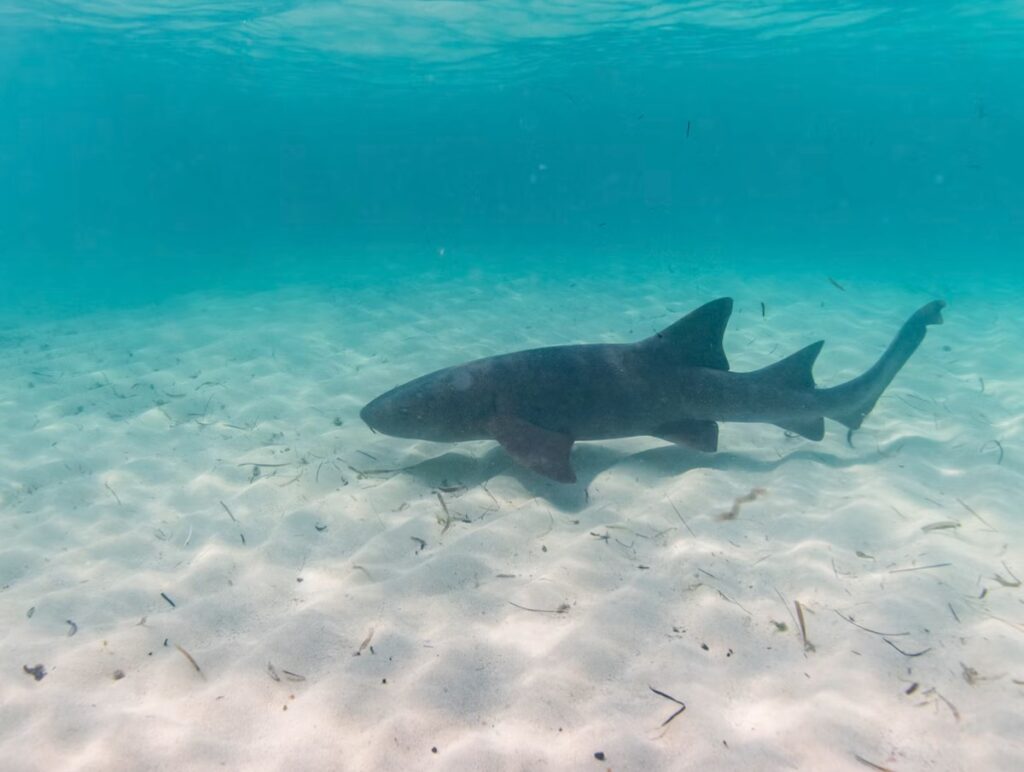
The nurse shark in the Maldives is the tawny nurse shark, which reaches about 3.2 m. It’s listed as Vulnerable by the IUCN. It’s a night feeder, so by day it rests in caves, under ledges and under jetties, sometimes in piles of several sharks.
Where to see nurse sharks
The easiest place is under an overwater restaurant, pier or bar that’s lit after dark. The lights pull in fish, and the nurse sharks and blacktips come with them. At our last resort we watched them from the restaurant deck with a drink the first evening, then went back the next afternoon with snorkels to see if we could swim with them, and we could.
They were a good size, bigger than most of the reef sharks we’d seen, and completely unbothered. Nothing was being put in the water to bring them in. We asked, and the resort said they’re always there.
Beyond that, look along the base of the reef where there’s sand to rest on. Resorts with a wreck on the house reef often have a resident group. You can see the reef where we watched them every day in my V Villas Maldives at Mirihi review.
Do nurse sharks bite?
They can, and the cases on record involve people harassing a resting shark. Left alone they’re about as placid as a shark gets. We got to within a metre or two and stopped there. Close enough to see every detail, far enough not to spook them. Leave them be and they carry on sleeping, happy to let you watch.
Whale sharks in the Maldives
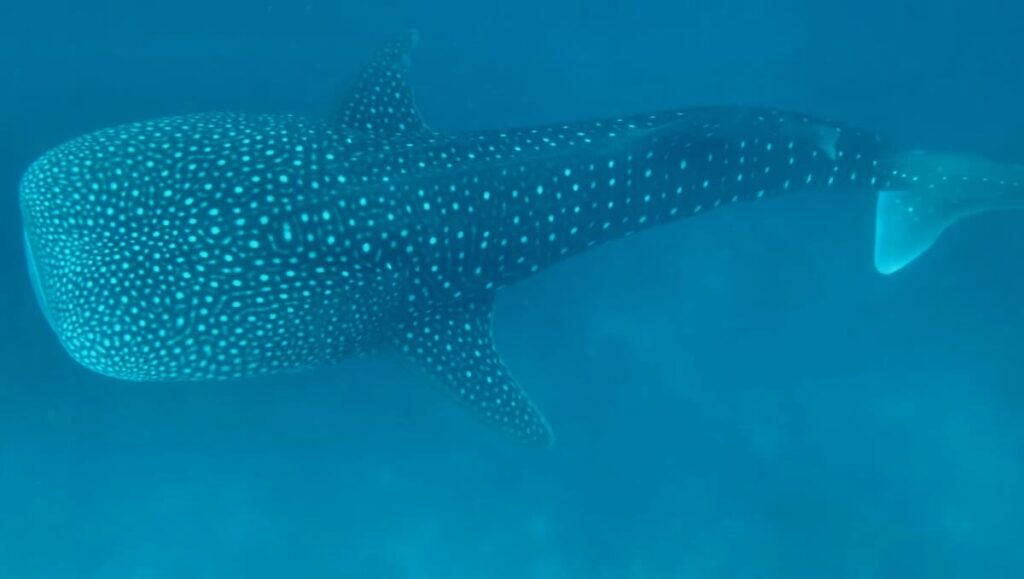
Where and when to see whale sharks
Whale sharks turn up across the Maldives, and the Maldives Whale Shark Research Programme has logged encounters from Baa Atoll in the north to Gaafu Alif in the south. Most atolls see them seasonally.
South Ari Atoll is different: it has a population that is there all year, and that is why almost every whale shark trip in the country leaves from there. In 2020 the programme logged 238 encounters in South Ari against 22 in Baa and 9 in Thaa. The South Ari Marine Protected Area was set up in 2009 to look after them.
If whale sharks are a big part of why you’re going, pick a South Ari resort. That population stays put, so you don’t need to time your trip around them. Choose your dates on everything else in my guide to the best time to visit the Maldives.
There’s still no guarantee: the research programme puts your odds on a South Ari trip at roughly 50/50. We reached both our South Ari resorts by seaplane, and my Maldives seaplane transfer guide covers how that works.
What a whale shark trip is actually like
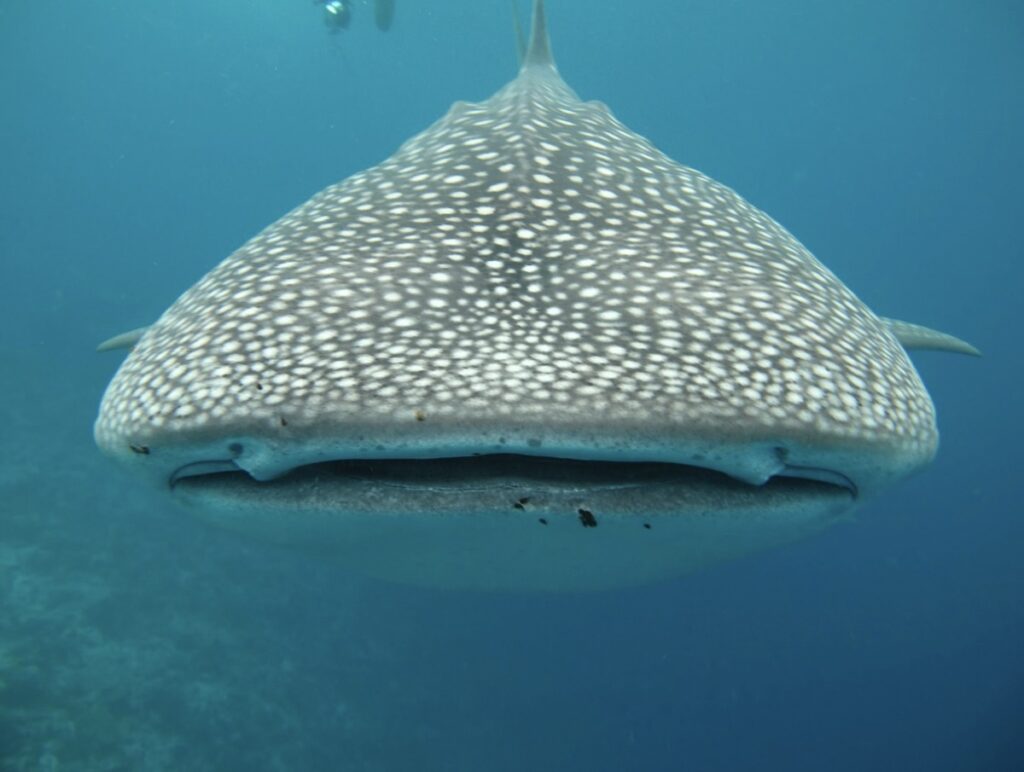
Ours took just over half a day. The boat was easy, with snacks and drinks on board, and the crew headed for the areas where they’d been seeing sharks. When they spotted one they tried to work out which way it was swimming, circled round ahead of it and dropped us in. That worked perfectly once. The other two times the shark changed direction a little and we were dropped right beside it instead. The first was a bit deep, but the next two came up near the surface and we got a proper look.
It was a snorkel trip, no diving qualification needed, and you only need to be comfortable swimming in open water for a few minutes at a time. A rash vest for the sun and seasickness tablets if you’re prone are the two things worth packing for it.
Three whale sharks in one trip was more than we’d hoped for. They are huge. I’ve never been in the water with anything that size and the first sighting was surreal. It was a bit hectic, with a couple of other boats working the same stretch and everyone jumping in at once, but that didn’t take away from it.
What a whale shark trip costs
Trips vary by resort and how far you need to travel to where the whale sharks are. Our first resort was around $180 (£135), and our most recent was north of $300 (£225).
Is it worth it? You can’t see whale sharks from a house reef, so if you want one this is the only way. I’d pay it every time, and we were always going to go as it’s something we wanted to see for a long time. If sharks don’t excite you and the money would rather go on a spa afternoon, that’s a fair call too.
The rules in the water
The Maldives Environmental Protection Agency set these in 2009 and your boat should brief you on them.
- Stay at least 3 m from the shark’s head and body and 4 m from its tail.
- Don’t cross in front of it or block its path.
- No touching, no riding, no flash photography.
- A maximum of 12 swimmers in the water from one boat.
- Boats keep to 5 knots inside a 250 m zone around the shark and 2 knots within 50 m, and stay at least 10 m away.
- No motorised swim aids or anything towed behind a boat.
The research programme suggests three questions for any operator if you want to ensure they are reputable:
- Do they brief you properly before each trip?
- Do they follow the guidelines?
- Do they report their encounters to research?
A resort that answers yes to all three is the one to book with. The Be Gentle to Giants campaign also keeps a list of its confirmed partner operators.
How to behave around sharks
If a shark swims towards you
Stay still, stay upright in the water and watch it. That’s what we did the first time a bigger blacktip turned our way, and it had a look and moved on. My partner was next to me watching too, and if she hadn’t been I’d have called her over rather than swum away. Every shark that came close to us did the same.
A few other things, mostly from the International Shark Attack File: take off shiny jewellery, stay away from anywhere people are fishing or cleaning fish, and never feed or chase anything for a photo. If something doesn’t feel right, get out of the water and wait.
Hands off, everything
This is the rule I follow without exception, and it goes for every living thing on the reef, not just sharks. No touching sharks, turtles, rays, fish or coral, and no standing on anything. Most of the bites on record come down to food in the water or a shark being handled, and a nurse shark that’s been grabbed is a very different animal from one that’s been left to sleep. Look, follow at a distance and let them come to you if they want to.
When to go in
Daytime gives you the clearest water and the easiest spotting, but dusk is better for sharks, and the dive centres told us the same. The reef gets busier as the light lowers, the sharks get more active, and some of our best sightings were late afternoon as the sun dropped. After dark, go in only on a guided night snorkel run by your resort, never on your own, because you can’t see the current or the reef edge. Nurse sharks feed at night, so a guided night snorkel is a good chance to see them.
Seeing sharks without getting in
In the Maldives you often don’t need to swim. The end of a jetty, a lit overwater restaurant deck at dusk and a walk round the island at the water’s edge will all show you sharks at most resorts with a healthy reef. The small blacktips sit in the shallows right at the shoreline, so look down or out to the water as you walk.
Sharks in the Maldives FAQ
Can you swim with sharks in the Maldives?
Yes. At a resort with a decent house reef you can snorkel with blacktip and whitetip reef sharks straight off the beach or your villa steps, and nurse sharks rest under the jetties. For whale sharks you need a boat trip, and South Ari is the atoll to base yourself in.
Are there more sharks in the Maldives than there used to be?
There’s no evidence of it. A 2014 study by the Maldives Marine Research Institute found no clear upward trend in shark numbers, and more recent research says reef shark populations are stable. What has changed is behaviour: dive and fishing businesses throwing fish into the water teach sharks to link people with food, and that’s been tied to more close encounters. It’s one more reason never to feed them.
Is it safe for children to snorkel with sharks in the Maldives?
The sharks children meet in the shallows are young blacktips, small and quick to swim off. The thing to watch is the water itself, since the UK Foreign Office warns that strong tidal currents around the islands have pulled swimmers out. Keep children in the lagoon or close to the beach, with an adult next to them in the water.
Which Maldives resorts are best for seeing sharks?
Ones with a house reef and a drop-off you can swim to from the beach or your villa, because the adult reef sharks stay along the reef edge. A lagoon resort where the reef is a boat ride away will show you far fewer. For whale sharks, choose South Ari. My guide to the best house reef in the Maldives compares the resorts and is the place to start if sharks are the point of your trip.




4 Comments
Comments are closed.