
Working out how to get to Ilha Grande is the first proper job of planning the trip, and for first-timers it comes down to three questions: which mainland port, which boat, and how long the whole thing takes.
For most people the answer is Conceição de Jacareí and the hourly fast boat, around three and a half hours from Rio to the pier, with Angra dos Reis the better bet if you’re coming up from São Paulo.
We skipped the bus and the transfer packages and took an Uber straight to the port instead, which is worth pricing up before you assume the package is the sensible option, particularly with three or four of you.
Since June there’s a compulsory tax every visitor pays before landing on the island, with a fine if you turn up without the voucher, and if you’re flying in there’s a cut-off time for airport pickups that decides whether you make a boat that day or sleep on the mainland. My guide below covers all the details you need to plan your trip to Ilha Grande and avoid unwanted surprises.
More of my Brazil guides to help plan your trip
- Ilha Grande Travel Guide – How to get there, what to do and where to eat
- Ilha Grande Pousadas and Hotels – The best areas to stay on the island
- Ilha Grande Hikes – The best hikes on the island, distance, time and top tips to enjoy
- Paraty Brazil Travel Guide – The best activities, things to see and how to get there
- Restaurants in Paraty – My favourite restaurants in Paraty across different budgets
- Things to Do in Rio de Janeiro – Best sights, prices, and a 5-day plan map for your phone
- Where to Stay in Rio de Janeiro – The best areas and hotels for first-timers at every budget
- One Day in São Paulo Itinerary – A plan for São Paulo with map, lunch options and afternoon picks
The three mainland ports, and which one you want
There are no bridges and no car ferries to Ilha Grande. You travel by road to one of three towns on the Costa Verde, the stretch of coast south of Rio, then take a boat across. All the regular boats land at Vila do Abraão, the main village on the island, where most of the accommodation, restaurants and tour agencies are.
Three words are worth knowing before you book. The barca is the big public ferry, slow and cheap, carrying up to 1,000 people. A fast boat, sometimes sold as a flex boat, is a smaller covered launch carrying 30 to 60 people. A taxi boat is smaller again and leaves when it has enough passengers rather than to a fixed timetable.
Mangaratiba is the closest port to Rio. One ferry a day in each direction and nothing else.
Conceição de Jacareí sits between Mangaratiba and Angra and is the closest point to the island. Boats roughly every hour, and the crossing is 15 to 50 minutes depending on which one you get.
Angra dos Reis is the biggest of the three towns and the closest to São Paulo. It has both the public ferry and hourly fast boats, and it’s the one town of the three with proper shops and services if you want cash before you go over.
| Route | Crossing | Boat fare | Boats per day | Best for |
|---|---|---|---|---|
| Conceição de Jacareí | 15 to 50 min | R$75 (£11) | Roughly hourly, 08:00 to 18:00 | Most first-timers |
| Angra dos Reis (ferry) | Up to 1h 50 | R$20.50 (£3) | 1 | The cheapest crossing |
| Angra dos Reis (fast boat) | 30 to 40 min | R$75 to R$120 (£11 to £18) | Roughly hourly, 07:30 to 18:30 | Arriving from São Paulo |
| Mangaratiba (ferry) | Up to 1h 50 | R$20.50 (£3) | 1 | Almost nobody |
Disclaimer: This article may feature affiliate links. If you click these links, and choose to book with that hotel or company, I will earn a small commission at no extra cost to you. I appreciate the support that allows me to continue providing this information

Quick answer: the best route to Ilha Grande from Rio, Paraty and São Paulo
If you’re in a rush, this is my recommended route depending on where you’re starting, for more details read further down the guide.
From Rio: Conceição de Jacareí, a small port about two and a half hours’ drive away, then the hourly fast boat. Shortest time on the water, boats all day, and where every transfer package goes.
From Paraty: Angra dos Reis by Colitur bus, then the ferry or a fast boat. Conceição works too if a transfer drops you there.
From São Paulo: Angra dos Reis. The long-distance bus stops there, and the fast boats keep going until 18:30 if you’ve missed the ferry.
Pick Angra from Rio only if you want the cheapest crossing and can build the day around one ferry departure. If you’re still deciding whether the island is right for your trip at all, my Ilha Grande travel guide covers how many nights you need and what to do once you’re there.
The tourist tax you pay before you land
Since 1 June 2026 Angra dos Reis council charges a Sustainable Tourism Tax on visitors, and it applies to anyone landing on Ilha Grande whichever port you sail from. It is a flat R$50 per person, valid for 30 days, and you pay it through the vivaangra.com.br portal or at self-service totems at Estação Santa Luzia in Angra and at Vila do Abraão. You fill in how long you’re staying, pay by QR code, and carry the voucher. Children up to 12, over-60s, residents and people with disabilities are exempt but still need to register. There is a fine if you’re found without it.
My Top Tip! Sort the voucher online the night before you travel rather than at a machine on arrival, when you’ll have bags at your feet and a boat to catch.
If you’re not staying in Abraão
Every boat in this article ends at Vila do Abraão. If your pousada is somewhere else on the island, at Araçatiba, Praia Vermelha, Bananal or Sítio Forte, do not board for Abraão, because there is no regular boat service between the island’s communities and you’ll be paying for a private transfer to get across.
Those places are reached by their own boats, mostly from Angra dos Reis, and your pousada will tell you which pier and what time. My Ilha Grande pousadas guide compares Abraão with the quieter bays if you haven’t booked yet. Check this before you book anything else.

Conceição de Jacareí: the fastest crossing
This is the port most first-timers should use. It’s a small place on the Rio-Santos coast road with a pier and ticket booths, but it’s only 12 km from the island and the boats go all day.
The bus from Rio to Conceição de Jacareí
There is no dedicated bus service to Conceição de Jacareí. You take the Costa Verde bus from Novo Rio, the main bus station, heading for Angra dos Reis, and ask to be dropped off at Conceição. From the drop-off on the BR-101 it’s about a ten-minute walk to the pier. Because it’s sold as a section of the Angra route rather than a route of its own, the fare is a little under the full Angra one, so the Angra price is the most you’ll pay.
Watch out for boarding that bus without telling the driver where you want to get off, because Conceição is a request stop on the side of a main road and it’s easy to miss. Tell him when you get on, and again as you get close.
Time about 2h 30 • Cost typically R$83 to R$98 (£12 to £14)
Fast boat or taxi boat
Scheduled fast boats leave roughly every hour from 08:00 to 18:00, coming back from Abraão on the same pattern from 08:00 to 17:30. The fare is R$75. On a fast boat the crossing takes 15 to 25 minutes. The slower boats that also work the route take up to 50.
Taxi boats are the other option at the same pier. They’re smaller and they go when they’ve filled up rather than to a timetable. Ask at the booth for the current price.
We turned up at Conceição with no boat booked at all and left around 2pm, and while we got on with room to spare there was a stretch of standing around wondering whether we would. If you’re travelling at New Year, over Carnival or on a long weekend, buy the boat ticket in advance so you’re not standing there wondering whether you’ll get on. A return bought online is R$140 against R$150 at the counter, so it’s cheaper as well as less stressful.
The crossing is short, but it’s an interesting one. The boat sits low in the water and it was a real mix of people: tourists with rucksacks, islanders going home, and we had a bloke next to us with a tray of herb plants he was delivering. The blue plastic seats aren’t comfortable but they feel solid, and there’s roll-down plastic sheeting along the sides for wet days. Ours was sunny so the sides were up the whole way, but on a choppy day spray comes over, so anything you’d rather not get wet goes inside a bag. Backpacks go at the front of the boat and you keep your small bag with you.
Time 15 to 50 min • Cost R$75 (£11)
Angra dos Reis: the budget route and the São Paulo gateway
Angra is the largest of the three towns and the only one with banks and proper shops. If you want cash or lunch before you cross, this is where you get it.
The public ferry
The barca is operated by Consórcio Barcas Rio, which took over the state ferry contract from CCR Barcas. At R$20.50 it’s easily the cheapest way across, and easily the slowest, taking up to 1 hour 50 minutes for the 22 km.
There is one sailing a day. It leaves Angra at 15:30 Monday to Friday and 13:30 at weekends and on public holidays. Coming back, it leaves Abraão at 10:00 every day. Bicycles travel free, up to ten per sailing. You can pay by cash, credit or debit card at the pier.
Time up to 1h 50 • Cost R$20.50 (£3)
Faster boats from Angra
If you miss the ferry, or you don’t fancy using a whole day for it, fast boats leave from Estação Santa Luzia in the town centre roughly every hour from 07:30 to 18:30, and the return follows a similar pattern. AngraFlex, Doce Angra and Objetiva all work this route. A fast boat takes 30 to 40 minutes. The older schooners on the same route take up to 1 hour 40, so check which you’re buying.
Time 30 to 40 min • Cost R$75 to R$120 (£11 to £18)
The bus from Rio to Angra dos Reis
Costa Verde runs about ten buses a day from Novo Rio to Angra, and the trip takes around three hours. Fares start at about R$83 booked ahead, with R$98 nearer the average. You can buy at the Novo Rio counter on the day or book online through the usual Brazilian bus sites, which is worth doing on a holiday weekend.
The bit people get wrong is assuming the bus drops them at the boats. Angra’s bus terminal is out at the edge of town near the BR-101, and the three piers are in the centre, so allow for a circular bus, which goes every five minutes, or a taxi at the far end.
Time about 3h • Cost typically about R$98 (£14)
Mangaratiba: closest to Rio, hardest to use
Mangaratiba is 23.5 km from Abraão and the nearest departure point to Rio, which is why people keep picking it off a map. The bus terminus is directly opposite the pier, so the connection at that end is the easiest of the three.
The timetable is the problem. There is one ferry a day, leaving Mangaratiba at 08:00 and returning from Abraão at 17:30. The Friday late sailing that used to leave at 22:00 is currently suspended. There is no fast boat, no taxi boat and no second option, so a missed ferry means a full day lost. I personally recommend you don’t go this route.
The return is the harder half. The ferry docks at Mangaratiba after 18:30, and unless you’ve confirmed a Costa Verde bus to Rio after that time you’re in Mangaratiba for the night. Book this route only if you’re already staying nearby with your own transport at both ends. Otherwise use Conceição or Angra.
Time up to 1h 50 • Cost R$20.50 (£3)
Rio to Ilha Grande: package transfer or do it yourself
This is the choice most people are actually weighing, and the answer isn’t as obvious as it looks.
What a package includes
A door-to-door transfer picks you up at your accommodation or the airport in a shared van, drives you to the port, and includes the boat ticket in one booking. The whole journey takes about four hours. Shared transfers are typically advertised between about R$180 and R$300 per person including the crossing, and the spread is wide enough to be worth comparing before you book.
Three conditions catch people. Some listings sold as transfers are the van only, with the boat ticket bought separately at the port, so read the inclusions before you pay. Pickup zones are limited, usually the South Zone, Centro, Lapa and the airports, so if you’re staying in Barra da Tijuca or anywhere off the usual pickup route you’ll be asked to meet the van at a central point. Worth checking against where you’re staying in Rio before you book either. And they fill up over Christmas, New Year and Carnival so you’ll need to book in advance.
Time about 4h • Cost typically R$180 to R$300 per person (£26 to £44)
Getting a taxi or Uber straight to the port
The third option is simply ordering a car. We left Rio at 10:30 and got an Uber directly to Conceição de Jacareí for R$287.24, arriving at the pier around 13:00. Add two boat tickets at the current R$75 and the total for two comes to about R$437, or around R$219 each.
Set against a shared transfer at R$180 to R$300 a head, that’s competitive for two people and cheaper for three or four. You also go when you want rather than when the van is full. My recommendation is to price the car up before you assume the package is the sensible option, particularly if there are more than two of you, but if you’ve Ubered in Rio before you will also know that the quality of the car can vary!
Time about 2h 30 • Cost R$287.24 (£42) for the car

Arriving from Rio airport on the same day
Yes, you can land at Galeão and sleep on the island the same night. It depends entirely on what time your flight gets in.
Straight from Galeão
Shared transfers pick up at Galeão and drive straight to the port without going into Rio first, which saves a couple of hours and a hotel night. Santos Dumont is different: it’s inside the city, so it’s covered by the ordinary Rio pickups rather than a dedicated airport run. Operators put the door-to-door time at around three and a half to four hours.
The number that matters is the last pickup. Airport collections generally stop around 15:15, because the boats stop in the early evening and the drive is three hours. Book the transfer before you fly rather than after you land, since the last slots go first.
Time about 4h • Cost typically R$180 to R$300 per person (£26 to £44)
If you land late
If your flight arrives after mid-afternoon, you’re choosing between a private boat, which some operators will arrange at any hour at a premium, or a night in Rio and a fresh start.
Take the night in Rio and use the morning for one of the easier things to do in Rio before you head for the port. After a long-haul flight you’re not going to enjoy a three-hour drive followed by a boat in the dark, and you’ll arrive at a pousada late with nothing open. My advice is to arrive the next morning and enjoy it.

Getting to Ilha Grande from Paraty
Paraty is the colonial town further down the same coast, and plenty of people do both in one trip. My Paraty guide covers what to do there with one or two days.
The Colitur bus
Colitur runs the L101 public bus between Paraty and Angra dos Reis, taking around an hour and a half with stops along the coast. On weekdays it leaves Paraty at 05:40, 07:00, 09:00, 10:20, 11:40, 13:00, 15:00, 16:00, 17:00, 17:40 and 19:40. At weekends and on holidays it’s 05:40, 08:00, 09:40, 11:00, 12:20, 14:00, 16:20, 17:20 and 19:40. Tickets are bought at the counter in Paraty bus station, or from the driver if the counter is shut. Angra’s bus terminal is on the edge of town, so allow for the local bus or a taxi to the pier at the far end.
Time about 1h 30 • Cost R$27.50 (£4)
Transfer packages from Paraty
Van and boat packages work this route too, with morning and early afternoon pickups from Paraty hotels, roughly three hours by road and a 45-minute crossing. You can also get an Uber or a private taxi from Paraty to the port, which is what we did and it worked well, as long as you time your arrival to the boats.
If you’re connecting by public transport, work backwards from the boat rather than forwards from the bus. The ferry leaves Angra at 15:30 on weekdays and 13:30 at weekends. To make it with room for the taxi across town, take the 11:40 or earlier on a weekday and the 09:40 or earlier at the weekend. Anything later, plan on a fast boat from Estação Santa Luzia, which keep going until 18:30.
Getting to Ilha Grande from São Paulo
Reunidas Paulista and Primar run buses from Tietê, São Paulo’s main bus station, to Angra dos Reis. It takes about eight hours and twenty minutes and there are roughly seven departures a day. If you’ve got a day in the city first, my one day in São Paulo itinerary is built for exactly that.
The timing is tight in a way that’s easy to miss. The first buses leave Tietê around 07:15 and 07:30 and reach Angra about 15:35, which is five minutes after the 15:30 ferry has gone. So if the public ferry is your plan, you need the overnight bus, which arrives early morning and leaves you a comfortable day. If you’re on a morning bus, plan on a fast boat from Estação Santa Luzia instead, since they carry on until 18:30.
Time about 8h 20 • Cost typically about R$130 (£19)
My Top Tip! Breaking the journey in Paraty is worth considering if your dates allow it. Eight hours on a bus and then a boat is a long day, and Paraty is on the way and well worth a night.
Getting off Ilha Grande
The return catches people out more than the outbound, because by then you’re relaxed and in island mode.
Back to Rio
Boats to Conceição de Jacareí leave Abraão every hour or so from 08:00 to 17:30, and the fast boats to Angra keep going until 18:30, so getting back to the mainland is straightforward on any day. From Angra, Costa Verde buses to Rio go about ten times a day and take three hours. Shared transfers back to Rio also handle airport drop-offs.
On to Paraty and São Paulo
Take a morning boat to Angra, either the 10:00 ferry or one of the fast boats from 08:00, so you’re on the mainland by early afternoon. For Paraty, the 10:00 ferry lands you in Angra in time for the 12:40 Colitur bus, with the 14:00 on weekdays or the 15:00 at weekends as the fallback. For São Paulo it matters more, because the ride is eight hours: the 12:00 bus from Angra gets into Tietê at about 20:20 and the 13:30 at about 21:50, and after that you’re into the overnight services.
Timing it against a flight
For a flight out of Rio, leave six hours between stepping onto the boat at Abraão and your departure time. Bad weather stops the boats and the coast road is slow when it’s busy. Either one can cost you the flight. If it’s an early flight or an expensive one, my advice is to come back to Rio the night before and sleep near the airport.

What to expect when you arrive at Abraão
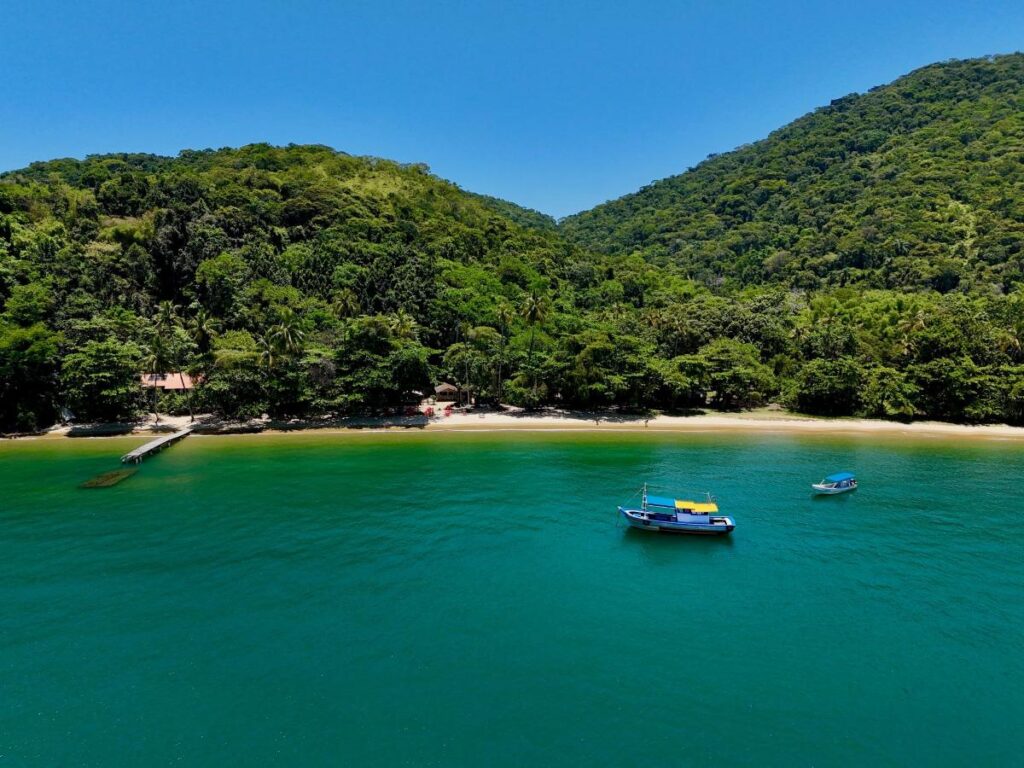
The approach into Abraão is lovely, green hills coming down to the water and a strip of restaurants and bars along the front by the pier. Coming straight from Rio it felt like island life had started the moment we stepped off the boat, and that was the point the journey felt worth it.
Luggage and the walk from the pier
The pier is in the middle of the village, so most accommodation is a short walk. There are no cars on the island and the streets are sand and packed dirt, which is hard work for wheeled suitcases. Porters with push-carts wait at the pier and will take your bags to your pousada for a fee.
We carried our own and it was no bother at all, but we had backpacks. If you’re travelling with a large wheeled case, pay the porter, and follow him rather than trying to find the address yourself.
Cash and cards
There are no reliable ATMs on Ilha Grande. Most pousadas, restaurants and agencies take cards, but card machines do go down. Bring enough cash to cover a day or two and draw it out in Rio or in Angra, because neither Conceição de Jacareí nor Mangaratiba has a reliable ATM either.
Getting to Ilha Grande: common questions
Can you do Ilha Grande as a day trip from Rio?
You can, but don’t. It’s around four hours each way, so a day trip gives you a couple of hours on the island for eight hours of travelling. There’s a lot here, the hiking in particular is excellent, and two nights is the minimum worth doing.
Do I need to book the boat in advance?
Not usually. Boats from Conceição de Jacareí and Angra go all day and you can buy at the pier. Book ahead for New Year, Carnival, Easter and long weekends, when both the boats and the transfer vans fill up.
What is the cheapest way to get to Ilha Grande?
The Costa Verde bus from Novo Rio to Angra dos Reis and then the 15:30 public ferry, at about R$105 to R$120 (£15 to £18) per person plus the R$50 tax. It’s also the least flexible, since missing that one ferry costs you the day.
Can I drive to Ilha Grande?
No. There are no roads or vehicles on the island beyond a handful of emergency vehicles. Drive to Angra dos Reis or Conceição de Jacareí, leave the car in one of the car parks at the port, typically R$15 to R$40 (£2 to £6) a day at Conceição, and cross as a foot passenger.
What time does the Ilha Grande ferry leave?
The public ferry leaves Angra dos Reis at 15:30 on weekdays and 13:30 at weekends, and Mangaratiba at 08:00 every day. Coming back it leaves Abraão at 10:00 for Angra and 17:30 for Mangaratiba. Those are the only sailings. Everything else to the island is a fast boat or a taxi boat, which go through the day from Conceição de Jacareí and Angra.
How long does it take to get to Ilha Grande from Rio?
About three and a half to four hours door to door via Conceição de Jacareí, whether you take a transfer, a car or the bus. Via Angra on the public ferry, allow five to six hours, plus whatever waiting time the single daily departure adds.






6 Comments
Comments are closed.